Monday, 30 November 2015

St Andrew's Day

After yesterday's post, a few folk have asked why St Andrew is Scotland's patron saint.  St Andrew was Christ's first apostle and was martyred on an X shaped cross because he said that he was unworthy to be crucified on the same shape of cross as Christ.  This depiction of the saint from a stained glass window in Westburn Church, Greenock shows him with the ropes and nets of a fisherman.


If you look very closely at the stained glass you will also see some other Scottish features - the lion and the thistle.  (Westburn Church, Nelson Street, Greenock was first called the West Kirk, then it became the Old Kirk before becoming St Luke's after it was joined with other congregations).


There are many legends about St Andrew and Scotland.  One of these is that relics of the saint were brought to the town of Kilrymont, later St Andrews in Scotland in the eighth century.


Another legend concerns a leader of the Picts called Angus who in 832 faced a much larger army of Angles at Athelstaneford in East Lothian.  On the eve of the battle, Angus had a dream about St Andrew.  On the morning of the battle white clouds in an X shape appeared in the brilliant blue sky.  Taking this as a positive sign Angus, heavily outnumbered, attacked the foe and won the battle.  So, not only did Scotland get a patron saint, but also a national flag - the saltire!


Andrew is also patron saint of Greece and Russia.

Sunday, 29 November 2015

St Andrew in St John's, Greenock

Tomorrow is St Andrew's day here in Scotland.  So I thought that I'd show you some photographs of a beautiful stained glass window which depicts Scotland's national saint.


This wonderful window is in St John's Episcopal Church on Union Street in Greenock.


The colours are lovely.  There are many other beautiful windows in this church - I must get around to writing about them soon.


Joining with InSPIREd Sunday.

Wednesday, 11 November 2015

Remembrance

On this day we take time to remember all of those who gave their lives for their country.  Many of us will especially remember our family members who bravely served in the armed forces.  If your family came from Greenock and your ancestors fought in either World War 1 or World War 2, then you may be interested in these resources produced by Inverclyde Council, Libraries Department.  Greenock War Dead WW1 is a downloadable resource which gives a list of names and the regiments they belonged to.


Greenock War Dead WW2 is also a downloadable resource which lists the men and women of this area who died as a result of World War 2 (1939-1945).  Their regiments and date of death are also listed.  Members of the Merchant Navy who lost their lives are also listed along with the name of the ship of which they served.  There is also a list of members of Greenock Civil Defence Service and civilians who lost their lives during the war.  Their addresses are also given.

"They shall grow not old, as we that are left grow old:
Age shall not weary them, nor the years condemn.
At the going down of the sun and in the morning
We will remember them."

Monday, 28 September 2015

Steamers in a state!

Update - these murals have now been refurbished.  You can see them here.

For this week's Monday Mural, I thought I'd revisit the mural of Clyde paddle steamers which I wrote about almost two years ago in my post Neglected Past.


Not much has changed - they are still in a bad way and getting worse.  They can be found lining the underpass linking Wallace Place and the Bullring car park in Greenock.


There are twelve Clyde steamers depicted, many have been defaced by graffiti.


Some seem to have had bits gouged out of them.


They are the work of artist Robert Stewart (1924-1995) who was a student at Glasgow School of Art and later taught there as head of the printed textiles department.  He also worked for Liberty in London.  You can read more about Robert Stewart here.  These tiles are very different from his usual style.  According to the Tiles and Architectural Ceramics Society entry, the design was screen-printed onto plain white tiles.


Sunday, 27 September 2015

Former tobacco warehouse

The former tobacco warehouse in Greenock is very typical of industrial buildings of the late 19th century.

Built of red brick with contrasting yellow brick detail.


I love this type of architecture.  You can read more details on the Buildings At Risk website


It was also used in the past as a bonded warehouse for whisky storage.


I showed some pictures of the warehouse interior in a previous post.  Just look at the brickwork details -


Hopefully this building can be saved, but there are so many worthy buildings in Greenock - such a shame that they can't all be rescued!

Monday, 14 September 2015

Open doors and shadows

Yesterday was a Doors Open Day in Greenock and I visited the old 19th century former Tobacco Warehouse on Clarence Street in Greenock.


The building a huge empty space and the afternoon sun was streaming through the windows.


Got some great shadow shots.  Joining with Shadow Shot Sunday.


I'll be posting more photographs of this incredible building very soon.

Friday, 21 August 2015

A walk along Cathcart Street

Greenock Town Trail, Plaque 2, Cathcart Street.
Let's take a walk along Cathcart Street.


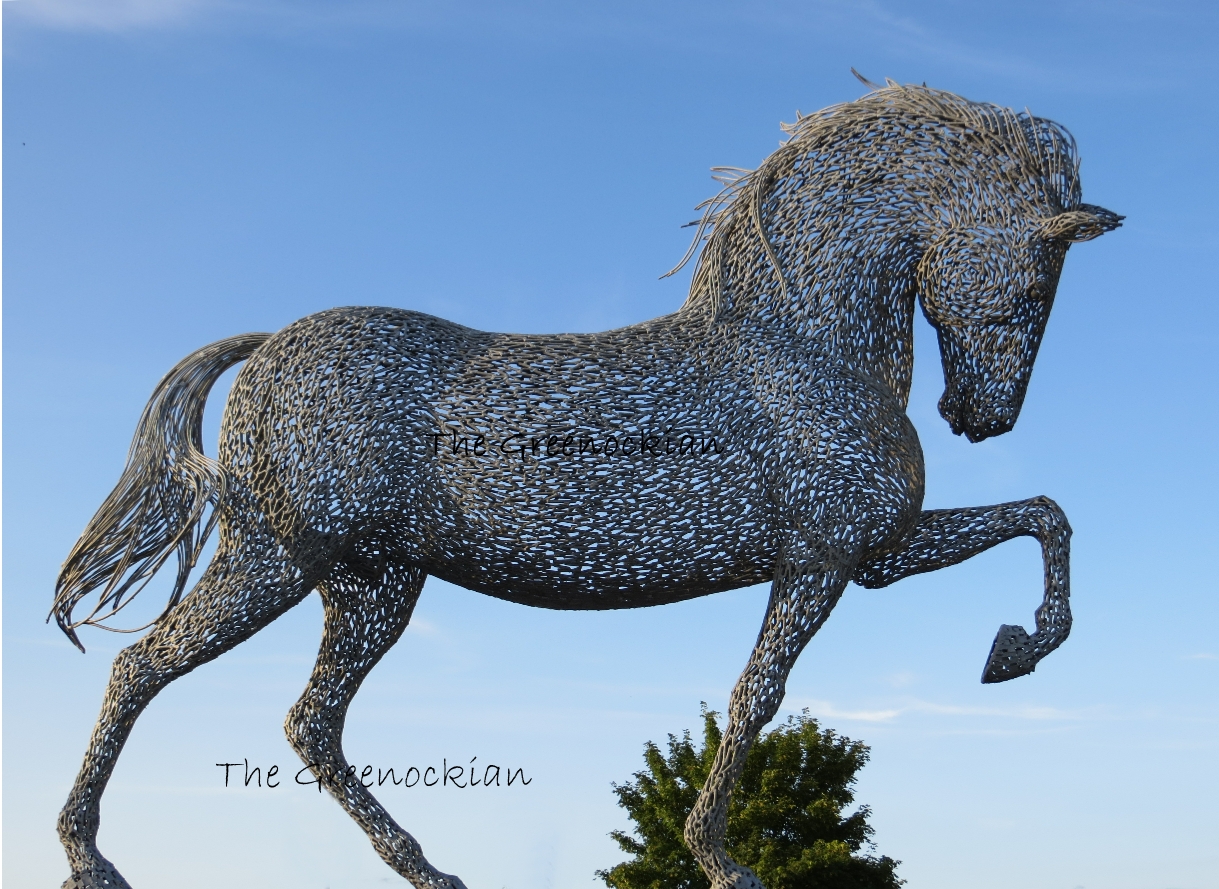
Ginger the Horse, a sculpture by Andy Scott starts our westwards journey along to Cathcart Square.


Once the financial and social centre of  19th century Greenock, just a few of the fabulous buildings remain.


Because of its closeness to the docks and shipyards, the area was the target of German bombers during World War 2.  In May 1941 during the Blitz, the area was decimated and many lovely buildings destroyed.  That accounts for the architectural mix which you can see in the street now.  Some of the old street surfaces remain.


The south side of the street near the square contains a car park and looks up to the Well Park.


Cathcart Street ends at Cathcart Square.


Some more lovely buildings here.  Perhaps the most popular building on Cathcart Street is the old Post Office which is now the James Watt bar - it was open, but hidden by scaffolding when I was taking photographs, so it will have to wait for another day!

Sunday, 16 August 2015

Gourock Railway Station

Love these shadows on the wall of Gourock Railway Station.  Great crossed lines and angles.


The walls are full of vintage travel posters from the days when Gourock was the place to get a Clyde steamer "doon the watter" for many Scottish holiday makers making their way to places like Dunoon and Rothesay.


The shadows are from the beams on the roof of the station.


Joining with Shadow Shot Sunday.

Tuesday, 11 August 2015

Longwell Close

In the old days when Greenock was a thriving seaport there were many little narrow passageways, or closes as we call them in Scotland, which led off the main thoroughfare down to the river.  One of these was Longwell Close which ran from Cathcart Street to Shaw Street.
Source - Views & Reminiscences of  Old Greenock
In "Views and Reminiscences of Old Greenock", Longwell Close is described thus - "The Close was not much of a thoroughfare except for those living there in the locality which were of the poorer class".  I don't think it would have been a very nice place to live.  A newspaper report from 1863 describes a scene there.


Another report is of shebeening (illegally selling alcohol) in Longwell Close.


There are many other reports of drunks and violence.  I've done my family history and discovered that some of my family lived there!


It was named after the Long Well (1682) which was situated there.  The well was rediscovered in 1877 when the area was cleared under the Artisans' and Labourers' Dwellings Improvement Act.  Workmen found that it had been filled in.  It was 4'6" in diameter.  It seemed to have been supplied by a natural spring.  After improvements, Longwell Close was renamed Duff Street.  The site of the Long Well is still marked.


I took a photograph from the site and you can still see the backs of some old tenements in nearby William Street.  There's a fabulously atmospheric photograph of Longwell Close on Inverclyde Council's website - have a look.
 ("Views and Reminiscences of Old Greenock" Published by James McKelvie & Sons, Greenock, 1891 - available to read online) .

Friday, 7 August 2015

Greenock Custom House

Greenock Town Trail, Plaque 1, Greenock Custom House
Our first stop on the Town Trail is the Custom House.


Completed in 1818 it was designed by Scottish architect William Burn (1789-1870) at a cost of £30,000.  It it situated at Custom House Quay, or Steamboat Quay as it was once called.  It is a beautiful building and shows the importance Greenock once had as a major sea port.  The long room which measured 75 feet by 49 feet, held the public counter where ships' masters would come to pay duties on their cargoes and meet with local merchants.


Here is a description from 1821 -


"The Custom-house enters from the front towards the river by a very handsome projecting portico of the Grecian Doric order, in which style the building is designed, and the Excise on the east end, by a corresponding colonnade of three-fourth columns."


Greenock's Custom House was extensively restored in the late 1980s.  Stone from the Bolehill Quarries, Wingerworth, Derbyshire was used in the restoration - it was the closest matching sandstone that could be found.  The building was the headquarters for the issuing of gaming machine licences.


The building only ceased to be used as a Customs and Excise office in 2010.  It now contains office accommodation. There used to be a great Customs Museum in the building, but sadly that has gone too.

It is a Grade A listed building and you can see some photographs of the beautiful classical interior at the RACHAMS site (Royal Commission on the Ancient and Historical Monuments of Scotland).

Read more about Greenock Custom House on this blog -

Famous wardrobe malfunction - about the Scottish coat of arms above the door.
Wood Notes Wild - Robert Burns' Seal - in the Burns' Exhibition inside the Custom House

Tuesday, 4 August 2015

Greenock Town Trail

If you are ever visiting Greenock then try and pick up one of these booklets.  They are available in the museum and library and you can also find them in the local information display racks in the Oak Mall - our local shopping centre.


They were produced by Discover Inverclyde to show off some of Greenock's main attractions. There's a very useful map on the inside showing where everything is.

There are twenty-one plaques throughout Greenock and I've been and photographed each one of them!


I hope to write a blog post about each of the sites hopefully giving a bit more information.  You can download a copy of Greenock Town Trail from the Inverclyde Council web site here.

Saturday, 1 August 2015

School's Out ... Forever!

It has gone!  It was once Greenock Academy and then became the set for Waterloo Road, a BBC television programme.


The demolition squads have done their work.


Little by little, bit by bit the school has been torn apart.


The trees will probably remain.


Greenock Academy, also known as Waterloo Road has totally gone.


Some of us will have great memories of the place.


I suppose they will build houses on the site - the views are amazing.  Wonder what the streets will be called - Academy Place?  Or perhaps Waterloo Drive?