The Greenockian
Sunday, 22 June 2014
Tuesday, 17 June 2014
Sinking of the Pomona 1859
It was (and probably still
is) every emigrants dream - to succeed and create a new life in a distant
land. Greenock mill worker William
Caldwell formerly of Duncan Street, emigrated to America and found employment
in New York. By the beginning of 1859 he
had saved enough money to send home to Greenock so that his wife and four young
children, two sons and two daughters, could travel out to be with him. Arrangements were made and his brother
travelled with the young family to help on the journey to Liverpool where they
would board the emigrant ship Pomona. At 5am, as she waved goodbye to her brother
in law, I wonder how Mrs Caldwell felt as she stood at the ship's rail with her
little children and the prospect of a long voyage ahead.
The New York based clipper Pomona (1500 tons) owned by the D L
Line, sailed from Liverpool on 27 April 1859 with a crew of 36 under Captain
Merrihew. There were 380
passengers. The mood on board was happy
as this newspaper clipping shows - there was music and dancing on deck.
However, later that night the
weather changed, high winds got up and the ship was slightly off course. The winds drove the ship onto the Blackwater
Bank - a notorious sandbank in Co Wexford, Ireland.
Attempts to launch the lifeboats failed and several crew died in the attempt. All night the pumps were manned and eventually, the next day a small boat was launched. In it were the 3rd mate, Stephen Kelly, along with 18 crewmen and 3 male passengers. As the howling gale continued, the ship slipped off the sandbank and immediately filled with water and sank. Captain Merrihew, his 1st and 2nd mates and the rest of the crew, went down with the ship as did all the passengers.
The only survivors were those in the boat, who immediately on reaching shore raised the alarm (although it is said that they all, with the exception of Stephen Kelly removed themselves from the scene). But by the time the lifeboat reached the stricken ship, only the mizzen mast was visible. Almost 400 lives had been lost.
Men, women and children, many
of whom, like the Caldwell family from Greenock, would have been looking
forward to being reunited with loved ones and starting new lives in America. As the long day wore on, bodies began to wash
ashore at Ballyconigar beach and along the coast. Unfortunately some locals stripped the
clothes from the bodies. They were
eventually caught and severely punished.
A sad tale, but not uncommon
in those days when the winds and weather could dramatically alter the fate of
a voyage.
Interestingly, another victim of the sinking was Irishman Henry Lavery, a Belfast publican on his way to New York to find work. He left behind a wife who died of grief three months later and a young son who went on to become the acclaimed Glasgow trained artist Sir John Lavery.
The Greenockian
Monday, 16 June 2014
Stanley Spencer in Port Glasgow
This unusual sculpture is dedicated to Sir Stanley Spencer
and can be found outside Port Glasgow's new B&Q store in a nice little
landscaped area with seating. This is
the site of the former Lithgow shipbuilding yard.
Spencer was fascinated by Port Glasgow cemetery and based
his work "The Resurrection" there.
It is an enormous painting showing people climbing out of their graves,
in their everyday clothes, looking as if they had just woken up. It is held by the Tate Gallery and you can
see it here.
This is a very fitting tribute to a prolific painter who
immortalised the ordinary men and women who worked tirelessly in local
shipyards filling the endless demand for ships which would play an important part
in the war effort.
The final paragraph on the tribute reads -
These panels have been commissioned to celebrate the life and works of the Wartime Artist Sir Stanley Spencer CBE.
More of Sir Stanley Spencer's work can be seen at the
Stanley Spencer Gallery in Cookham, Berkshire.
Stanley Spencer spent a lot of time in Port Glasgow during
WWII when he was commissioned to paint scenes in the local shipyards showing
the workers' contribution to the war effort.
These are no idealised representations, but honest, down to earth views
of the shipyard workers going about their tasks.
The final paragraph on the tribute reads -
These panels have been commissioned to celebrate the life and works of the Wartime Artist Sir Stanley Spencer CBE.
The steel plates represent both the work of the Artist and the Ship
Building Industry of Port Glasgow. Their
shapes take inspiration from one of Spencer's most significant works entitled
'Burners' painted in 1940. It depicts
Ship Workers 'burning' or cutting steel plates before they are rivetted
together.
The Greenockian
Friday, 30 May 2014
Friday, 23 May 2014
Infinity Reflected
Actually it is the reflection of the cruise ships Celebrity Infinity which visited
Greenock last week.
The
Greenockian
The photograph was taken just as she was berthing and the
men were out to attach the ropes. She is reflected in the entrance way to Greenock Ocean
Terminal.
Joining up with Weekend Reflections.
Thursday, 22 May 2014
Wartime Remains
It
is not just the town of Greenock that has an interesting history. The hills above the town are full of history
too. Up at Loch Thom are some
interesting wartime remains.
The engine is part of a Cheeta engine from an Avro Anson
trainer plane which crashed in the hills above Greenock on 26 July 1939. It had been taking part in a formation
exercise. One crew member died but the
pilot walked away unharmed. The second
engine can still be seen at the site of the crash.
Avro Ansons were designed for maritime reconnaissance. It had retractable landing gear that had to
be hand-cranked 160 times by the crew to unwind it!
A little piece of the past in Greenock's hilly hinterland.
The Greenockian
Wednesday, 21 May 2014
Municipal Sculptures
Here are some of the incredible sculptures from Greenock's
Municipal Buildings, which was completed in the 1880s.
Greenock's motto - God Speed Greenock.
These are on the front (south facade) of the building at
Clyde Square.
The Greenockian
Thursday, 15 May 2014
Greenock is back on the map!
The cruise ship season got underway on Monday with the
arrival of Thomson Spirit to
Greenock and yesterday's visitor was Mein Schiff.
Fortunately our local volunteers, Inverclyde Tourist Group,
have some wonderful maps to help visitors find their way around!
Lots more ships to come!
The Greenockian
Friday, 9 May 2014
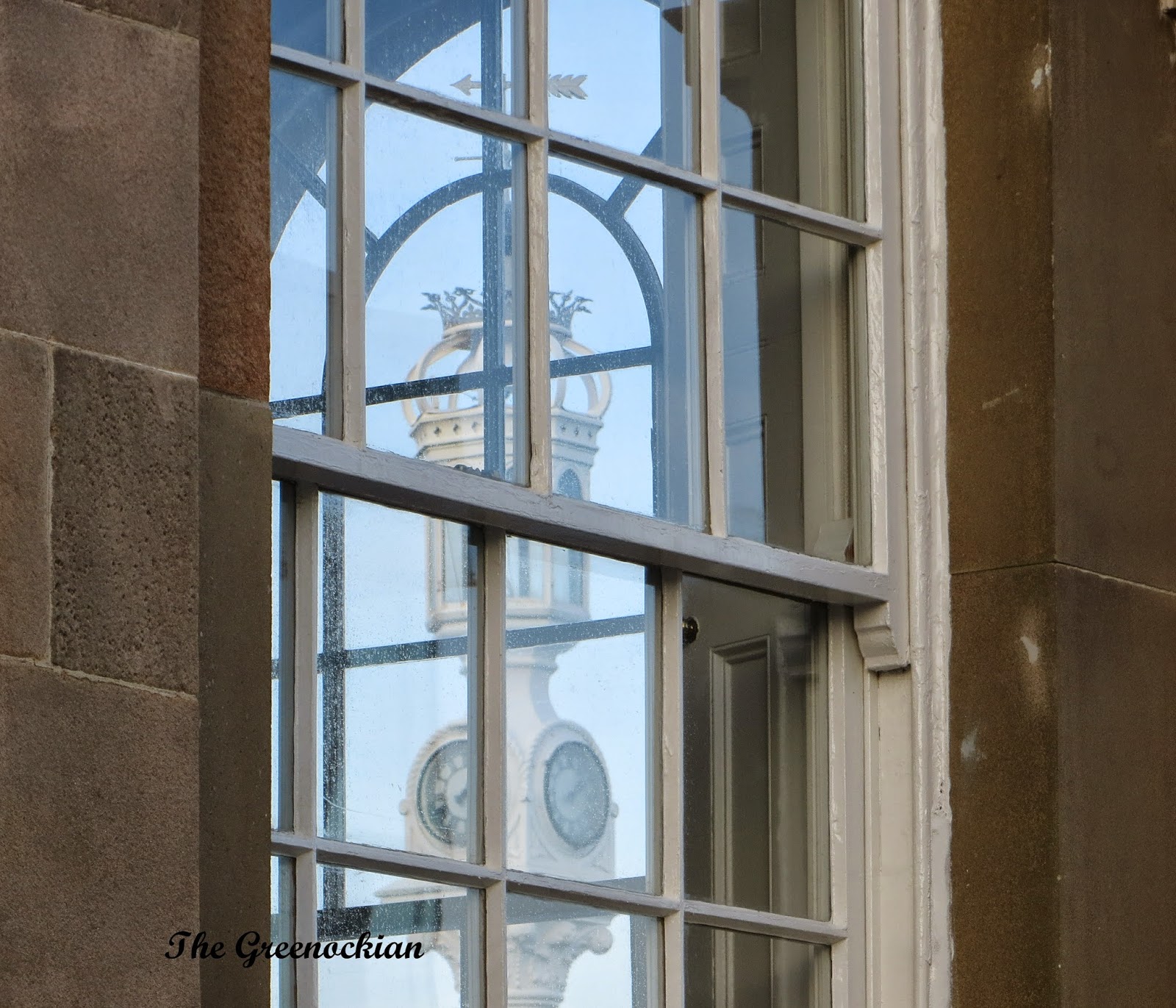
Beacon Reflected
Greenock's Beacon clock tower reflected in the windows of the
Custom House.
Joining Weekend Reflections.
The Greenockian
Wednesday, 7 May 2014
Greenock - Port of Departure
In my last post I mentioned the Scottish Diaspora, those
Scots who travelled far and wide across the world in search of new lives. Many of them would have sailed in the
thousands of ships which left the port of Greenock each year taking folk away
to all corners of the globe. I came
across this poem recently -
Wilfred Campbell (1860-1918) was a Canadian poet, and lived
in Ontario. You can read about him here.
I'm ashamed to admit that I hadn't heard of him before. But these few verses from his poem The
World-Mother (Scotland) appealed to me (if we ignore the fact
that for each of the Scotsmen who moved away, there were an equal number of
Scotswomen with them who contributed just as much!).
Of course his poetry is of its time and appears very old fashioned and
romanticising to us today. But in this
year of Homecoming Scotland I thought that the last line was quite apt.
The Greenockian
Monday, 5 May 2014
Greenock Has Been Wiped Off the Map!
I picked up a brochure yesterday - it is called Welcome
to Scotland. However, I was shocked to
discover that on the main map of central and southern Scotland - Greenock is not there!
The port of Greenock will welcome at least forty cruise
ships this year bringing over 100,000 passengers and crew from all around the
world. Many will probably pick up this
booklet at some point on their visit to Scotland, good luck to them if they try
to find the port which welcomed them!
Greenock has truly disappeared off the map!
Port Glasgow which is home to the beautiful Newark Castle is
missing too!
This is the year of Homecoming Scotland, which will attract
many descendents of the Scottish Diaspora back to their ancestral homeland, anyone
picking up this booklet will have a problem with the map if they try to find
the place that thousands of families sailed from to start new lives overseas!
OK - here's my map - here's where to find Greenock and Port
Glasgow - where you are sure of a wonderful welcome!
The Greenockian
Labels:
Greenock,
maps,
Port Glasgow
Thursday, 1 May 2014
A Tax On Your Windows!
The Window Tax was introduced in Scotland in 1740 and
householders with more than a certain number of windows would be taxed on each
additional window.
Inside the house, their position was often marked by an alcove as in this photograph.
Of course these false windows may also have been added to maintain the symmetry of the look of buildings.
This led to many houses being built like this -
False windows were put in place - these were set slightly
back externally so that glazed windows could be easily added as the householder
required and often were painted to look as if they contained panes of glass. Inside the house, their position was often marked by an alcove as in this photograph.
Of course these false windows may also have been added to maintain the symmetry of the look of buildings.
The tax was stopped in Scotland in 1798, but this extract
from Hutcheson's Greenock Register of 1841 shows that some sort of local variation
was still in place in Greenock.
This notice gives a fascinating glimpse into the rules and
regulations associated with the tax -
No windows deemed stopped unless with stone, brick, or
plaster.
Opening windows without notice forfeits £10. (I presume this means unblocking!)
Glass doors, or lights over doors, considered as windows.
Windows of out-houses to be reckoned.
A window lighting two rooms, or in two frames, to pay as two windows.
Every window more than 12 feet high, including the frame, or 4 feet 9 inches wide, if more than 3 feet 6 inches high, must be charged as two windows, except where belonging to shops, warehouses, or licensed public-houses.
In Greenock there are still may examples to be seen of this, even in buildings constructed after the mid 19th century. I think they add a fascinating glimpse into
the past and actually make the buildings look a bit more interesting!
The Greenockian
Subscribe to:
Posts (Atom)