Showing posts with label sugar refining. Show all posts

Saturday, 25 July 2026

John Walker & Co, Sugar Refiners

For over a hundred years, the Walker family of Greenock ran the huge sugar refinery situated on the corner of Nicolson Street and West Shaw Street (now the site of shop - the Range).  The West Burn ran through the area.

Photo source - Watt Institution

Two brothers, John and Hugh Walker along with their brother in law James Speirs who was married to their sister Elizabeth, were the first of the family to run the business under the name of John Walker & Co.  They commenced business in 1850.  Over the years, their sons and a nephew, Duncan Shaw were involved in the company.

Photo source - Watt Institution

Despite being burned down three times, a common problem for sugar refineries, the business grew successfully.  However, after a downturn in trade in 1920, but were rescued by Tate and Lyle but kept the Walker name.  The refinery closed in the 1970s and was demolished shortly thereafter. 

News article 1928

The Moving Image section of the National Library of Scotland has three great films showing workers at Walker's Refinery.  Click on links to view - Film 5151 also Film 5152 there's also a great film of sugar being unloaded from a ship at Film 5153.  These are amazing films!

Gravestone of Hugh Walker in Duncan Street cemetery

 The Walker family had been involved in business in Greenock for many years.  Hugh Walker, a baker, was born in Leith in 1762 and moved to Greenock where in 1795 he married Margaret Gardiner.  The couple had a family of three sons and four daughters.  The family lived at George Square while Hugh's baker's shop was at 8 West Blackhall Street.  Hugh died in Greenock in 1838 and was buried in Duncan Street Cemetery.

Hugh and Elizabeth's daughters Agnes (1800-1867) and Charlotte (1806-1877) did not marry and lived in the family home where they looked after the three children of their sister Margaret (1811-1842), the wife of Captain John Shaw.  Margaret had died at sea in 1842.  Her son, Duncan Shaw (1840-1925) would later join the firm.  Another daughter, Elizabeth (1803-1846) married James Speirs, a wine and spirit merchant in 1831. James Speirs (died 1872) was one of the founding partners in the company.

John Walker - picture source - Greenock Burns Club

John Walker after whom the company was named was twice married.  His first wife was Mary Anne Carmalt (born 1815) who died in 1838.  Re remarried in 1841 -  Jane Barnhill (1811-1850).  He had several children.  John Walker died in 1866 and was buried in Greenock Cemetery.

His brother Hugh Walker (1809-1889) continued the business.  Hugh was married to Emma Agnes Wonham (1829-1896).  The couple had a large family.  His sons were involved in the sugar business.  Hugh was a keen yachtsman, competing in regattas around the country.  He stood down from the business in 1887.

Hugh Walker and family - picture source - Greenock Burns Club

Before becoming sugar refiners, John and Hugh were the owners of three ships - Merlin (lost in 1847), Kilblain and Hugh Walker.  These were sold in 1851.  Captain Duncan Shaw was the master of one of these ships.

Sugar refining was very much a family business in Greenock.  Other families involved in this trade were the Lyles, the Fairrie family, the Macfies and the Kerrs.

Tuesday, 28 May 2024

The original Glebe Sugarhouse

Greenock’s first Glebe Sugarhouse (and the fifth sugarhouse to be constructed in the town) was built sometime in 1811 or 1812.  It was situated around Ardgowan Street, Clarence Street, Nelson Street and Crawford Street as this advertisement for its sale in 1814 shows. 

The advertisement reads: -  The Glebe Sugarhouse in Greenock
To be sold by public roup, within the Tontine Tavern, Glasgow, on Wednesday the 28th day of September current, at 12 o’clock noon.
All and whole the GLEBE SUGARHOUSE, in GREENOCK, belonging to the sequestrated estate of ROBERT TAYLOR and Co, Commission Agents in Edinburgh, with the whole Utensils therein.  These premises extend to 230 feet in length, in front of Ardgowan Street, 136 feet in front of Clarence Street, 19½ in front of Nelson Street, and 140½ feet in front of Crawford Street; and, as the buildings were originally erected for a Sugarhouse, they are particularly well adapted for carrying on the trade of sugar refining.
For further particulars application may be made to William Mylne, merchant in Leith, the trustee; John Muir, writer in Greenock; or Thomas Johnston, 37 Albany Row, Edinburgh, in whose hands are the title-deeds and articles of roup.”

That may be a bit confusing at first, because today Nelson Street and Ardgowan Street are in the west end of the town, Crawfurd Street no longer exists, and Clarence Street is generally now known as Container Way.  So where was this Glebe sugarhouse?  It is all in the name – Glebe.  In past times, a glebe was “a portion of land assigned to a parish minister in addition to his stipend”.  So, from that we would assume that this Glebe had to be near Greenock’s main church.  That’s exactly where it is.  Check out the map below.  There you will see the Old West Kirk at the eastern section of the clip and the other streets mentioned in the advertisement.

The sugarhouse was started by William Leitch & Company.  In August 1828 many of the works in the town were “inspected” by Earl and Lady Cathcart accompanied by Sir Michael and Lady Shaw Stewart.  A newspaper report describes the reason for the visit was “to examine the progress of improvements in the town during the long period which he had been absent from it – no less than fifty years”!

In July 1834 the workers at the sugarhouse went on strike demanding higher wages.  They marched through Greenock stopping at all the other sugarhouses in the town conferring with the workers in these in the hope that they would join them.  Their employer, William Leitch demanded that they go back to work, threatening to bring in workers from Liverpool to take their places.  They eventually returned to work.  (The company also had a refinery in Liverpool.) 

By 1843 the Glebe sugarhouse was owned by Connal and Parker.  When Matthew Parker retired it became known as E Connal & Co.  Ebenezer Connal had previously been involved with the Finnieston brewery and distillery along with other members of his family. 

In 1849 disaster struck.  At four o’clock in the morning of Sunday 22 April, the alarm was raised that a fire had broken out at the sugarhouse in the Glebe belonging to Ebenezer Connal & Co.  Fire engines were quickly on the scene and quickly got to work hosing down the western end of the building where the fire had originated.  The building was a mass of flames the scene described as “one of terrific grandeur”.

After two hours ablaze, the roof collapsed on the three-storey building, taking all the sugar making equipment in its path down with it.  The firemen worked hard to contain the fire and successfully stopped it from spreading to nearby buildings.  150 puncheons of molasses were rolled out and stored safely away from the burning building.  Clarence Street, opposite the sugarhouse was covered with several inches of boiling molasses which had escaped from the building.  Barricades were erected in the event of the rest of the building collapsing and to prevent pilfering.  The total loss incurred was believed to be about £20,000 which included building, machinery, and stock.  Fortunately, everything was insured, no lives were lost and no injuries were incurred.  Unfortunately, the damage meant that many of the sugarhouse workers no longer had jobs to go to. 

The refinery was not rebuilt for some time.  In 1850 what remained was sold including: - “Animal Charcoal, Charcoal Cisterns, Steam Boilers, Melting Pan, Heaters, Steam and other Pipes, Brass Valves, a quantity of Copper, and a great variety of other articles used in the process of Sugar Refining …”.

In 1853 the ruins had been replaced by a large warehouse used by Thorne & Sons as a bonded store holding 3000 puncheons (a puncheon was a barrel holding 70 gallons).  The premises had obviously been enlarged as the dimensions are now quoted as:-“ It forms a square fronting the entire length of Ardgowan-street by about 235 feet, and of Nelson-street by about 195 feet, with a front to Clarence and Crawford-streets of about 140 feet”.  The building remained as warehouse accommodation.

Old West Kirk Glebe

Source - Greenock Burns Club

The Glebe took up quite a considerable space when it was laid out.  It is described as "commencing at the old manse, passing outside the burying-ground wall, crossing what is now Crawfurd Street, comprehending a portion of the area lying between Crawfurd Street on the north and West Blackhall Street on the south, then turning north-westward it meets what is now Boyd Street, down Boyd Street to Clarence Street, and thence turning east ward along the south side of Messrs. Laird & Co.'s ropework to the point first mentioned".  The original manse was much nearer the church at the east end of Clarence Street.
At that time there were eight streets in the Glebe.  Their names reflect both local and national interests.  As for the two main streets, Clarence Street was named after HRH the Duke of Clarence and Crawfurd Street named after Baillie Hugh Crawfurd.  Nelson Street so named after the famous Admiral Lord Nelson.  Ardgowan Street named as a compliment to Sir John Shaw Stewart.
To save confusion when the two Ardgowan and Nelson streets existed at the same time, they were identified as Ardgowan Street (glebe) or Ardgowan Street (west).

The "New" Glebe Sugarhouse
A sugar refinery stood on the site of what is now known as the Glebe Sugarhouse since 1831.  A syndicate of local businessmen known as the "Glebe Sugar Refining Company" under the leadership of Abram Lyle until 1873.  It remained a refinery for many years.
Exciting developments are taking place in the old building.  Creative Regeneration, have big plans for the old building, hoping to turn it into a wonderful space for the community.  They have a fabulous website with lots of information about plans and interesting information about the heritage of the building.  Click on link - Creative Regeneration.


Saturday, 26 March 2022

Mysteries at the McLean Museum - the Wooden Spoon

The McLean Museum, Watt Institute, Kelly Street, Greenock has an exhibit about Greenock's sugar trade.  In it is this unusual wooden spoon.  Unusual in the fact that it has lots of little metal rings around the handle and a little metal discs attached.  What is it doing there?  There was no card to explain why it is in this exhibit.  

Of course the simple explanation could be that wooden spoons are used a lot in cooking and baking and thus its significance in a exhibit case dedicated to Greenock's sugar trade.   But why the rings?

Most of us will know that winning a wooden spoon means that an individual or team has come last in a competition.  So it can be inferred that the names on the metal rings must be the names of the losers in a competition.  The spoon reads "Greenock Sugar Trade Golf Club Inst. 1919" on the bowl of the spoon.  So, those with good eyesight can then understand what this unusual item is all about.  There was nothing explaining this to the viewing public.  Many youngsters will not know what winning a wooden spoon means and that this is really a bit of fun (unless you take your golf really seriously!).  

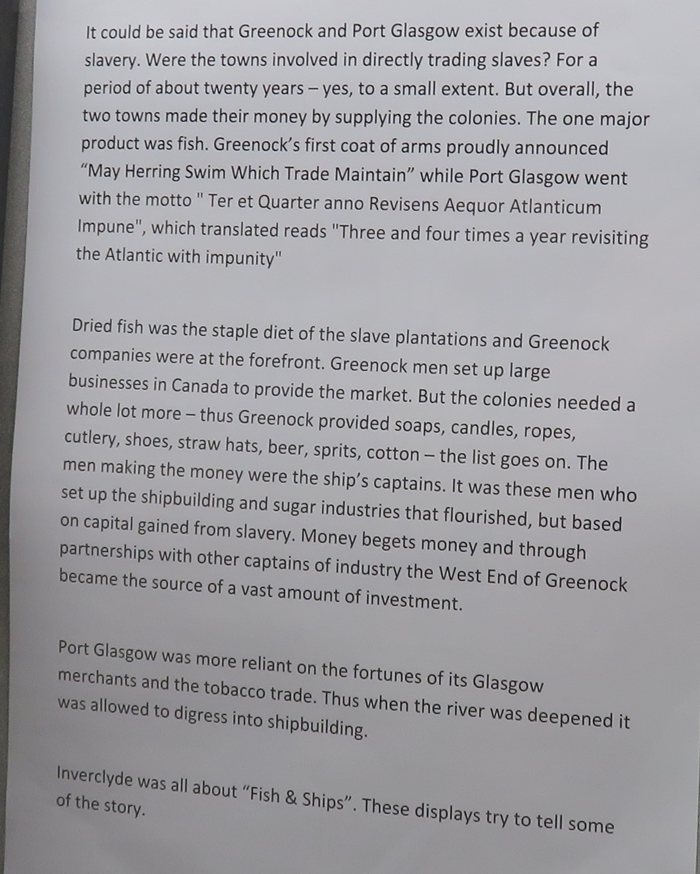
There were no cards to explain what any of the individual exhibits in this case are.  The large poster lists Sugar, Ships and Slavery as being "The Story of Inverclyde".   Ah, so that explains the items in the display!?

Enlarged, the poster goes on to explain (I think) the link between Greenock and Port Glasgow's coats of arms and "supplying the colonies".  Herring was a major export from the area.  Long before Greenock became involved with the Atlantic trade, dried fish were exported from here to many parts of Europe, especially Roman Catholic countries which advocated the eating of fish on Fridays and holy days.  Port Glasgow's coat of arms refers to the North American timber trade and was only adopted in the mid to late 19th century, long after slavery had been abolished.  Also interesting to see that Port Glasgow was "allowed to digress into shipbuilding" after the River Clyde was deepened!


It is flattering to think that the staff at the McLean Museum credit us all with having the intelligence to work out what everything in the exhibit is - after all there is a notice stating that it is about Greenock and sugar.  I can just hear children ask - "What are those big white triangle things?  What kind of bug is that and what has it got to do with sugar?  What are those tins and what's their connection to Greenock?  What is that "Target Zero" notice all about?  Who were Tate & Lyle?"  How are children - let alone visitors from out of the area or overseas -supposed to make sense of all this? 


A small notice in the case (in very small print) draws attention to an exhibition named "Remembering Sugaropolis" - online teaching and learning activities.  (No explanation of "Sugaropolis" the name given to Greenock at the height of its sugar refining industry.  How are people supposed to link Greenock/Sugaropolis?)  If you happen to have your phone or tablet handy (and have the time to listen) then you can go online and find out about some of the items in this case.  It links to a YouTube "Curating Objects" video in which an academic lists some of the items in the exhibit and explains "what is involved in writing a display label for an object in a museum collection"!  Oh the irony!

The cruise ship season is underway and many visitors will be arriving in Greenock over the summer.  I hope they are not too confused by the Mysteries at the McLean!  Check out another mystery - The Children of Greenock.


Thursday, 13 March 2014

Greenock's Flatiron Building

New York and Toronto have their flatiron buildings - they are tourist attractions in their own right and must have been photographed millions of times.  Greenock has a building which is just as magnificent and is a wonderful (almost) triangular shape.  Here it is -


Not quite something tourists would really want to photograph!  The building was once a sugar refinery (or sugarhouse, as we call it) here in Greenock.  It is one of my favourite buildings in the town, despite its derelict appearance.  It is a fabulous shape and the brickwork is wonderful.


Built in the 19th century, it was the Glebe Sugarhouse in the days when sugar refining was an important industry in Greenock.  I've already written about Abram Lyle and the connection with Tate and Lyle sugar.  You can read it here.


The building has been unused for some time now.  It has been left ruinous.  Pigeons fly in and out of the broken windows.  It lies among waste ground abandoned and forlorn.  The windows facing the street have now been boarded up.  An Aldi supermarket has now been built right in front of it.


It is situated right across the street from the container terminal which is where the large cruise liners dock when they visit the west coast - bringing thousands of tourists to the area.  What a great first impression  …………………. not!


But how wonderful it could be and what a great asset for Greenock if only someone with money and vision would take it over.  Personally, I would turn this building into a heritage centre for Greenock.  I would have a first class café, with some pretty little shops on the ground floor.  Arts, heritage centre and gallery on the upper floors.  A bar and restaurant on the top floors which would have amazing river views! It could be magnificent!


In the meantime, I pass by and dream. 


I even think that it may be haunted ………….....!

The Greenockian

Monday, 20 January 2014

Lyle's Golden Syrup - the Greenock Connection

Lyle's Golden Syrup - used by bakers everywhere and one of the most iconic tins in Britain.  Here's the Greenock connection - did you know that Abram Lyle (1820-1891) was born in Greenock?  In fact, he was a former provost (mayor) of Greenock in the 1870s.  His family were coopers in the town and Abram went into the shipping business, especially the importing of sugar from the East and West Indies.  He later founded the firm of Abram Lyle & Sons, sugar refiners.


Have you ever really looked at the picture on the tin?  It depicts a dead lion with a swarm of bees around it.  It seems a strange image to adorn a tin of food, but it would appear that the story behind it comes from the Bible (Judges 14:5-18) and it's a pretty horrible tale!  In the story, Samson kills a lion, the next time he passes the carcass, a swarm of bees have made a honeycomb in it.  He makes up a riddle about this "out of the strong, something sweet" - and that's why it is on the tin!  This trade mark was registered in 1904, although syrup was first put into tins in 1885.


Lyle opened a refinery in London, not far from that of his business rival, Henry Tate (of Tate Gallery fame).  The two companies were joined in 1921 after both men were dead.  Thus we have the company of Tate & Lyle, which had a refinery in Greenock until the 1980s.


So, the next time you open a tin of syrup or treacle, just remember the story of the logo and the Greenock connection! 

The Greenockian