Showing posts with label Municipal Buildings. Show all posts

Wednesday, 29 October 2025

Greenock's fallen angel

In January 1884 a storm caused damage to Greenock’s Municipal Buildings which were in the process of being constructed just off Cathcart Square.  Scaffolding had been set up so that work could commence on the building of the Victoria Tower.  Unfortunately the storm caused the scaffolding to fall bringing with it the sculpture of an angel above the entrance to the carriageway facing Cathcart Square – Greenock’s fallen angel lay in pieces on the ground.  Fortunately, no one was injured.


The two smaller carvings which were said to represent “certain industries of the town” were also damaged – one lost its head and the other lost an arm.

Some of the scaffolding was blown onto the roof of Rowan’s Warehouse, in Cathcart Square, causing damage there.


Fortunately, the angel sculpture was replaced and the damaged sculptures put right.  Greenock still has its angel which hopefully will not go the way of its predecessor!


Wednesday, 20 August 2025

Greenock - youth and maturity

These handsome men are to be found on the west façade of Greenock's Municipal Buildings - just opposite the Central Library in Wallace Place.  Look up - and there they are!

Presumably they represent youth and maturity, growth and strength.

The Municipal Buildings were designed by Hugh and David Barclay.  The foundation stone was laid on 6 August 1881 by Provost Dugald Campbell, and work continued for a number of years.

The whole building has some magnificent sculptures all the way around and there are more here on the west side - see photographs here.


I think these two are my favourites - for now!

Tuesday, 13 February 2024

Municipal Buildings' unusual details

The eastern entrance to Greenock's Municipal Buildings in Cathcart Square is absolutely full of interesting sculptural details.  This drawing from when the buildings were designed in the 1880s shows how it was to look.


It would appear from the drawing that statues were meant to stand in the niches above the entry which are now windows.

Designed by H & D Barclay, they were constructed in the 1880s.  The Victoria Tower, at the eastern end of the buildings stands at 245 feet high (75m).  However, a closer look at the entry-way reveals a lot of unusual sculptures.


Around the archway is a frieze of wonderful animals and birds.


Two lovely ladies decorate either side of the arch.  Some of these details are easy to miss, but just add a wonderful, decorative touch to the entry to the carriageway.  Next time you are in Greenock have a closer look at the Municipal Buildings - it is amazing what you'll find!

Monday, 21 August 2023

Greenock men and their images

Like proud Roman senators, these eminent Greenockians are portrayed in very classical style.  The busts can be found in the vestibule leading to the council chamber of Greenock's Municipal Buildings. 


John Caird (1820-1898) - Born in Greenock son of John Caird of Caird & Co and Janet Young.  Principal of the University of Glasgow 1873-1898.  Died at Dungourney, Newark Street the home of his brother Colin Stuart Caird.

Duncan Hendry - (1824-1880) Councillor and Magistrate.  Shipwright and shipowner,  Married to Cochran McKerrow.  Lived at Broomfield, Esplanade.

John Duff (1832-1887)  - Councillor and Magistrate. A brassfounder, married to Jessie Biggar Adam, the family lived at Hazelwood, Eldon Street.  

Robert Shankland (1826-1889) - Councillor and Magistrate.  Provost of Greenock.  Shipowner who was married to Janet Gibson.  Lived at The Craigs, Newark Street, Greenock.

Alexander Murray Dunlop (1798-1870) - Legal advisor to those who formed the Free Church of Scotland at the Disruption of 1843. In 1844 he married Eliza Esther Murray (1818-1902) and took the name Murray Dunlop.  In 1866 he inherited his cousin’s estate and as a condition of that changed his name to Alexander Colquhoun Stirling Murray Dunlop. He became MP for Greenock in 1852 and retired from public life in 1868 to his estate at Corsock in Dumfries which he inherited through his wife. He died there in 1870.

Quite a collection of Greenockians.

Friday, 3 September 2021

5 Beautiful Buildings in Greenock

 Here are my top 5 must-see buildings in Greenock. 

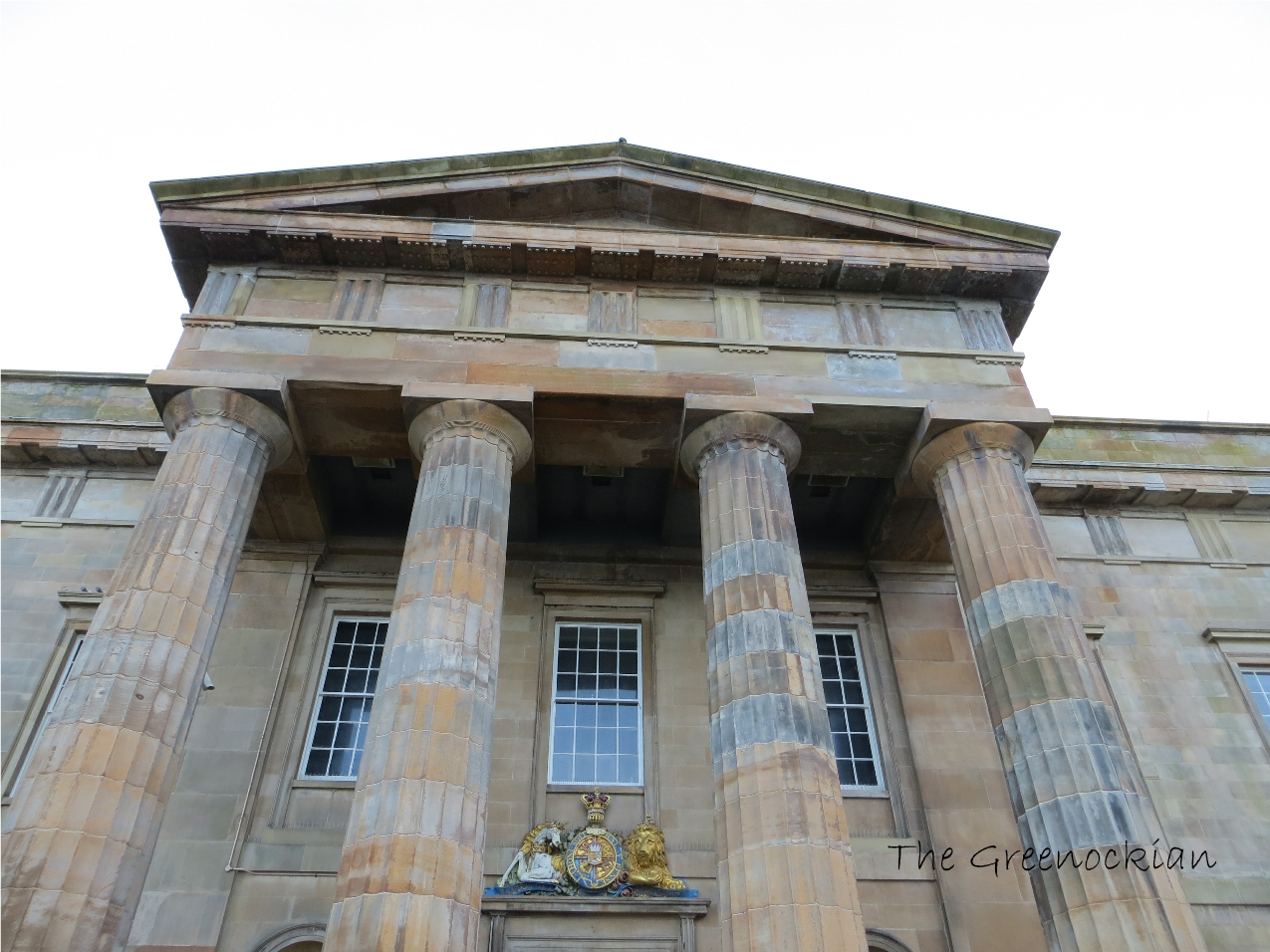
Greenock Sheriff Court

The first is the Sheriff Court building on Nelson Street.  It opened in 1869 and the architects were Peddie and Kinnear of Edinburgh.  Looks more like a fairytale castle than a working courthouse but in my opinion one of the most beautiful buildings in Greenock.  For more information and photographs see here.

Sir Gabriel Wood Mariners Home, Greenock

Second would habe to be the Sir Gabriel Wood Mariners Home in Newark Street.  It is empty and up for sale at the moment but hopefully will given a new lease of life very soon.  Built in the 1850s it was founded by local man Sir Gabriel Wood and brought into being by his widow Lady Augusta Wood and his sister Frances Ann Wood.  It is a spectacular building in a beautiful setting.

Greenock Custom House

My third choice had to be the Greenock's former Custom House.  Built in 1818 it was designed by William Burn.  It is now occupied by a variety of businesses and also homes Greenock's Burns Museum which has an interesting display of memorabilia of Scotland's national poet, Robert Burns (check Burns Club  website for details of when open).  Situated on Custom House Quay the building is right down at the riverside with spectacular views across the water.  See more photographs and find out more here.

Sculpture detail from Municipal Buildings, Greenock

Greenock's Municipal Buildings would be my fourth choice.  The buildings were constructed in the 1880s and designed by H & D Barclay.  All around the building are some fabulous architectural features and sculptures - see more here.  But perhaps my favourite feature is the wonderful Victoria Tower which is a fabulous landmark in Greenock.

Wellpark Mid Kirk, Greenock

My next favourite has to be the Wellpark Mid Parish Church in Cathcart Square.  Completed in 1761 it has a fabulous history.  You can read more here.  This is another town landmark and still used by the Church of Scotland as a place of worship today.

The Victoria Tower, Municipal Buildings, Greenock
It was difficult to choose my top five favourite buildings in Greenock as there are so many fabulous buildings in the town.  I'll list more of my favourites at a later date.

Wednesday, 22 November 2017

Greenock Town Hall Saloon

The Saloon of Greenock Town Hall is used for a variety of purposes.  It is beautifully decorated.


There are beautiful glass inserts in the ceiling.  The colours and details are amazing.


There's a fantastic blue and white plaster frieze around the top of the walls.


Some of the windows are painted with wonderful allegorical figures - just look at the details.


The plasterwork ceiling is lovely.


There is so much to see in just that one room.

Sunday, 4 September 2016

Cowan's Corner

This photograph is of the north west side of Cathcart Square in Greenock and is locally known as Cowan's Corner and there is an interesting story surrounding this empty space!


When Greenock's Municipal Buildings were being designed in the 1880s, the owner of this piece of land refused to sell to the Corporation.  There were shops and office on the site - you can see a photograph of how it looked on the McLean Museum website.  So, the new Municipal Buildings had to be build around the standing buildings.  Ironically it remained that way until Greenock was bombed during the Second World War in May of 1941 when the corner was destroyed, but the Municipal Buildings received much less damage! 


Robert Cowan was a draper and silk merchant in the town, the son of Archibald Cowan, a tailor and Elizabeth Turner.  In 1832 Robert married Jane McIver, daughter of Captain David McIver.  As this extract from Fowler's Commercial Directory 1836-1837 shows, Robert Cowan already had premises at the corner of Cathcart Square and Hamilton Street (may have once been his father's).  His home was at 25 Anne Street.


He seems to have been a very successful and well thought-of business man.  He two daughters - the younger daughter, Mary Elizabeth died in 1865.  By this time the family were living in Union Street.  His other daughter, Jane Boyd, married in 1862 a Glasgow merchant, Lawrence Bennett Robertson, the son of Andrew Robertson (woollen merchant) and Margaret Bennett.

Robert Cowan died from heart disease in 1867 leaving a substantial estate both in property and business to his daughter Jane Boyd Robertson.  She and her husband took over the running of the business, and it was with Lawrence Bennett Robertson that negotiations into the disposal of "Cowan's Corner" began.  The Corporation refused to pay the compensation Robertson demanded for giving over the land and therefore the Municipal Buildings had to be built around the area - the original design having to be amended to fit in with these circumstances.  Later a fine set of tenements with shops underneath were built which fitted in rather well with the surrounding area - look here.


There were many complaints at the time as the above newspaper cutting shows.


The Cowan and Robertson family are buried in Greenock Cemetery.  The headstone reads -

In memory of our beloved daughter Mary Elizabeth who departed this life November 15, 1865.
Robert Cowan fell asleep in Jesus on the 18 April 1867 aged 65 years
Jane McIver died 10 October 1881
Jane Boyd wife of L B robertson died May 1881
Lawrence B Robertson died 31 August 1889

It is interesting to note that Robert Cowan's grandson - Robert Cowan Robertson (1836 - 1910)  became a well known marine and landscape artist.  He was fond of sailing around the Western Isles and built a studio on Barra.  He was a friend of the artist Samuel John Peploe (1871-1935).  You can view some of his work on the McLean Museum collection at ArtUK.  My particular favourite is "Tug Standing By a Schooner in a Gale" 1899.

Wednesday, 21 May 2014

Municipal Sculptures

Here are some of the incredible sculptures from Greenock's Municipal Buildings, which was completed in the 1880s.


Greenock's motto - God Speed Greenock.


These are on the front (south facade) of the building at Clyde Square.


The Greenockian

Friday, 17 January 2014

Greenock Gates

These are the gates of Greenock's Municipal Buildings.


I don't think I've ever seen them closed before - in fact, I don't think I've ever really noticed them at all!  These photos were taken early on New Year's Day.

GMB - Greenock Municipal Buildings, I think that's what the initials are.

 Joining Friday's Fences.
The Greenockian

I wonder if anyone noticed something in the second picture of the submarine in my previous post?  Look at the very right of the photograph!

Tuesday, 7 January 2014

Above the Red Door

It looks like a rather unremarkable door doesn't it?  It is a small side entrance to Greenock's Municipal Buildings, on the west side at Wallace Place.  However, if we look a bit closer ...


Perhaps a reference to Greenock's mastery of the sea.
there are some remarkable carvings in the stonework.  This is above the doorway.

 
The foundation stone of the Municipal Buildings was laid in 1882 and the buildings completed in 1886.  This was a time when Greenock was a major port and shipbuilding town.  This is reflected in the sculpted imagery.

 
To the left of the door are images of the Greenock's importance as a port - sailing ship, docks, warehouses and crane for loading and unloading cargoes.  The detail is incredible.  Look at the chains on the crane.

 
The right side of the doorway shows nature's bounty - cattle, crops, and a plough - for the food necessary to feed the Greenock's workforce.  The bee hive is particularly significant as Greenock was a major sugar importer and there were many refineries in the town.  The beehive is also a sign of industry - busy as a bee!


I hadn't realised until I took a closer look at my photographs just how much detail was in this tiny part of the building.  There's a lot more, but that's for another day!


The Greenockian