Showing posts with label McLean Museum. Show all posts

Saturday, 11 February 2023

Mysteries at the McLean Museum - Model Aircraft

Another visit to the McLean Museum in Greenock (Watt Institution, Kelly Street) and another mystery object.  Obviously a model aircraft shoved in a display case with a variety of objects, none of which have any written sign or information as to what they might be or what their link to the local area is.


Of course I asked at the desk what the object was and its relevance to Greenock.  No one knew anything about it except that it had been put in the display case because it looked interesting!  What kind of aircraft is it?  Who made it?  Why was it donated to the museum?  No answers!


I've written before about the lack of information regarding objects on display at the McLean Museum.  Nothing has changed - many of the objects I have previously written about are still in cases without any written details.

No information in display case about these objects, but you can read about them here.

Whenever I go anywhere now I always visit local museums.  I thought perhaps that this lack of information was modern museum practice - but that does not seem to be the case in other places ... just Greenock.

It is very frustrating to be in such a wonderful building, surrounded by so many fascinating and interesting objects and not have a clue as to their significance to Inverclyde's wonderful history and heritage.

Tuesday, 24 May 2022

Mysteries at the McLean Museum - What is it?

Here's another Mystery from the McLean Museum in Greenock.  (Part of the Watt Institution, Kelly Street).  Dumped in a case beside Houdin's Clock is this object.  Looks wooden and very decorative, but what on earth is it?  The Museum have not provided a card to say exactly what it is (or anything else in the display).  If you don't know what you are looking at, searching the online Museum catalogue becomes very difficult!

However, as I was looking for information online about another object in the display case, I accidentally came across the information I was looking for.  Does the strange object look a bit familiar now?

It is actually a ceremonial carved wooden mallet presented to Provost Dougald Campbell when he laid the foundation stone of the Municipal Buildings On 6 August 1881.  That took a lot of searching!

This other strange item - had no idea what it was till I got home and was able to enlarge my photographs to read the inscription on it.  (Psychic powers seriously lacking on last week's visit to the McLean!)  It is a ceremonial level and plummet also presented to Provost Dougald Campbell on the 6 August 1881 at the laying of the foundation stone of the Municipal Buildings!  Who knew?  (Well we would have if the exhibit had been labelled.)

In a totally different display case are two other presentation items associated with that auspicious day in Greenock's history.  (Nothing in this display case is labelled and there is no indication as to what anything is.)

These are the ceremonial trowels presented to Provost Campbell on the same day.  One commemorates the laying of the foundation stone at the Municipal Buildings, the other was presented to the Provost at the laying of the foundation stone of the James Watt Dock on the same day.

Wouldn't they tell a wonderful story if they were placed together in the one case with photographs of the Municipal Buildings and the James Watt Dock.  I am sure the Museum has photographs of the ceremonials at the laying of the foundation stones in both places.  6 August 1881 was a big day in Greenock's history and there were lots of processions and celebrations throughout the town. 

The Museum obviously think that these items are worth exhibiting - so why not have them in the same case?  Giving explanations of their origin would perhaps give overseas visitors to the Museum a sense of the pride that Greenockians had (and still have) in their town.  I believe it would also highlight the beautiful Municipal Buildings and Victoria Tower which are such a part of Greenock's skyline.  The James Watt Dock, a marvel of engineering in its day, can also be visited and is now a Marina.  Why not tell their stories?

There are lots of other "Mysteries at the McLean Museum" on this blog.  Just put the word McLean in the search box on the right and you should find them!

Sunday, 24 April 2022

Mysteries at the McLean Museum - Sugar Connections?

You will need all your psychic abilities to get to the root of this week's Mystery at the McLean!  Another display cabinet at the McLean Museum in Greenock (part of the Watt Institution, Kelly Street) holds some (what seems to me) random objects.  Here's the object that caught my attention - in the photograph below.  


Obviously a set of overalls with "JW" embroidered on the front.  What on earth does this stand for?  If we are not possessed of psychic powers, then what are us lowly mortals visiting the museum supposed to make of this display?  

As an old Greenockian, I assumed that the "JW" refers to Walkers - once upon a time important sugar refiners in the town.  A quick check at the online collections site (Inverclyde Council website) confirms that this is indeed a uniform jacket dated 1965-1970 from John Walker & Co, sugar refiners, Greenock. (The National Library of Scotland have two wonderful old films from the 1960s showing sugar being processed in Greenock.  Check them out here.)

The only notice in the entire case is the same "Remembering Sugaropolis" label from another case containing a wooden spoon.  The notice is quite small and very difficult to read.  For those who are not local, Sugaropolis was the name given to Greenock when it was a major sugar refining centre in Britain.  There were some other items which perhaps had a more obvious sugar connection - some jars of samples of sugar, a machete and a sugar sack. 

So, if this is a case referring to Greenock's sugar refining heritage, what do the other objects inform us about the sugar industry? The piece of paper on top of the Walkers uniform - what is that?  An employment record of someone who worked at Walkers, perhaps?  No!  It is a document dated 1798 stating that Captain Andrew Ramsay of the ship Union of Greenock could trade between Great Britain, North America, West Indies and Europe.  Just about 200 years before the uniform on which it rests!  An amazing piece of local history in its own right, but what has it got to do with the overalls or sugar?  No explanation is given.

Then, in the same case, are these bottles - what have they got to do with sugar?  Well, there is no notice as to what they might be, but on zooming in on my photograph I could make out the word "Hoytema & Co".  A quick check on Google led me to discover that they were late 18th century Dutch gin bottles found in Nigeria.  So, the connection to Greenock's sugar trade is?  Obvious ... eh, isn't it??

What about this lovely stoneware jar in the display case.  It is labelled "MacSymon Company Ltd" - a grocery shop owner in Greenock in 1880 and later Liverpool.  His shops presumably sold sugar - perhaps that's the connection?  Was it stored in jars like this?

Why is nothing labelled in this collection of what seems to me, random artifacts?  If they are connected, why is there no information as to how?  Sadly, I discovered that I had photographed the exact same display in September 2021 - nothing had changed and no information cards had been added in the intervening 8 months.

It won't be long till cruise ships arriving at Greenock bring lots of visitors to the area.  Many will seek out the museum expecting to learn about local history.  As a Greenockian, I hope they will visit the Watt Institution because the staff are lovely, the building is amazing and there is a fabulous art collection.  Whether they will be any the wiser as to Greenock's wonderful history and heritage is very much in question as long as the museum continues to randomly display objects without any explanation as to their meaning or importance. 

Check out other Mysteries at the McLean - Children of Greenock  - Wooden Spoon - Magician's Clock - Spanish Armada Relic - click on links.

Saturday, 9 April 2022

Mysteries at the McLean Museum - Spanish Armada Relic

There is a relic of the Spanish Armada at the McLean Museum in Greenock.

Sitting just outside the Museum entrance on Kelly Street is this old cannon.  The Museum's online catalogue describes it as a "A 16th century Spanish Armada 12 pounder cannon from the Portencross wreck".  The cannon is supposed to come from a Spanish ship which ended its days at Portencross near West Kilbride in North Ayrshire - just 23 miles south of Greenock.  The name of the ship is unknown but it appears to have gone down just off shore from Portencross Castle.  Another cannon was found and remains at Portencross.

Portencross Castle

In 1588 when the Spanish fleet was routed by the English many ships trying to return to Spain were caught up in bad storms and blown way off course.  A few ended up in Scotland.  There's an excellent article about the defeat of the Spanish Armada on the Royal Museums Greenwich site (click to read).

How did this cannon end up in the Watt Institution, Greenock?  It was donated to the museum in 1877 by Caird & Co, shipbuilders.  When Greenock's main harbour was formed in 1710 the cannon was placed there by the magistrates of the town.  In 1810 when the harbour was being improved, shipbuilder John Scott bought it and placed it in his shipyard.  It was used to secure ships.

John Scott had a brass plate made for the cannon giving its full history - "The famous Spanish Armada sailed to conquer England in the year 1588, under the command of the Duke of Medina.  The fleet was scattered in a tempest, and many of the ships were wrecked on the western islands of Scotland.  This gun, saved from one of the wrecked ships, was brought here, and placed by the magistrates on the West Quay, in the year 1710, where it remained for one hundred years.  Mr Scott having purchased all the materials of the old Quay when the harbour improvements were going on, this gun was removed here, not for the purpose of destroying ships, but for assisting vessels for repairing safely in and out of dock."  "Building yard, Greenock 1843.  Caliber of gun 12 pounder.  Circumference at breech 3 feet 6 inches.  Length of gun 8 feet 3 inches.  Circumference at muzzle 2 feet 3 inches."  There is now just a small descriptive plate attached to the cannon.

Such was its importance that in 1905 it was send from Greenock to be exhibited at the Naval, Shipping and Fisheries Exhibition at Earls Court, London.

Returned to Greenock, it still guards the entrance to the McLean Museum.

There are interesting links between Armada shipwrecks and Greenock.  In 1680s the Earl of Argyll employed Archibald Miller a diver (salvor) from Greenock to investigate the wreck of an Armada ship which had sunk off Tobermory, Mull.  Miller is recorded as finding several items for the Earl.

In 1874 another attempt was made to find any treasure left behind on the ship.  This time Greenock submarine diver, Charles Gush, was employed by to find any remains of the ship at Tobermory.  The Marquis of Lorne and his wife HRH Princess Louise were on board the steam yacht Colombia to view the proceedings, but there was an accident.  Fortunately Charles Gush recovered.

In 1906 once again attempts were made to salvage any remains from the wreck at Tobermory.  James Gush, submarine diver (son of Charles Gush) was employed by Captain William Burns (salvor) and the West of Scotland Syndicate, a group of businessmen intent on finding treasure.  Some items were recovered and sold at auction - perhaps not the treasure they expected.

Since then many more expeditions have set out to try and find the "Tobermory Treasure".  You will find a full and detailed account on the Canmore site (click to view) of the ship now thought to be the San Juan De Sicilia and the salvage operations undertaken over the centuries.  It is a fascinating story.

Saturday, 2 April 2022

Mysteries at the McLean Museum - the Magician's Clock

Another trip to the McLean Museum, part of the Watt Institution, Kelly Street, Greenock, and another mystery!  I saw the coat of arms of Port Glasgow and immediately thought - good, something interesting about Port Glasgow in that display case.  Well, that wasn't the case (get it!).  Inside was a jumble of artefacts most of which related to Greenock.  Only one had any sort of notice describing what it was, although there was a notice stating that new displays on the history of Inverclyde were coming soon.  Can't wait to see those!  However, something in the case caught my eye - a beautiful clock.


The clock is described in the Museum's online catalogue (try finding that on the Inverclyde Council website!) as a "Nineteenth century pendule mysterieuse clock made by Jean-Eugene Robert Houdon ..."  I was intrigued - here was a genuine mystery!  I wanted to find out about M. Houdon and why the clock was described as "mysterieuse".  Unfortunately there was no card near the clock to explain anything to the public.  Pendule Mysterieuse or mystery clock - the workings are hidden so that the hands appear to move on their own.  These mystery clocks created quite a sensation when they were first exhibited to the public.

Jean-Eugene Robert Houdon

Once described as one of the greatest and richest magicians in the world, Jean-Eugene Robert (1805-1871) was born in Blois in France to a family of clockmakers.  After his marriage to Josephe Cecile Houdon, the daughter of a clockmaker, he added Houdon to his own name.  He later moved to Paris and set up business as a clockmaker.  He also had a fascination with magic and befriended many magicians who graced the theatres of Paris.  He became popular throughout Europe and also in Britian.  He was also an excellent mathematician and engineer and also became famous for his "electric clock" made for the Hotel de Ville, Blois.

Spurred on by his combined interests, Robert-Houdin (as his name was commonly spelt) made a mechanical figure which was bought by P T Barnum for a large amount of money.  Houdin was also making mechanical articles for his own magical theatre which opened in Paris in 1843.  Appearing in evening dress on stage, he also had an act "Second Sight" which involved his son in a blindfold identifying objects handed to Houdin by the audience.

During the Revolution of 1847 which closed much of Paris, Houdin took his show on tour and performed in London for Queen Victoria.  He also toured Europe for a number of years.  In 1856 he was sent on a diplomatic mission to French Algeria to help suppress a rebellion.  He later retired to his home near Blois.

Robert-Houdin died in 1871 and his home became a museum open to the public - La Maison de la Magie Robert-Houdin.  He is known as "the father of modern magic".  

Interestingly, the famous escape artist and illusionist, Harry Houdini, born Ehrich Weisz, named himself after two famous magicians - Harry after Harry Keller and Houdini after Robert-Houdin.

Who would think that a random, unlabelled exhibit in a relatively small museum in Scotland could conjure up (see what I did there!) such an interesting history!  However, a mystery still remains.  How was this mystery clock acquired by the McLean Museum - was it donated or bought for the collection?

Read about other Mysteries at the McLean - Children of Greenock and the Wooden Spoon.

Saturday, 26 March 2022

Mysteries at the McLean Museum - the Wooden Spoon

The McLean Museum, Watt Institute, Kelly Street, Greenock has an exhibit about Greenock's sugar trade.  In it is this unusual wooden spoon.  Unusual in the fact that it has lots of little metal rings around the handle and a little metal discs attached.  What is it doing there?  There was no card to explain why it is in this exhibit.  

Of course the simple explanation could be that wooden spoons are used a lot in cooking and baking and thus its significance in a exhibit case dedicated to Greenock's sugar trade.   But why the rings?

Most of us will know that winning a wooden spoon means that an individual or team has come last in a competition.  So it can be inferred that the names on the metal rings must be the names of the losers in a competition.  The spoon reads "Greenock Sugar Trade Golf Club Inst. 1919" on the bowl of the spoon.  So, those with good eyesight can then understand what this unusual item is all about.  There was nothing explaining this to the viewing public.  Many youngsters will not know what winning a wooden spoon means and that this is really a bit of fun (unless you take your golf really seriously!).  

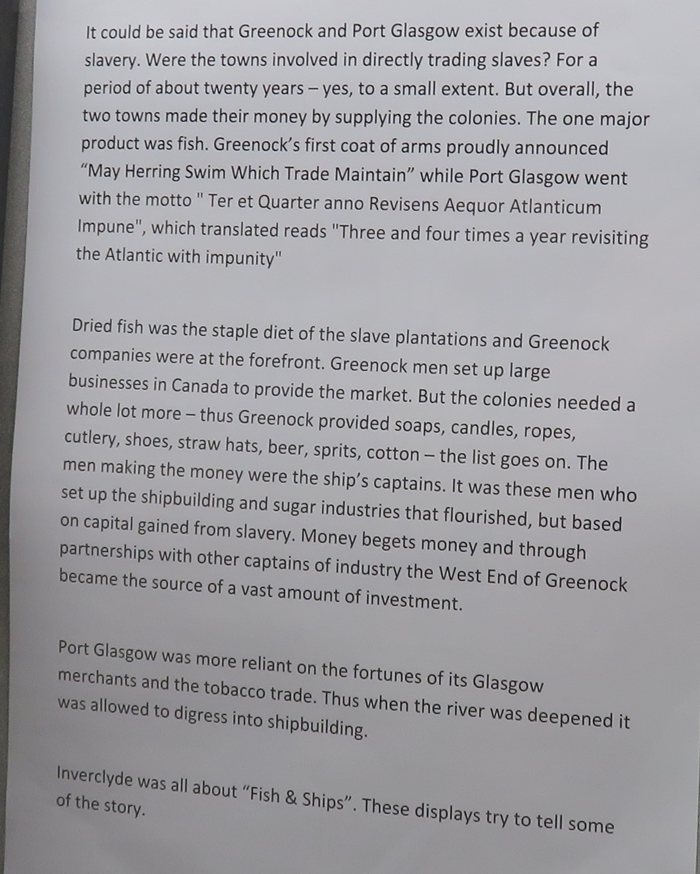
There were no cards to explain what any of the individual exhibits in this case are.  The large poster lists Sugar, Ships and Slavery as being "The Story of Inverclyde".   Ah, so that explains the items in the display!?

Enlarged, the poster goes on to explain (I think) the link between Greenock and Port Glasgow's coats of arms and "supplying the colonies".  Herring was a major export from the area.  Long before Greenock became involved with the Atlantic trade, dried fish were exported from here to many parts of Europe, especially Roman Catholic countries which advocated the eating of fish on Fridays and holy days.  Port Glasgow's coat of arms refers to the North American timber trade and was only adopted in the mid to late 19th century, long after slavery had been abolished.  Also interesting to see that Port Glasgow was "allowed to digress into shipbuilding" after the River Clyde was deepened!


It is flattering to think that the staff at the McLean Museum credit us all with having the intelligence to work out what everything in the exhibit is - after all there is a notice stating that it is about Greenock and sugar.  I can just hear children ask - "What are those big white triangle things?  What kind of bug is that and what has it got to do with sugar?  What are those tins and what's their connection to Greenock?  What is that "Target Zero" notice all about?  Who were Tate & Lyle?"  How are children - let alone visitors from out of the area or overseas -supposed to make sense of all this? 


A small notice in the case (in very small print) draws attention to an exhibition named "Remembering Sugaropolis" - online teaching and learning activities.  (No explanation of "Sugaropolis" the name given to Greenock at the height of its sugar refining industry.  How are people supposed to link Greenock/Sugaropolis?)  If you happen to have your phone or tablet handy (and have the time to listen) then you can go online and find out about some of the items in this case.  It links to a YouTube "Curating Objects" video in which an academic lists some of the items in the exhibit and explains "what is involved in writing a display label for an object in a museum collection"!  Oh the irony!

The cruise ship season is underway and many visitors will be arriving in Greenock over the summer.  I hope they are not too confused by the Mysteries at the McLean!  Check out another mystery - The Children of Greenock.


Thursday, 17 March 2022

Mysteries at the McLean Museum - Children of Greenock

The McLean Museum in Kelly Street, Greenock is part of the Watt Institution.  It is a fascinating place to visit and the front of house staff are lovely and could not be more helpful.  But there are exhibits which puzzle me.  Perhaps it is taken for granted that locals know their local history and that putting description cards beside exhibits would be an insult to their intelligence.  I am not sure what the lack of information in display cases is about, but here is a glaring example.


This lovely artifact is lumped in an exhibit of shipbuilding bits and pieces at the back of the museum.  It is a tribute to the Greenock born poet William Sydney Graham.  (I've written about him before here and here.)  Entitled "The Children of Greenock" (the title of one of Graham's poems) and has lines from the poem around its edges.  

"Her window watched the shipyards sail their men away.  The sparrow sill bent grey over the struck town clocks.  Striking two towns, and fed its flocks."

It is a view of Greenock through a window with ships out on the River Clyde.

However, trying to find any information about this was just about impossible!  There was no little printed card in the display case to explain who W S Graham was or his connection to Greenock.  There was nothing to indicate who had made this work or why it was in a display about local shipbuilding.  I was curious so I asked the lovely lady at the welcome desk if she could tell me a bit more about it.  She was very helpful, but had no knowledge of the work.  She suggested that it would be detailed in their online collection.  A colleague passing by who happened to have a laptop with him was able (after a bit of a wait and after he had opened the case and checked the acquisition number on the frame) to give me details.  It was created by Michael McDonnell (1939-2022) and bought by the Museum in 2002.

Mike McDonnel was born in Greenock and died in January of this year.  He seems to have been a fascinating man and led an extremely interesting life.  He was a doctor and after many years of travel,  spent his latter years in Shetland, creating many art works there.  You must read his full obituary to appreciate what an interesting character he was.  You can also see more of his original work here.  W S Graham, a fellow Greenockian was his favourite poet and that is why he made the piece that was bought by the McLean Museum.  There are other works which he made as a tribute to Graham.  You can see them here.

So, part of the mystery is solved, but I still have a few questions.  Why is there no notice to explain who Graham was or his connection to Greenock?  Why is there no information about Mike McDonnell, the creator of this unusual work and what it represents?

One of the few notices in that actual display case.

The front of house staff at the McLean Museum are wonderful and I just wish that their lives were perhaps made easier by proper explanation of exhibits.

Interestingly, a new exhibit from the McLean's Egyptian Collection had copious printed notes about the pieces on display.  It is just a pity that the same attention to detail is not noticeable in local history exhibits.

Friday, 24 April 2015

Inverclyde Tourist Information

There are a lot of new signs in Inverclyde which are part of the Inverclyde Heritage Coastal Trail.


There's even a new bench at Custom House Quay - not sure how you would manage to read the information if folk were sitting on it!


Information about the Custom House itself.


Information about the Quay and how many, many Scots left from here to start new lives abroad.


Two "Great Greenockians" - Abram Lyle of sugar fame - Lyle's Golden Syrup


James McLean, founder of Greenock's museum and art gallery.


Great information for tourists to Greenock.