Thursday, 9 February 2017

James Watt Cairn in Greenock Cemetery

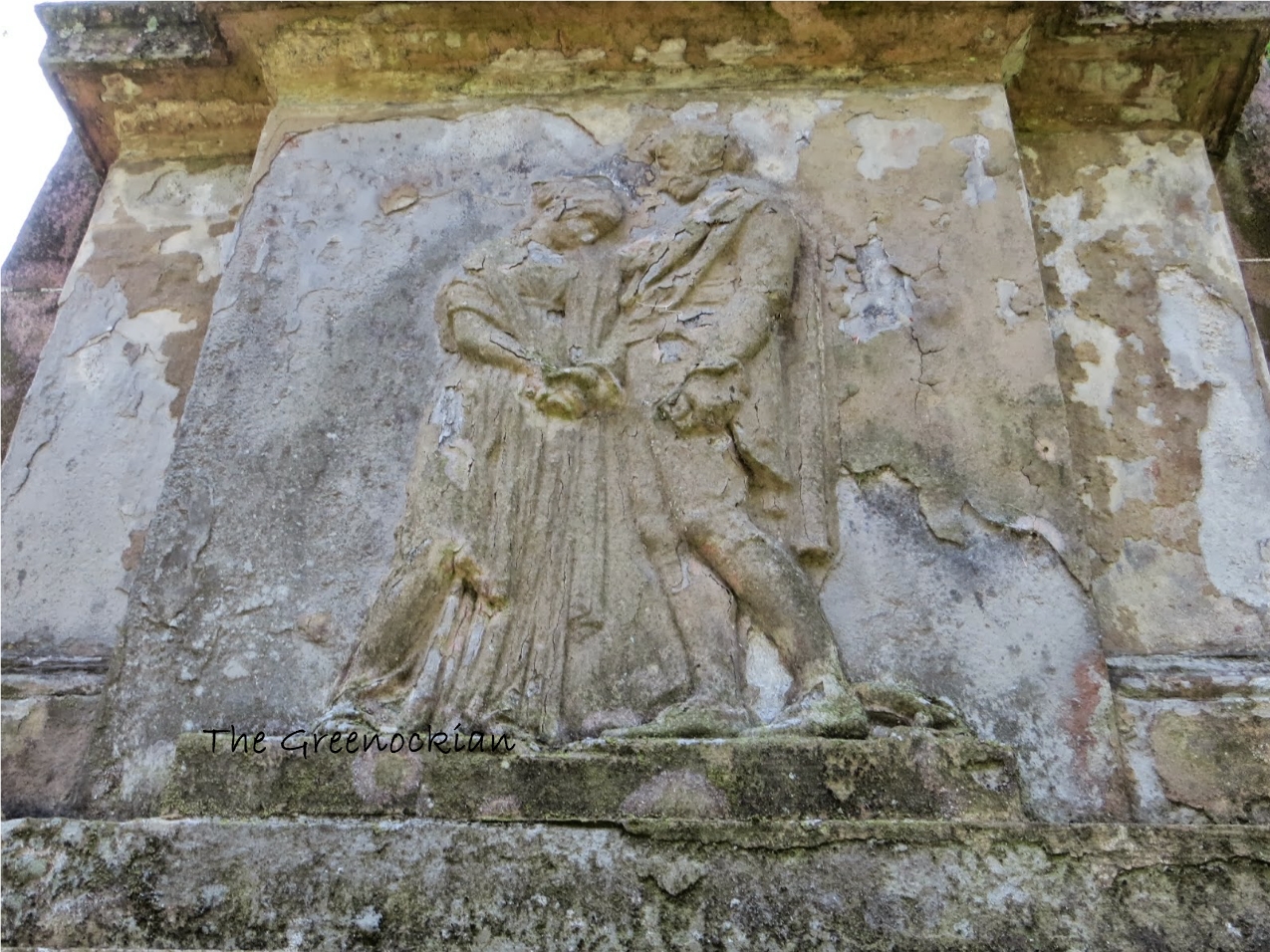
In Greenock Cemetery there is a memorial cairn to the great engineer James Watt born in Greenock in 1736.  In Scotland, a cairn is a pile of stones, usually to commemorate a special place or person.


The plaque on the cairn reads:-
The Watt Cairn
Projected and commenced by the Watt Club 1854.
Arranged and completed on the 200th anniversary of Watt's birth 1936.
These stones, gifted from all parts of the world, speak of the universal homage
accorded the great engineer, inventor and scientist.
The monument also marks the burying place of James Watt's ancestors
removed from the Old West Kirk, 26th April 1927.


Another plaque lists the names of those who sent stones to Greenock from all over the world.
The Stones and their Donors
Malta, St Paul's Bay, Major General Sir William Reid, governor of Malta
Sebastopol Granite, Henry Innes, Secretary to the Port Admiral
Marble from Tunis, Sir Edward Baines HM Consul General
Marble from Carthage, Admiral Sir Houston Stewart
Slab from Palestine, John Currie
Stone from Peru, Alex Prentice, Lima
Stone from Ghaut of India, Bombay Mechanics Institution
Red Sandstone from Seneca Quarry, Potomac River, Gilbert Cameron
Granite Slab, Heriot Currie


Pentagonal Column from the Giant's Causeway
Stone, Mechanics Institute, St Helens
Stone from Canada, Rollo Campbell, Montreal
Foundation stones, Dougald Dove, Nitshill and Arden Quarries and
Sir Michael R Shaw Stewart Bt, A member of the Watt Club.


It is a very unusual monument.  It is right beside the memorial to Highland Mary in Greenock Cemetery.

Tuesday, 7 February 2017

The Galt Marbles?

It is curious to think that but for a last minute payment, those fabulous ancient Greek artefacts called the Elgin Marbles could have been owned by the author John Galt - The Galt Marbles - doesn't quite have the same ring to it, does it?


Galt was in Athens at the time the marbles were being shipped back to Britain.  In his Autobiography (Part I, p158) Galt relates the circumstances behind him almost acquiring the marbles -
         "Here was a chance of the most exquisite relics of art in the world becoming mine, and a speculation by the sale of them in London that would realize a fortune.  The temptation was too great.  My correspondents at Malta were Messrs. Struthers, Kennedy, and Co., to whom I wrote to pay the bills upon receiving the stones, etc etc and I shipped myself on board the vessel that I might see her safely to Hydra, where she was to put herself under the protection of a man of war.  Accordingly that evening we sailed with our precious cargo, and next morning arrived at Hydra, from which the vessel was conveyed to Malta.  But on her arrival there, the agent for the earl paid the bills, and my patriotic cupidity was frustrated."


Galt does actually make fun of himself stating later - 
"... I also imbeciliated a mock heroic poem on the Rape of the Temples, in which I was myself so guilty of being accessary in art or part."  
The poem was Athenaid and he appends it in the Autobiography after telling about his part in the scheme "in the language of Goody-Two-shoes"!  I love the fact that Galt can mock himself.
Verse from Galt's Athenaid
There was (and of course still is) a lot of disapproval of Thomas Bruce, Lord Elgin (1766 - 1841) and his actions with regard to the Parthenon marbles.  Lord Byron criticised him in his epic The Curse of Minerva, which, says Galt, Byron wrote after reading his Athenaid.  
Elgin's original intention was to make drawings and casts of the sculptures. He employed Giovanni Battista Lusieri (1755 - 1821) a landscape artist and architect formerly in the employ of the King of Naples to undertake this work.  Lusieri was the agent who dealt with the matter for Elgin.  


Lord Elgin
The French Consul M. Fauvelle tried to stop Elgin from removing the marbles to Britain - he wanted them for France and Napoleon (so says Galt).  Elgin's defence was that if he did not take them they would be destroyed by the Turks or stolen by the French.  He had a firman (permit or authority) to remove them, Galt says that he saw the firman, but being unable to read Turkish was told that the Earl had permission to remove one stone.  (Autobiography, Part 1, p160).  Of course later Elgin sold the marbles to the British Government and they are on display in the British Museum in London.

So, could there be controversy today about "The Galt Marbles"?  Or did Galt make the whole thing up?!


In his Letters from the Levant (p113), Galt writes:-
     "The distant appearance of the Acropolis somewhat resembles that of Stirling Castle, but it is inferior in altitude and general effect."
Wonderful Scottish put-down!  Wha's like us?

Monday, 6 February 2017

Muir of Newfoundland

Adjacent to the grave marker of the family of Richard and Ann (Burley or Burleigh) Muir in Greenock Cemetery, is that of Richard's brother Robert Muir and his family.  The gravestone sadly notes that it is "In memory of Robert Muir and Mary Livingston his spouse, who died within 14 days of each other."


Robert Muir (1784 - 1854) and his wife Mary Livingston (1786 - 1854) lived at Muir's Land in Lynedoch Street, Greenock.  A look at the map dated 1842 from the National Library of Scotland site shows Muirs's house to be on the south-west side of Lynedoch Street.  Like his brother, Robert ran a successful shoe and bootmaking business, this was continued by his son William.  


However it is the younger son, Robert Livingston Muir who travelled to Newfoundland.  Born in 1826, Robert seems to have forsaken the shoemaking business and became an apprentice to Cowan & Lawrie, drapers in Greenock.  He was lured overseas like many of his fellow Greenockians to St John's, Newfoundland.  Here he joined Edwin Duder (son of Thomas Duder and Ann Congdon) to form the company of Muir & Duder, merchants and ship owners in St John's.  He married Emily Duder in Greenock on 14 July 1847 and had several children born in Newfoundland.  Unfortunately Emily died aged just 29 in 1856 and is buried at St Marychurch, Torquay, Devon (Kingskerswell would appear to be where the Duder family originated).

The firm was successful and Muir made annual business visits to Greenock and Glasgow and obviously kept in touch with the large Muir family here in Greenock.  In June 1865, Robert Livingston Muir died, aged just 41, as the result of injuries received in a dreadful accident in Newfoundland.  According to his obituary in the Greenock Telegraph -


     "It appears that Mr Muir had been returning from business to his house in the country in a carriage  and while going down a steep hill the horse took fright and became unmanageable.  On nearing      an embankment he thought the animal was making to go over it, when he leapt from the machine.   In doing so he unfortunately broke his leg above the ankle.  He was carried into a house close by, and a friend of his - Mr Grieve, son of Provost Grieve of Greenock - driving up shortly after, got him laid in his machine on the top of a mattress and conveyed home, where medical assistance was called in; but owing to the serious nature of the injuries, he died after lingering for a few days."


A posthumus daughter, Roberta Livingston Muir (1866 - 1944) was born to Muir's second wife, Sarah Peele, daughter of George Peele of London.  They had married on 16 April 1860 at Southwark, London.  Sarah Muir (1834 - 1919) lived to the ripe old age of 85 and is buried at Monkton Combe, Bath.


The gravestones of Greenock Cemetery tell the stories of some remarkable and well travelled Greenockians.  Robert Livingston Muir's cousin was the noted  barrister Sir Richard Muir.  The Greenock born poet, Margaret Peace also lived in Newfoundland for a while.

The grave markers read -
In memory of Robert Muir and Mary Livingston his spouse who died within 1 day of each other the latter 19 March 1854 aged 70 years and the former 1st April 1854 aged 68 years.
Also their daughter Janet McLeod who died 15th June 1869 aged 59 years and Johnina daughter of the above Janet McLeod who died 26 December 1865 aged 17 years.
Robert Mackenzie son in law of the above Robert Muir who died 5th Nov 1879 and Elizabeth Muir or Mackenzie his wife born 16 Oct 1816 died 1st April 1895.

To the memory of Emma Duder the beloved wife of Robert L Muir of St John's Newfoundland who died 19 July 1856 at St Mary-Church near Torquay, Devon in the 29th year of her age.
Also their daughter Emma who died at St John's Newfoundland January 1856 aged 11 months.

Also the above Robert Livingston Muir who died at St John's Newfoundland 6th June 1865 aged 41 years also their son Edwin Duder died 7 July 1870 aged 22 years.

Sunday, 5 February 2017

The Greenockian who prosecuted Crippen

The Greenockian's name was Richard David Muir and he commenced his cross-examination of Dr Hawley Harvey Crippen with the question -
"On the morning of February 1 you were left alone in your house with your wife?"

Dr Crippen
"Yes" replied Crippen in response.
"She was alive?"
"She was."
"Do you know of any person in the world who has seen her alive since?"

One can just imagine these intense moments as the murderer and prosecutor faced each other across the Central Criminal Court in October 1910.  It is reported that when Crippen heard that Richard Muir would be prosecuting he said, 
     "It is most unfortunate that he is against me.  I wish it had been anybody else but him.  I fear the worst."  

Crippen was accused of the murder of his wife, Cora (stage name Belle Elmore) and fled aboard SS Montrose with his mistress Ethel Le Neve dressed as a boy.  The couple were apprehended when the ship arrived in Canada and brought back to Britain.  Crippen, aged 48, was found guilty of the murder of his wife and was executed at Pentonville Prison on 23 November 1910.  Crippen's crime and the ensuing trial have gone down in history - there can't be many who do have not heard of Dr Crippen.  (You can read all the fascinating details of the case at the Old Bailey Online.) 
Perhaps not so much is known of his prosecutor, Richard Muir.

Sir Richard Muir (knighted in 1918) took part in many of the most sensational trials of the late 19th and early 20th centuries.  He was in great demand for his cool, methodical approach to his work.  Possessed of a good memory, he was a logical thinker and thorough in his attention to facts and details, a trait he expected in others, especially police officers working on his cases.  As this excerpt from his notes in the Crippen case shows, he set everything out in a clear precise manner.  He kept his notes on small cards and used coloured pencils for different aspects of his cases.


A lot of information about Muir's legal cases can be found in the book - Sir Richard Muir - A Memoir of a Public Prosecutor written by Sidney Theodore Felstead and edited by Lady Muir.  (London, John Lane the Bodley Head Limited, 1927).  It is a fascinating read and readily available to purchase online.

Muir was born in Greenock on 8 March 1859 to Richard Muir, a master shoemaker in the town and his wife Ann Burley (or Burleigh) who had married in Greenock in July 1839.  His father ran a successful business and by 1851 was employing sixteen men.  At that time the family lived in Kelly Street.  Richard was the third son, and eighth child - more children were to follow.  Richard Muir senior's business flourished and he began to invest in shipping.  By 1861 the family had moved to Clyde Street or Low Gourock Road (Eldon Street before the Esplanade was constructed).  By the time of the 1881 census they were living at Oakbank on Union Street.

At this time Richard Muir was working as a commission clerk locally and was active in the Greenock Royal Rifle Volunteers, but he soon decided to join his elder brother Robert Burleigh Muir (a solicitor) in London.  Through extreme hard work he qualified as a lawyer and began his apprenticeship in the chambers of Sir Forest Fulton in Fountain Court.  He also began to learn shorthand at Pitman's school in Chancery Lane.  He soon earned a reputation as a first class verbatim reporter, specialising in parliamentary speeches.  He joined the reporting staff of The Times newspaper under William Leycester (1826 - 1893).  He ably juggled the two jobs and hardly surprisingly, seems to have had few outside interests.


He began to concentrate on legal work, taking over the Fountain Court chambers and began to make a name for himself as a thorough and dependable man.  He married Mary Beatrice Leycester (photo from National Portrait Gallery) in 1889 and they had two children, a son and a daughter.  His son, Burleigh Leycester Muir, also a barrister, was a Captain in the Army Service Corps during World War I and died on 4 November 1918 of influenza.  He left a widow, Vera Brodie MacQueen whom he had married in 1915 and a young son.  Muir's daughter, Mary Leycester Muir married Lieutenant Robert William Godfrey Kiesow of the Lancashire Fusiliers.

Sir Richard Muir died in 1924 and is buried at Norwood Cemetery in London.  However his name is included on the family headstone in Greenock Cemetery along with many of the other members of this large family.


The fraudster Whitaker Wright, the murderes Ronald True and Frederick Henry Seddon, German spies, the Hatton Garden Pearl Robbery and many, many other sensational trials made up the casebook of Sir Richard Muir - a truly remarkable man … from Greenock.

Friday, 3 February 2017

The Greenock Riot 1820

This sculpture is called The Hands of the Fallen by Angela Hunter.  "The fallen" is a reference to the local people who were killed or wounded during a riot in Greenock on 8 April 1820.  The sculpture is on Bank Street across from the Wellpark Mid Kirk.


The sculpture commemorates a dreadful day in Greenock's history.
Economic downturn after the Napoleonic Wars led to higher prices and unemployment. There was general unrest among workers and attempts to achieve political reform.  Artisan workers, including weavers were particularly active, calling for strikes across central Scotland.  Bands of radicals rallied and there were many skirmishes with the armed forces who had been called out to deal with the threat of unrest.  The ringleaders were arrested and jailed.  Paisley gaol was full so five prisoners were sent to Greenock to be imprisoned here.


A rumour about this soon got out and a mob gathered in the streets around the Bridewell (west side of Bank Street behind the Mid Kirk).  The five radical prisoners duly arrived in a cart escorted by the Port Glasgow Volunteers with a fife and drum playing.  The prisoners were put in jail and the Volunteers prepared to return to Port Glasgow.  The crown turned on them.  One of the local magistrates Mr Dennistoun tried to calm things down but to no avail.  Just at the Tontine (then on Cathcart Street), the mob began throwing stones and bottles.  Several of the Volunteers were hurt and fired a few shots in the air to warn the mob.  This only proved to anger them and eventually (at Rue End) the Volunteers had to fire in earnest, injuring and killing some of the crowd. 


The mob gathered together their own weapons, even pulling up iron railings en route, and followed the Volunteers on their way to Port Glasgow intending to fight.  They got as far as Garvel Park when they heard that more militia were being sent to Port Glasgow to help the local Volunteers.  At this, the crowd dispersed.  Meanwhile, some had broken into the prison and released the radicals (but none of the other prisoners).
A detachment of hussars and guards were sent from Glasgow by steamboat to Port Glasgow in case of any trouble.  But by the time they arrived the next day all was quiet.


A list of the dead and wounded appeared in the Glasgow Herald -

Adam Clephane (48) wound under the groin (dead)
Archibald Drummond (50) shot through the cheek (dead)
James Kerr (17) shot through the belly (dead)
John McWhinnie (65) shot through shoulder and chest (dead)
Hugh Paterson (14) shot through the leg (leg amputated)
John Patrick (30) shot through the thigh (doing well)
David McBride (14) shot through cheek and jaw (doing well)
A McKinnon (17) shot through chest and arm (doubtful)
Catherine Turner (65) shot through the leg (leg amputated)
John Boyce (33) shot through the belly (dead)
George Tillery (25) shot through the thigh (doing well)
Robert Spence (11) shot  in foot (slightly)
William Lindsay (15) shot dead on spot (dead)
James McGilp (8) shot in right thigh
Gilbert McArthur (18)shot through the left thigh (flesh wound)
John Turner (22) (flesh wound)
Peter Cameron (14) (flesh wound)
John Gunn (24) shot through calf of left leg
It was thought that there were so many leg injuries because some of the crowd had tried to wrestle the guns from the Volunteers.


The wording on the memorial plaque reads:-
Radical War Memorial
In Memory of those wounded and killed on the 8th of April 1820 during a protest against the imprisonment of those who led the campaign for better social and economic conditions in a period of insurrection known as "The Radical War".  Eight died, the youngest of whom was 8 years old, and the oldest 65.

Listen to The Greenock Riot 1820 Podcast by The Greenockian


Friday, 23 September 2016

Gourock heron

It was a beautiful day in Inverclyde yesterday.  I went out to get some photographs and came across a heron sitting on some rocks down at Gourock.


Friday, 16 September 2016

Good for Greenock!

It has just been announced this week that Greenock has been voted 3rd in the Cruise Critic's destination awards - British Isles and Western Europe section!


This year Greenock has been visited by over fifty cruise ships - and while many of the passengers travel to Glasgow for the day, many choose to stay in the local area to enjoy what we have to offer here in Inverclyde.  Of course it's not just the gorgeous scenery, wonderful architecture, interesting history and heritage that make this area so attractive, but credit must be given to the wonderful local people who make our visitors feel so welcome.

Friday, 9 September 2016

What to see this weekend in Greenock

Still wondering where to visit on Doors Open weekend?


Watch my short slide-show for a few suggestions.


A full list can be found here.


Tuesday, 6 September 2016

Jean Street School Port Glasgow

School Court in Port Glasgow is a great example of what can be achieved when old buildings are renovated.


The former Jean Street Primary School designed by H & D Barclay and opened in 1884, was a popular school in Port Glasgow and could house 460 pupils.  It closed in the late 1970s.


The local author and teacher Janetta Bowie (1907-1996) taught here for a short while after graduating.  Her book Penny Buff - described life in local schools in the 1930s.


You can see an old picture of the school at the McLean Museum website.  Thank goodness the old building hasn't been destroyed like so many others in Inverclyde and has now been turned into flats.

Sunday, 4 September 2016

Cowan's Corner

This photograph is of the north west side of Cathcart Square in Greenock and is locally known as Cowan's Corner and there is an interesting story surrounding this empty space!


When Greenock's Municipal Buildings were being designed in the 1880s, the owner of this piece of land refused to sell to the Corporation.  There were shops and office on the site - you can see a photograph of how it looked on the McLean Museum website.  So, the new Municipal Buildings had to be build around the standing buildings.  Ironically it remained that way until Greenock was bombed during the Second World War in May of 1941 when the corner was destroyed, but the Municipal Buildings received much less damage! 


Robert Cowan was a draper and silk merchant in the town, the son of Archibald Cowan, a tailor and Elizabeth Turner.  In 1832 Robert married Jane McIver, daughter of Captain David McIver.  As this extract from Fowler's Commercial Directory 1836-1837 shows, Robert Cowan already had premises at the corner of Cathcart Square and Hamilton Street (may have once been his father's).  His home was at 25 Anne Street.


He seems to have been a very successful and well thought-of business man.  He two daughters - the younger daughter, Mary Elizabeth died in 1865.  By this time the family were living in Union Street.  His other daughter, Jane Boyd, married in 1862 a Glasgow merchant, Lawrence Bennett Robertson, the son of Andrew Robertson (woollen merchant) and Margaret Bennett.

Robert Cowan died from heart disease in 1867 leaving a substantial estate both in property and business to his daughter Jane Boyd Robertson.  She and her husband took over the running of the business, and it was with Lawrence Bennett Robertson that negotiations into the disposal of "Cowan's Corner" began.  The Corporation refused to pay the compensation Robertson demanded for giving over the land and therefore the Municipal Buildings had to be built around the area - the original design having to be amended to fit in with these circumstances.  Later a fine set of tenements with shops underneath were built which fitted in rather well with the surrounding area - look here.


There were many complaints at the time as the above newspaper cutting shows.


The Cowan and Robertson family are buried in Greenock Cemetery.  The headstone reads -

In memory of our beloved daughter Mary Elizabeth who departed this life November 15, 1865.
Robert Cowan fell asleep in Jesus on the 18 April 1867 aged 65 years
Jane McIver died 10 October 1881
Jane Boyd wife of L B robertson died May 1881
Lawrence B Robertson died 31 August 1889

It is interesting to note that Robert Cowan's grandson - Robert Cowan Robertson (1836 - 1910)  became a well known marine and landscape artist.  He was fond of sailing around the Western Isles and built a studio on Barra.  He was a friend of the artist Samuel John Peploe (1871-1935).  You can view some of his work on the McLean Museum collection at ArtUK.  My particular favourite is "Tug Standing By a Schooner in a Gale" 1899.

Thursday, 25 August 2016

Highland Mary's Grave Refurbished

What a difference the recent refurbishment has made to Highland Mary's grave in Greenock Cemetery.  It had fallen into a great deal of disrepair, and the sculptures were starting to crumble.  Now it is looking much better and brighter.  (James Watt's Cairn is in the background.)


How the monument looked before restoration.
Highland Mary was Mary Campbell, one of Scottish poet Robert Burns's great loves.  He wrote a number of poems dedicated to here.  You can read all about her here in a great leaflet available to download by Inverclyde Council.


While most of the monument is now looking in great shape, I had a wee chuckle when I saw this -


The words of that wonderful Burns poem came to me, slightly altered ... "My love is like a red, red nose".  (Sorry Burns fans!)


Good to see that Greenock's heritage is being cared for.

Wednesday, 24 August 2016

Inverclyde Doors Open Days 2016

The list of local places taking part in Inverclyde's Doors Open Days 2016 is now available.  This year the event takes place on Saturday 10 and Sunday 11 September.


It's a great excuse to get a look inside places that aren't usually open to the public.  As well as venues in Greenock, Port Glasgow and Gourock, there are also places to visit in Kilmacolm, Quarrier's Village, Wemyss Bay and Inverkip.


It's not just historic buildings that you can visit.  This year you can visit Inverclyde Council's Materials Recycling Facility, the huge new Ferguson Marine Shipyard and find out about the history of the Yard or perhaps you'd rather see a demonstration by the Greenock and District War Games Club!  Such a great variety of local things to do.


You can find a full list and more details on the Doors Open Days website here.