Friday, 19 August 2016

Margaret Sharp Peace - Greenock Poet

Margaret Sharp Ferguson was born in Greenock on 8 January 1822.  In 1845 she married Robert Peace, a tinsmith also from Greenock.  Margaret and Robert would go on to have 10 children and travel widely, eventually settling in Auckland, New Zealand in 1865 after a time in Newfoundland.


Margaret published a book of poems "The Convict Ship and Other Poems" in 1850 (Robert A Baird, Publisher, Greenock).  The preface reads -

"The wishes of many friends induced the following sheets to be committed to the press.  The copies of this little work will chiefly, it is believed, circulate among the friends of the Authoress; it was therefore thought better by those who collated its pages to retain in every case her own thoughts in the very words she had chosen to clothe them with, than to attempt to give a stronger artistic effect by the use of language less homely than she had herself employed."

Among the many religious poems are several which seem very personal to her.  Many portray her thoughts on family life and loss - "My Wee Son" - "Dear laughing imp o'joy, thy een, Blue, blue as heaven's azure sheen."  Others depict sights she has seen and her life experiences. 

One of my favourites is "To Newark Castle, Port Glasgow".  Many of the verses are full-blown in their descriptive tone, but one or two capture the beauty of the place -
"All, all are mute; thou alone art remaining,
Sad wreck of the past, of the days that are gone,
Still towering sublime; lovely even in ruin,
None gaze on thee coldly, thou desolate one."


Margaret and her husband travelled on the brig Ann Johnson to St John's in Newfoundland where Robert set up business on Water Street as a tinsmith making stoves.  Margaret would have eight children there (not all survived).  She wrote poems of her life in Newfoundland.


However, by 1864 the family were once again on the move.  The Peace family along with the Foote family bought a 132 ton 3 masted ship, Clara, the set sail for New Zealand.  Can you even begin to imagine a journey like that - from Newfoundland to New Zealand with six children!  There's a wonderful description of the voyage written by a great-granddaughter of the Foote family.  You can read it here on the site for the Encyclopedia of New Zealand.  Margaret's sister Isabella Ferguson was with them and you can read some of Margaret's diary entries of the voyage here.

It wasn't all plain sailing.  The skipper, Captain Roper does not seem to have been popular with the passengers who complained during a stop over at Melbourne of the poor quality of the provisions on board.
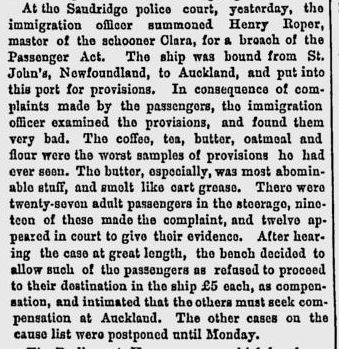

On 30 June 1865 they arrived safely at New Zealand.  Robert once again set up in business as a stove maker on Shortland Street, Auckland.  


Margaret died at Auckland in 1897 aged 75 and Robert died in 1908.  They are buried at the Purewa Cemetery in Auckland.
I wonder if the young poet, Margaret Sharp Ferguson Peace from Greenock ever imagined that her life with Robert Peace would involve emigrating not just once, but twice with a large family in tow, to make a brand new life on the other side of the world.  What a remarkable woman!

Thursday, 18 August 2016

Harry McNish, Port Glasgow Hero

There's a small island, off the coast of South Georgia in the Antarctic that's named after a Port Glasgow man.  It's McNish Island honouring Harry McNish (formerly written as McNeish) who was a carpenter on Shackleton's Imperial Trans Antarctic  Expedition of 1914-1916.


There is also a plaque in Port Glasgow Library in memory of this brave man who endured many hardships on that fateful expedition.

Harry McNish was born in Lyons Lane in Port Glasgow in 1874.  He joined Ernest  Shackleton's expedition as ship's carpenter (hence his nickname "Chippy") on board the Endurance - he was forty years old at the time.  The expedition aimed to be the first to cross the Antarctic.


The story of the Endurance is well known, but when the ship became trapped in pack ice, it was McNish who constructed huts for the crew.  Eventually after the loss of the ship Shackleton decided that the men would have to haul the three lifeboats across the ice.  McNish did not approve of this plan and made his disagreement clear.  However, after some time, with supplies running out, it was decided to wait for the ice to take them to open water.  When it did, ship's carpenter McNish prepared the three lifeboats for the next part of the hazardous journey to Elephant Island.  


McNish was in the small boat James Caird.  Eventually they reached South Georgia, unfortunately on the wrong side of the island.  Weak and ill, McNish and some others were left to camp in the upturned James Caird while Shackleton went on, overland to get help at the whaling station at Husvik.  Eventually McNish and the others were rescued.  You can read a much fuller account of the whole expedition here.  Without doubt McNish's skills as a carpenter were instrumental in the fact that so many of the men survived both on open sea and on land.


After his recovery McNish returned to the sea, eventually settling in New Zealand.  He died on 24 September 1930, destitute and relying on charity.  Although buried with full military honours, it was not until many years later that his grave in Karori Cemetery, Wellington was fully recognised by the New Zealand Antarctic Society.

Wednesday, 17 August 2016

Scotts shipbuilders of Greenock

Perhaps one of the most famous Scottish shipbuilding firms is Scott Lithgow which built many ships here in Greenock, employing a vast number of local workers.  This leaflet dates from the 70s.


John Scott first starting building ships in Greenock in 1711.  This fabulous sketch if of sloop-of-war Prince of Wales built in 1803 for the Royal Navy.


Scotts merged with Lithgows in 1970.  Many ships and submarines were built for the Royal Navy at their Cartsburn yard in Greenock.


The company ceased trading in 1993.


You can see some amazing photographs of the shipyard at Greenock's McLean Museum site here.

Tuesday, 16 August 2016

Royalist on the Clyde

The training ship TS Royalist was in the James Watt Dock Marina, Greenock at the weekend.


She was built in Spain in 2014 to replace a previous ship with the same name.  TS Royalist provides sailing experience for Sea Cadets - visit their site here.  There's lots of information about the ship.


These photos were taken as the ship sailed down the River Clyde.

Sunday, 14 August 2016

James Watt's Makeover

At long last Greenock's statue of James Watt has had a makeover!


The statue, situated on the corner of Dalrymple Street and William Street, was unveiled by Andrew Carnegie on 1st June 1908.


You can see that it was looking a bit stained and faded.  It is now a deep shade of brown.  I'm still getting used to the difference!


These sculptures are around the base of the statue's pedestal.


The strange looking device he is holding in his right hand is the Watt Indicator.


Here you can see the name of the sculptor - Henry Charles Fehr (1867-1940).  He produced another statue of Watt which is in Leeds.


Born in Greenock in 1736, James Watt was responsible for improvements to the steam engine and was a brilliant inventor and engineer.

Friday, 12 August 2016

Mineral Greenockite

In 1840 when the Glasgow, Paisley and Greenock railway line was being constructed a new mineral was discovered while a tunnel was being dug near Bishopton.  It was named Greenockite.


It is seemingly quite a rare mineral - a naturally occurring cadmium sulphide.  You can read more about its structure and analysis here.


Greenockite was named after Earl Charles Murray Cathcart, the then Lord Greenock (1783-1859) who became the second Earl Cathcart on the death of his father.  He had a passion for geology and minerology and was a fellow of the Royal Society of Edinburgh.  Cathcart had a distinguished military career and was Governor General of British North America.

Charles Murray Cathcart
Arthur Connell (1794-1863), Scottish chemist and mineralogist was responsible for describing and naming the mineral.

Thursday, 11 August 2016

Things to do in Inverclyde

Here in Inverclyde we are getting a lot of cruise ship visitors arrive at Greenock's Ocean Terminal.  It made me think what I would do if I only had one day to spend in the area.  Here's what I would advise visitors -


In no particular order -
Newark Castle in Port Glasgow is a must!  Cared for by Historic Scotland is a wonderful place to visit - there's so much to see.


McLean Museum & Art Gallery - fabulous exhibits showing a little of the area's fantastic history.


Gourock - a smashing wee town with some lovely shops selling a variety of great hand-crafted and unusual gifts.


Greenock Esplanade - take a gentle stroll along the Esplanade and enjoy the views across to the hills of Argyll.


These are just some of the great things to do in Inverclyde.

Thursday, 16 June 2016

Newport Glasgow

I wonder if the eagle-eyed among you noticed the coat of arms within Port Glasgow's coat of arms? It is on one of the ship's sails.  It is actually the coat of arms for the city of Glasgow and is a reference to the very beginning of the town of Port Glasgow's history.

Lamp post from outside Glasgow Cathedral


During Glasgow's great tobacco trading days, laden ships could not get up the River Clyde all the way to the city.  Goods had to be off-loaded at Greenock or Newark Bay (near where the castle stands) and then put onto smaller boats, lighters, to be transported up-river to Glasgow.  Fed up with this, in 1668, the Glasgow merchants got together and bought some land (18 acres) from the then Laird of Newark, Sir George Maxwell and created their own port originally called Newport Glasgow.  This was eventually shortened to Port Glasgow.  

Newark Castle, Port Glasgow
The port was run by Glasgow magistrates and merchants, so in effect was a little bit of Glasgow further down the Clyde.  Eventually the river was dredged so that bigger ships could get all the way to Glasgow. 


Glasgow's Coat of Arms is full of symbolism connected with the city's patron saint, Kentigern (also known as Mungo) and four of his miracles.  There's a little rhyme about it -

"There's the tree that never grew,
There's the bird that never flew,
There's the bell that never rang,
There's the fish that never swam.
Let Glasgow flourish by the preaching of the Word."

The tree that never grew - when Mungo was a boy he was once left in charge of the refectory fire.  Unfortunately he fell asleep and the fire went out.  When he woke up, Mungo broke off some frozen branches from a tree (originally a hazel), prayed over them and they burst into flames, thus relighting the fire. 
The bird that never flew - is a robin which was a favourite of Mungo's tutor, Saint Serf.  Some jealous boys killed it and Mungo brought it back to life. 
The bell that never rang - Mungo is supposed to have brought a bell, a present from the Pope back to Glasgow from Rome.  
The fish that never swam - a salmon with a ring in its mouth.  This comes from a legend of a Queen who gave a ring, which had been a gift from her husband, to her favourite knight.  Her husband, the jealous king, took it from the knight and threw it into the River Clyde.  The King demanded in front of the court that his wife produce the ring.  She of course could not.  But St Mungo asked one of his monks to bring him a fish from the river and there, in its mouth, was the ring!  Thus the Queen was saved from dishonour. 

Glasgow's motto now is - "Let Glasgow Flourish" which is the shorter form of the original motto "Let Glasgow flourish by the preaching of the Word" which is supposed to have been said by St Mungo.


So, two coats of arms for the price of one!


Wednesday, 15 June 2016

Port Glasgow's coat of arms

Here's a great picture of Port Glasgow's coat of arms from the present Town Hall building.


The Latin inscription reads - 
Ter et Quarter anno Revisens Aequor Atlanticum Impune
which means - 
  Three and four times a year revisiting the Atlantic with impunity.


This is a reference to Port Glasgow's trans-Atlantic timber trade with North America. A lot of timber was needed for the shipyards in the town. The town lamp post can be seen outside the Library and it also shows the town's coat of arms.

Port Glasgow's coat of arms can also be seen in the decorated pediment above the Library.


Crossing the Atlantic with impunity - a proud boast for a very proud town.


Monday, 13 June 2016

Keeping in touch

If you enjoy reading posts about places and people in and around Greenock then you might want to receive future posts by The Greenockian by email.  Just look in the right hand column of this blog to the note that says "Follow by Email".  Enter your email address, hit the submit button, and all future posts will be sent to you automatically!  Simple!


Please don't hesitate to get in touch if you have any questions about the local area or are looking for information regarding local family history research.  You'll see my email address in the right column too.


I'm always happy to help ... if I can!

Sunday, 5 June 2016

St Elizabeth in stained glass

Here's another beautiful stained glass window from the church of St John the Evangelist, an Episcopal church in Greenock.


The window depicts Elizabeth, mother of John the Baptist.


The colours are just beautiful.


The church itself was built by Paley & Austin of Lancaster in Gothic Revival style and was completed in 1878.  It is situated at the corner of Union Street and Jamaica Street in Greenock.  You can see more beautiful stained glass from a previous post.


Joining InSPIRED Sunday - come and have a look at some more churches from around the world.

Thursday, 2 June 2016

The Port Glasgow Hoard

In the summer of 1699 a hoard of old coins and Viking silver was found somewhere in Port Glasgow.
  

The antiquarian Robert Wodrow wrote to William Nicolson in July 1699 from Glasgow -
"I have lately received accompt from Neuport Glasgow, about 18 miles from this, there have been descovred there by the falling doun of some earth a great deal  of old coins and other things that have (been) hid there."
Some of the hoard was acquired by antiquarian James Sutherland, botanist and antiquarian, who was a keen collector of early coins.  The coins were described as Saxon, the latest dated from the reign of the English King Edgar (943-975).   However no proper records were kept, so it is impossible to say what else may have been found.  From written descriptions of the coins, a deposit date of around the 970s has been given to the Port Glasgow hoard.


Sutherland's collection was purchased by the Faculty of Advocates in 1705 and in 1873 the collection was acquired by the National Museum.  It was impossible to tell which coins were from the Port Glasgow hoard, but a photograph of the arm rings, still in the National Museum in Edinburgh, can be seen here.  One is plain silver of a type known as Viking ringmoney - so called because as well as showing the wealth of the owner, it could easily be cut up and used to purchase items  The other is a more decorative arm ring made of three twisted strands of silver.

Dumbarton Rock
We'll never know who left the hoard there and why.  The River Clyde saw a fair bit of Viking activity.  In 870 the Vikings laid seige to Dumbarton Rock for four months before successfully taking the stronghold .  400 years later the Battle of Largs (1263) took place between the Vikings and the army of King Alexander III.  Perhaps it wasn't even a Viking who left it there, but someone who traded up and down the west coast of Britain.  The then king of Strathclyde Mael Coluim was known to have attended Edgar's court in the 970s, so perhaps it was one of his retinue who, for whatever reason, hid the riches.


No location apart from the name of the town given as to where the hoard was found, but extracts from the Records of the Burgh of Glasgow for 6 May 1699 show that some work was being done to the busy harbour at Port Glasgow could this be how it was unearthed?