Showing posts with label Cartsburn. Show all posts

Saturday, 9 March 2024

Crawfurd of Cartsburn window

This beautiful stained glass window is to be found in the Old West Kirk in Greenock.

It shows the arms of the Macknight Crawfurd family and the motto -  quod tibi hoc alteri  - nil durum volenti - "do to others as you would have them do to you nothing is hard for the willing".

The Old West Kirk had a laird's loft especially for the Crawfurd family and a vault where many of the family were buried.  You can read about some of the memorials to the Cartsburn family on a previous post here.  

This stone can be found in the wall of the Old West Kirk, Esplanade, Greenock marking the Crawfurd burial vault.

On wall of Old West Kirk, Greenock

The Crawfurd coat of arms from the original Cartsburn House in Greenock can now be seen at Lauriston Castle in Edinburgh.  The Castle was owned by Thomas Macknight Crawfurd (1820-1909).

At Lauriston Castle, Edinburgh


Thursday, 16 November 2023

Cartsdyke's problem piggeries

In 1857 doctors in Greenock were very concerned with public health and the unsanitary conditions arising from ordinary people keeping pigs in back courts of houses.  Stanners Street in Greenock's east end was one of the town's older streets and very overcrowded.  It ran from John Street north to Main Street where Hutcheson's Court stood (almost across from the shipyard entrance).  In 1856 the Nuisance Removal Act had been passed, and Greenock had its own Inspector of Nuisances - John Walsh.

Photo source Greenock Burns Club

The pig problem in this area was described:-

"It is a densely populated district, and within a court till recently wholly undrained, a yard of seventy feet by sixty, a congeries of piggeries, occupied by not fewer than forty swine, imbedded in stagnant ordure, emitting foul and offensive smells, which the tenants of the neighbouring houses declare to be so abominable that they dare not open their windows which look into the yard, and which the medical gentlemen employed to inspect the place pronounce to be prejudicial to the public health.  It appears from another witness, the proprietor of the premises, that the place had been, for a great number of years, occupied as a piggery; and we are therefore not surprised to find, on the unimpeachable testimony of DrWallace, that the street had, during epidemics, produced a greater number of fever patients, in proportion To its size, than any other street in the town.  Fifty-three cases of typhus fever were admitted into the Infirmary in 1847-1848 from the Stanners; and last year there were nine cases.  So recently as the month of January last, Dr Wallace was called to attend a case of typhus fever in Hutcheson’s Court, which looks into the piggery yard."

John Walsh reported:- "On the 11th December the pig-houses were in a very filthy condition, the pigs were very badly bedded; and in some of them, being lower than the general area of the court, the filth was allowed outside, along the front of another property into a cesspool in Main Street.  I took Dr Wallace down with me to inspect the premises and he gave me a certificate.  I saw the premises upon the 3rd February, when I served the complaint.  The houses were in the same state, but a small drain had been made on one side of the court, but it was not acting.  There was a foul and offensive small in the court at that time.  I was frequently at the place last summer, the smell was More offensive in warm weather.  I was there again on Thursday, Friday and Saturday.  There appeared to be a quantity of clean sawdust put into the pig-houses.  I examined them in presence of Dr Marshall.  The houses had a quantity of ordure and filth under sawdust.  I served each of the defenders, on the 18th January with notice to remove the swine."  

The pigs were not removed and the case was taken to court.  On the first day of proceedings in February 1858, Daniel Macfarlane, one of the proprietors of land in the area announced that he would represent the 14 people accused of keeping piggeries in Cartsdyke.  they were  – Murdoch Robertson, Thomas Beith, Hannah McNeill, Hugh McConnell, Janet McFeat, Malcolm McKechnie, George Croiley, Helen Barr, Susan McGlaughlan, Elizabeth McBride, Mary Lyons, Michael McAnulty, John Gray and James Brown.  Many of the men were at work and were represented by their wives in court. He was informed by the sheriff that he needed to either speak just for himself or be represented by a lawyer.

Macfarlane explained that he was not receiving payment because most of the others were too poor to pay for legal representation.  The Sheriff replied that if the others could not afford to employ an agent he would appoint one for them.  Macfarlane was not permitted to address the court.  However, when the others were called to plead Macfarlane seemed to be advising them on what to say and occasionally made remarks to the court.  Many said that they were widows and had no other means of making a livelihood than keeping a pig and without that they would be unable to pay rent or taxes and would have to go on the poor roll.  Eventually the Sheriff who, as the local newspaper reported:-

 “had shown great forbearance during the “scene”, at length said, Now, Sir, listen to me; I have never known the dignity of this court assailed in such a manner as it has been by you.  There is a power vested in me to protect the court against contempt.  That power is imprisonment.  Take care; don’t force me to use it”.

Macfarlane replied “I am here to represent these poor people; I know my rights, I am neither a child nor an interloper”.  The Sheriff again warned Macfarlane to be silent and appointed lawyer Andrew Boag as agent for the others.  

In his statement to the court Macfarlane stated:-  "I reside in Glasgow.  I have known the pig yard behind Stanners for 40 years.  I am a proprietor in the neighbourhood.  My property is about 100 yards from the spot.  I never heard any complaints from parties in the neighbourhood but rather the reverse.  The opinion was that both the keeping and eating of pigs fortified against disease.  I inspected the piggeries in this locality several months ago.  I saw them again today.  The yard is in a very proper state.  I have rarely seen a place of the kind in so good a condition.  The pig houses are very clean indeed many people are lying in worse beds here and elsewhere.  The pigs are confined to proper beds and houses.  I felt no smell, beyond what is usual among cattle ... The value of the pigs in the neighbourhood is about £2000."

Photo source Greenock Burns Club

The Sheriff decided that the pigs should be removed from the area, but gave the defendants three weeks to find a better place in which to keep them.  James Brown who lived in Stanners Street and was the proprietor of the ground was to pay three quarters of the cost and the other defendants the rest.

Photo source Watt Institution

Stanners Street - in the book "Greenock Place Names" by Sandra Macdougall and Joy Monteith, the name of the street is said to be from the fact that the official inspection of weights and measures was made from a shed in this street - Standards Street became Stanners Street.

Saturday, 8 April 2023

A succession of Crawfurds

As this memorial tablet shows, sometimes the laws of succession of lands and titles can be a bit tricky to work out.  The tablet has a prominent place in the former Old West Kirk on the Esplanade in Greenock, which houses the Crawfurd family vault.  The Crawfurds owned the lands of Cartsburn or Crawfurdsburn in the east end of Greenock. 

The tablet reads:- Here are deposited the remains of THOMAS CRAWFURD of Cartsburn who departed this life 3rd February 1743 in the 81st year of his age.  Also Ann, his daughter and Margaret Semple his fourth wife. Also Archibald Crawfurd of Cartsburn who departed this life 13th January 1783 in the 74th year of his age and Margaret Cunningham, his spouse who departed this life 23rd August 1787. And Thomas Crawfurd of Cartsburn their son, who departed this life 24 September 1791 In the 46th year of his age.  This monument was erected to their Memory by Christian Crawfurd of Cartsburn, Daughter to the first, and Aunt to the last mentioned Thomas Crawfurd 1792.

The Thomas Crawfurd (1662-1743) named on the memorial is the second of Cartsburn. He succeeded his father in 1695.  (Read about the first Crawfurd of Cartsburn here.)  He was married four times.  First in 1682 - Rebecca Barns (1659-1694), the daughter of Provost John Barns of Glasgow who had business interests in Greenock.  They had a daughter Marion (1688-?) who married Patrick Hunter of Hunterston.  Second in 1695 - Bethia Robertson (daughter of Archibald Roberton of Bedlay), Third in 1717 - Beatrix Clark and fourth in 1729 - Margaret Semple (daughter of William Semple of Cathcart).

Thomas Crawfurd and Bethia Robertson had the following children - (a) Thomas Crawfurd (d.1732).   He became and advocate and married Cecile Forbes (daughter of John Forbes of Knappernay).  Thomas died before his father and without issue.  (b) Archibald Crawfurd (1710-1783)- succeeded his father.  (c) Christian Crawfurd (1705-1796) - succeeded her nephew. 

Third of Cartsburn - Archibald Crawfurd (1710-1783) succeeded his father in 1743.  He married in 1739 - Margaret Cunninghame (daughter of John Cunningham of Caddel and Thorntoun, Ayr). They had one son, fourth of Cartsburn – Thomas Crawfurd (1746-1791) who succeeded his father in 1783 and died in 1791.  Read more about Thomas Crawfurd here.  He wrote to Scottish poet, Robert Burns, in 1788  inviting him to visit Cartsburn.  Thomas was unmarried and died without issue. 


Thomas was succeeded in 1791 by his aunt, fifth of Cartsburn - Christian Crawfurd (1705-1796), daughter of Thomas Crawfurd and Bethia Robertson.  She married Robert Arthur (d. 1779) in 1743 at Greenock.  Robert Arthur was a merchant from Irvine who had business dealings with George Moore of the Isle of Man (among others).  The couple had four children - Bethia (1744-), Thomas (1745-), William (1746-) and Christian (1749-).  Arthur Street in Greenock is named after this family.

At her death in 1796, her only surviving child was her daughter, Christian Arthur Crawfurd and that's where the story starts to get interesting!

Saturday, 18 March 2023

The first Crawfurd of Cartsburn

Thomas Crawfurd (1631-1695) was awarded the Barony of Cartsburn in 1669.  He was the second son of Cornelius Crawfurd of Jordanhill and Mary Lockhart.  

He lived in Glasgow and was  General Collector of Taxes for Renfrewshire during the time of Oliver Cromwell.  He managed to keep this office under Charles II.

Thomas Crawfurd also served in the Renfrewshire militia at this time when there was a lot of political and religious unrest in Scotland.  One of the more interesting adventures of the militia involved Archibald Campbell, 9th Earl of Argyll (1629-1685).  The Earl had led an uprising to overthrow James VII because of his Catholicism.  After many adventures he was captured at Inchinnan and taken to Renfrew by members of the militia including Crawfurd.  Argyll was executed at Edinburgh in 1685.  


In the car park of the Normandy Hotel (Inchinnan Road) are the Argyll Stones which are said to be the place where Argyll was captured by the Renfrewshire militia.  The stones are fenced off and have other interesting stories attached to them in connection with St Conval.

It was reported that Argyll had a particular regard for Thomas Crawfurd and presented him with a silver snuff-box.  He was quoted as saying “Thomas, it has pleased Providence to frown on my attempt, but remember, I tell you, err long, One shall take up this quarrel whose shoes I am not worthy to carry, who will not miscarry in his undertaking”.  The snuff box was kept in the family for many years.

Thomas Crawfurd (1st) of Cartsburn (1631-1695) married firstly, Jean Maxwell (daughter of John Maxwell of Auldhouse, merchant burgess of Glasgow).  This marriage produced two daughters - Marion Crawfurd who married William Walkinshaw of Scotstoun, and Mary Crawfurd who married Alexander Yuill of Dalreith (Bonhill, Dunbartonshire).

Secondly he married Joan Semple (daughter of Andrew Semple of Milnbank).  This marriage produced - (not in order)- Thomas Crawfurd (who would succeed his father), George Crawfurd - destined for the church, but became a historian, Hugh (Hew) Crawfurd of Woodside near Paisley who married Jean Maxwell, daughter of Zacharias Maxwell of Blawarthill (Glasgow), Margaret Crawfurd who married John Forbes of Knapperny, Bethia Crawfurd who married John Leslie of Newlands and Jean Crawfurd who married James Schaw.

Thomas Crawfurd was the first of Cartsburn and his family would go on to play a vital part in the interesting history of Greenock.

Thursday, 2 February 2023

Crawfurd of Cartsburn - the beginning

 The lands of Cartsburn are situated at the eastern end of Greenock on the south bank of the River Clyde in Scotland.

The area known as Cartsburn was erected into a barony by King Charles II by a charter in favour of Thomas Crawfurd in 1669.  This gave the Crawfurd family the right to hold markets and fairs as well as giving the Crawfurds judicial powers in the area.  The Crawfurds built a home there - Cartsburn House.

Cartsburn House was the home or Mansion House of the Crawfurd family for many generations.  It was once surrounded by gardens and parkland and would have had beautiful views over the River Clyde.

The Barony of Cartsburn was bound on the east by a line from what is now Border Street north to the River Clyde at the James Watt Dock Marina (formerly Garvel Estate).  On the west, the line of the Carts Burn marked the limit of the Crawfurd lands, separating them from the land belonging to the Shaw family.  The Shaw family had also acquired the lands of Easter Greenock from an earlier member of the Crawfurd family so that in effect Cartsburn was a separate area surrounded by Greenock. 

The area was also known as Crawfursdyke and was at one time important because it contained a sheltered bay and “dyke” or quay where boats could tie up.  Fishing, especially herring, played an important part in the area’s economy in the 18th century.


The area was described by George Crawfurd in “A general description of the shire of Renfrew” -

“A quarter of a mile west from the Castle of Easter Greenock, at the east end of a large bay, stands the town of Crawfurdsdike, built of one street, with a convenient harbour, capable to contain ships of a considerable burden.  It was erected into a Burgh of Barony, with the privilege of a weekly market and several fairs, in favours of Thomas Crawfurd of Cartsburn, by a Charter from King Charles II, dated the 16th of July 1669.  The town is chiefly inhabited by seamen and mechanicks.”

Cartsburn later became part of Greenock and the land was bought up for industrial purposes, especially those connected with shipbuilding and engineering.  Those industries having gone, the land is being put to other uses.

See also - An Invitation to Cartsburn House    The Cartsburn Thumbscrews    Kennedy's Mill


Wednesday, 14 September 2022

The Cartsburn thumbscrews

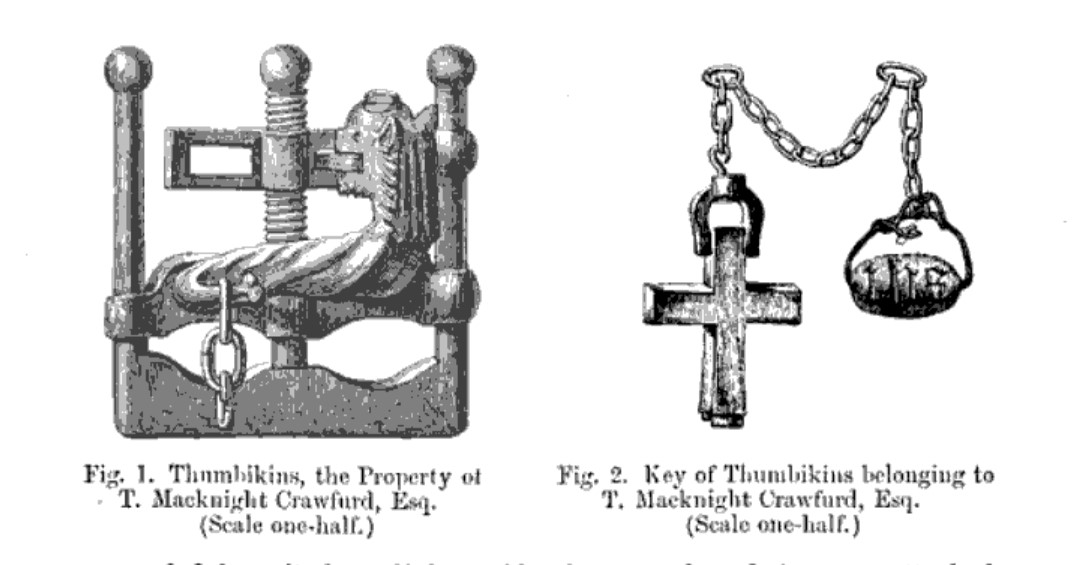
This unusual artifact once belonged to the Crawfurd family of Cartsburn.  It is a set of thumbscrews - an instrument of torture - ironically with a cross as part of the key.  Thumbscrews were also called thumbikins.

They were described in the Journal of the Society of Antiquaries of Scotland in 1890 who note that they "do not look like they have been used much". The unusual aspect of the thumbscrews is the key which is in the form of a cross which is attached by a chain to an egg-shaped pendant of ivory on which is engraved ihs - the monogram for the name of Jesus.  The Journal also states that "the ironwork does not appear to be of Scottish origin.  The introduction of the cross and the sacred initials might be said also to imply that it had been fabricated for ecclesiastical purposes."

It is doubtful that thumbscrews were used by the Crawfurd family.  They were supposedly given to a member of the family by a "Romish priest" in 1771.  Thomas Crawfurd (1746-1791), 4th Baron Cartsburn had travelled widely in Europe and these were probably acquired by him on his travels.  They were presented to the McLean Museum (Watt Institution) by Thomas McKnight Crawfurd.

However, there was another curious object collected by Crawfurd with the thumbscrews - a belt of penance.  This is in the care of the National Museums Scotland.  It is a belt made of iron links with small hooks or spikes attached.  It would have been worn around the waist and used as a form of penance.  Copyright prevents me from showing a picture of the belt but you can see the object here.

I'm sure these two objects were great talking points when in the hands of the Crawfurd family.  I wonder what Robert Burns would have made of them if he had accepted Thomas Crawfurd's invitation to Cartsburn House!

Sunday, 28 August 2022

An invitation to Cartsburn House

In March 1788, Thomas Crawfurd (1746-1791) wrote to the poet Robert Burns inviting him to come and stay with him for a few days at Cartsburn House in Greenock.  It is a wonderful, evocative invitation -

Cartsburn, 16th March 1788

My dear Sir – For congeniality of mind entitles me to the freedom of this appellation, and never did I use it with more cordial sincerity – through the medium of our mutual friend Brown I hazard inviting you to the participation of an agreeable rural retirement at a convenient distance from a town where there are many of your admirers (but, indeed, it is not distinguished from that by any town in Great Britain); a library I hope not ill chosen; a cellar not ill stored; a hearty cock of a landlord, whom his perhaps too partial friends regard as destitute neither of taste nor letters.  He has reached his eighth lustre untrammelled by the matrimonial chain; and having neither wife nor child to disturb his tranquillity or divide his affections, he can offer you a whole heart.  Halt!  This is going too far; he is not so forlorn a wretch as to be without a friend; but this does not hinder his having a very warm place in that same heart (for though the fellow’s person be little his heart is large) most cordially at your services!  How do you like the bill of fare?  Not amiss, provided it be not a vapouring sign to a wretched ale-house.  Good wine needs no “bush”.  Well-come (I must pun) and welcome; and I hope you will find it deficient neither in spirit nor flavour; but this sage reflection of yours prevents my proceeding to raise your expectations too high.  This much I will, however, in justice to myself, add, namely, that if you should be disappointed, I shall be much more so.  Shall I then be blessed with your society?  Answer me, my dear boy!

But I forget myself; you are no classic – no Latin one, I mean, though certainly to be classed (allow me a jingle) among the first Caledonian classics.  Tell me where you are.  God knows I would gladly come for you in person; but as this is not in my power, will you allow me to send a servant and a horse for you!  Do, my dear Burns, and bless me with your assent. – Your hearty friend,  T. Crawfurd.

Unfortunately Robert Burns did not visit Cartsburn House, Greenock - there were too many other things requiring his attention at the time.  Burns wrote to his friend Richard Brown (alluded to by Crawfurd in the invitation) in March 1788 commenting "I have to thank you for the ingenious, friendly and elegant epistle from your friend Mr Crawfurd.  I shall certainly write to him, but not now." 

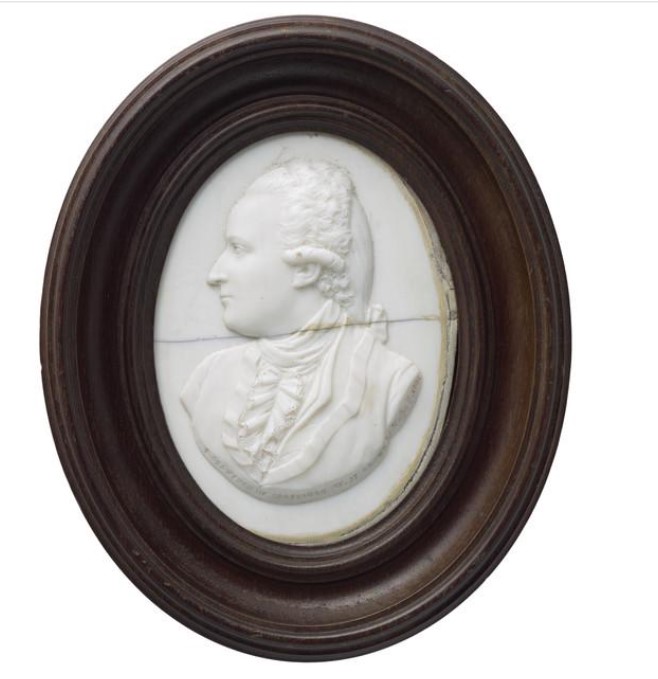
Thomas Crawfurd of Cartsburn
Source - National Galleries of Scotland

Thomas Crawfurd was the fourth Baron Cartsburn having succeeded his father in 1783.  Cartsburn at that time was not joined with Greenock, but was classed as a separate area.  The family home was Cartsburn House in (what is now) the east end of Greenock (just west of the present St Lawrence Street) Street).  At the time of this letter it was surrounded by fields and gardens.  Thomas Crawfurd was a well educated and well travelled man.  As his letter states, he was unmarried and had no children.  He even offered to send a servant and a horse to convey the poet to Cartsburn.

Certainly I think most people would have found this invitation difficult to turn down.  Cartsburn House sounds like a very convivial place to visit.