Showing posts with label poet. Show all posts

Wednesday, 30 July 2025

Galt and Graham at the Makars' Court, Edinburgh

One of the first things you will see on entering Lady Stairs' Close leading off the Royal Mile in Edinburgh is this paving slab commemorating Greenock's own writer John Galt.

The words on the slab read - "birr and smeddum" John Galt (1779-1839).  

Birr and smeddum are Scottish words often used by Galt in his writing.  Birr usually means energy or enthusiasm and smeddum can mean strength.

The courtyard called Makars' Court (makar is the Scots word for poet or author) contains many other slabs commemorating Scottish writers and among them was one for the poet William Sydney Graham - another Greenockian.

The words on the slab read - W. S. Graham 1918-1986 
"What is the language using us for?"

The quote is the title of one of Graham's poems published in the book "Implements in Their Places" (1977).  (Read the full poem and a review here.)  You can read more about W S Graham and Greenock on The Greenockian Blog here (there's more in this blog - just use the search box at the top right of this post).

The Writers' Museum faces the courtyard and has fabulous exhibits of the life and works of Robert Burns, Sir Walter Scott and Robert Louis Stevenson.  I asked if there was a display with information about John Galt and was told - no!  Very disappointing!  However the Museum is well worth a visit.


Friday, 7 March 2025

The Sailor Poet

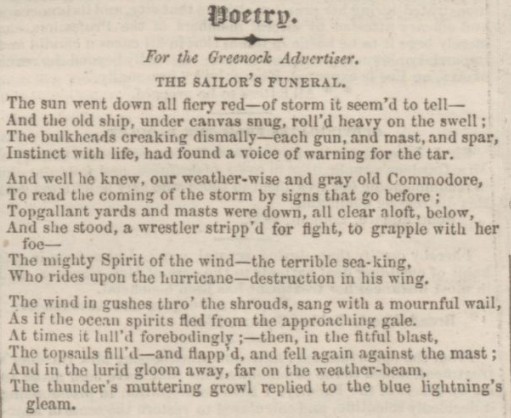
Robert L Malone worked as a clerk in the long-room in Greenock Custom House.  He was also a poet.  Before settling in Greenock, Malone had been a naval officer and many of his poems reflect his experiences in that sphere.

Robert Lamont Malone was born in Anstruther, Fife in 1811.  His parents were William Malone and Elizabeth Lamont.  The family had lived for a while in Rothesay before moving to Anstruther.  His father was a naval officer and later a customs official.  


Following his father's example, he entered the navy in 1826 serving on HMS Rattlesnake and HMS Pelican in the Mediterranean and South America.  However, due to ill health he left the navy and began writing poetry.

He moved to Greenock with his sisters Mary Ann and Amelia and became a clerk with HM Customs working in the Long Room at Greenock Custom House. 

In 1845 he issued a volume of poetry entitled The Sailor's Dream and Other Poems which achieved some success.  Some of his poems were published in the Greenock Advertiser.  

Several of his songs were published in Whistle Binkie, an anthology of Scottish poem and song published from 1832 until 1890, David Robertson of Glasgow was its first publisher.  Many of his poems reflect his love of Scotland like this verse from The Thistle of Scotland -

Far lovelier flowers glow, the woodlands adorning,
And breathing perfume over woodland and lea;
But there breathes not a bud on the freshness of morning,
Like the thistle - the thistle of Scotland for me.

Robert L Malone died at 3 Hamilton Street, Greenock on 6 July 1850.  After his death Greenockian Colin RaeBrown wrote a poem In Memory of Robert L Malone which was published in the The Glasgow Courier on  6 August 1850.


Sunday, 22 September 2024

The Lovely Lass of Inverkip

 The "Lovely Lass of Inverkip" is a poem by the "Radical Poet", Alexander Rodger (1784-1846).


Alexander Rodger was born in East Calder, Midlothian and worked as a weaver and music teacher in Bridgeton, Glasgow.  In 1819 he was editor of the radical newspaper The Spirit of the Union and was imprisoned because of his writings.  A collection of his poems in the Scots dialect was published in 1821.   Here's "The Lovely Lass of Inverkip".

O'er Cowal hills the sinking sun
Was bidding Clutha's vale guid-day,
And from his gorgeous golden throne,
Was shedding evening's mildest ray,
As round the Cloch I bent my way,
With buoyant heart and bounding skip,
To meet my lass, at gloaming grey,
Amang the shaws of Inverkip.
 
We met- and what an eve of bliss!
A richer, sweeter, neve flew,
With mutual vow, with melting kiss,
And ardent throb of bosoms true:-
The bees, ;mid flowers of freshest hue,
Would cease their honeyed sweets to sip,
If they her soft sweet lips but knew -
The lovely lass of Inverkip.
 
Her ebon locks, her hazel eye,
Her placid brow, so fair and meek,
Her artless smile, her balmy sigh,
Her bonnie, blushing, modest cheek -
All these a stainless mind bespeak,
As pure as is the lily's tip;
Then, O, may sorrow's breath so bleak
Ne'er blight my Bud of Inverkip.

Rodger worked at Barrowfield Printworks and then became a writer on the Glasgow Chronicle and later the Reformer's Gazette.  In 1832 his work appeared in Whistle Binkie, a collection of poems by various authors.  He was known as the "Radical Poet". 

Read more about Inverkip here.

Thursday, 6 June 2024

The Soldier's Return

These words from the poem “The Soldier's Return" by Scottish poet, Robert Burns is a fitting tribute to acknowledge the 80th anniversary of the D-Day landings of 6 June 1944.  Part of the poem is quoted on a little artefact which is on display in the Greenock Burns Club's Exhibition and Archive Room in the Custom House, Greenock. 

For gold the merchant ploughs the main,
The farmer ploughs the manor;
But glory is the sodger's prize,
The sodger's wealth is honor:
The brave poor sodger ne'er despise,
Nor count him as a stranger;
Remember he's his country's stay,
In day and hour of danger.

Source - The Soldier's Return

This poem tells the story of a soldier returning from abroad and looking for the girl he loved.  It also pays homage to those of his colleagues who did not return and those family members left behind:-

When wild war's deadly blast was blawn,
And gentle peace returning,
Wi' mony a sweet babe fatherless,
And mony a widow mourning;
I left the lines and tented field,
Where lang I'd been a lodger,
My humble knapsack a' my wealth,
A poor and honest sodger.

The legend on the wooden plaque in the Greenock Burns Club Exhibition and Archive room reads –

Made of Wood From
Burns’s Trysting-Thorn
Mill Mannoch, Near Coylton
“At length I reached the bonnie glen,
Where early life I sported
I pass’d the mill and trysting-thorn
Where Nancy aft I courted.”

A trysting thorn is a meeting place, usually romantic beside a tree.  The wood here comes from the trysting thorn tree (hawthorn) at the Mill of Mannoch in Coylton in Ayrshire where Burns had romantic meetings.  The actual tree died and the wooden artefact at Greenock was probably made from the wood of that original tree.  There are many similar pieces of Burns' trysting thorn around the world.   A sapling for the original was planted in its place and is now protected.  It can still be seen today.  

The poem has a happy ending when the returning soldier meets the lover he left behind and she still has feelings for him.  You can read the whole poem below -

When wild war's deadly blast was blown,
   And gentle Peace returning,
Wi' mony a sweet babe fatherless,
   And mony a widow mourning,
I left the lines and tented field,
   Where lang I'd been a lodger;
My humble knapsack a' my wealth,
   A poor and honest sodger.
 
A leal light heart beat in my breast,
   My hands unstain'd wi' plunder;
For fair Scotia hame again,
   I cheery on did wander.
I thought upon the banks o' Coil,
   I thought upon my Nancy;
I thought upon the witching smile,
   That caught my youthful fancy.
 
At length I reach'd the bonnie glen,
   Where early life I sported;
I pass'd the mill and trysting thorn,
   Where Nancy aft I courted.
Wha spied I but my ain dear maid,
   Down by her mother's dwelling?
And turn'd me round to hide the flood
That in my een was swelling!
 
Wi' alter'd voice, quoth I, Sweet Lass,
   Sweet as yon hawthorn's blossom,
O! happy, happy may he be,
   That's dearest to thy bosom!
My purse is light, I've far to gang,
   And fain wad be thy lodger,
I've served my king and country lang:
   Tak' pity on a sodger.
 
Sae wistfully she gazed on me,
   And lovelier was than ever;
Quote she, A sodger ance I lo'ed,
   Forget him shall I never.
Our humble cot and hamely fare,
   Ye freely shall partake o't;
That gallant badge, the dear cockade,
   Ye're welcome for the sake o't.
 
She gazed - she redden'd like a rose -
   Syne pale as ony lily;
She sank within my arms and cried,
   Art thou my ain dear Willie?
By Him, who made yon son and sky,
   By whom true love's regarded,
I am the man! and thus may still
   True lovers be rewarded.
 
The wars are o'er, and I'm come hame,
   And find thee still true-hearted;
Though poor in gear, we're rich in love,
   And mair we'se ne'er be parted.
Quoth she, My grandsire left me gowd
   A mailin' plenish'd fairly;
Then come, my faithful sodger lad,
   Thou'rt welcome to it dearly!
 
For gold the merchant ploughs the main,
   The farmer ploughs the manor;
But glory is the sodger's prize,
   The sodger's wealth is honour.
The brave poor sodger ne'er despise,
   Nor count him as a stranger:
Remember he's his country's stay,
   In day and hour o' danger.

Check out this short video - 


Remember D-Day 80 - 
Commemorating the heroes of the Battle of Normandy.

Monday, 17 July 2023

Allan Park Paton - remarkable Greenockian

Allan Park Paton was born in Greenock in 1818.  His father was John Paton,  a writer (lawyer) in Greenock and his mother was Margaret Park.  The family lived at East Blackhall Street. 

Allan had (at least) three brothers -

Robert Paton (1827-1869) - mariner.

Rev John Allan Hunter Paton (1831-1911) - minister at Duddingston.

James Fraser Paton (1832-1864) - doctor who died of typhus during an epidemic in Greenock.

His sister Mary Weir Paton (1830-) lived with her brother John at Duddingston.


Their father died in 1835 and their mother a few years later when the children were still very young.

In his youth Allan Park Paton travelled widely.  He studied law and had an office in Rue End Street, Greenock - he was also Land Factor for the Toward Estate, Dunoon.


In 1845 he published a book of poems which included "To My Native River".  Another poem about the local area was "The Road Round By Kennedy's Mill".   He published a second collection of poems in 1848.   He would later publish a novel entitled "The Web of Life".  He also wrote various pamphlets on literary subjects and was editor of the Hamnet edition of Shakespeare (Hamnet was the name of one of Shakespeare's sons).


In 1852 he was secretary of a bazaar which was held to raise funds for additions to the Watt Library.  In 1866 the Museum was added to the Library building.

Watt Library, Union Street, Greenock

In 1868 he became librarian at the Watt Library, a position he held until the end of 1894.  "During the period that he acted as librarian he did much to foster an appreciation of good literature in the community, and enriched the archives of the library with many interesting letters and autographs of men famous in the world of politics, literature, science and art". He corresponded with many of the great names in art and literature.


He lived in a house at the corner of Margaret Street and Brougham Street "Pmalder Cottage" (red lamp backwards).  The red lamp, a navigation aid once stood on the Esplanade at the corner of Margaret Street.


He was instrumental in raising money for the 
Galt Fountain on the Esplanade, just in front of his home.

He was greatly interested in the restoration of the Old West Kirk and was responsible for sourcing the beautiful stained glass windows from artists of the Pre-Raphaelite Brotherhood.


Burne-Jones window in the Old West Kirk


In 1864 aged 46 he married 24 year old Annabella Rodger, daughter of Alexander Rodger and Eliza Buchanan of Bagatelle, Eldon Street, Greenock.  Annabella was the granddaughter of Walter Washington Buchanan more information here.)  The couple had two children, James Fraser Paton born in 1865 and Ida born in 1866.  Annabella died at Bagatelle in June 1870 shortly after giving birth to a still-born son.  After her death, Allan lived with his two children near the Library on Union Street.  He continued working there until he retired in 1894 aged 76.  His son James Fraser Paton (1865-1928) was an artist and his daughter Ida (1866-1943) was a poet and artist.


Home Cottage, Esplanade, Greenock

Allan Park Paton died in 1905 at Home Cottage, Roseneath Street, Esplanade, Greenock and is buried in Greenock Cemetery.


Greenock Cemetery - the grave of Annabella Rodger and Allan Park Paton

It is impossible to quantify what this great man did in the interests of the literary and artistic heritage of Greenock.


Friday, 14 July 2023

Poetry panels - Cathcart Street

On 18 December 1909 a badly decomposed body was found floating in the sea off Mousehole, Cornwall.  Brought to shore, it was identified as being the remains of poet John Davidson.  He had disappeared from his home in Penzance in March of 1909. 

John Davidson was born in Barrhead in 1857 and his family moved to Greenock when he was just five years old.  His father, Alexander Davidson was a minister in Nelson Street Evangelical Union Church.  John was educated at Highlanders Academy and became a pupil-teacher there.  He worked for a while in the laboratory at Walker’s sugar refinery.  Later he moved to London.


Sculpture of Ginger the Horse, Cathcart Street, Greenock.

John Davidson was a poet and a writer.  The poetic lines on the panels come from his work A Ballad in Blank Verse on the Making of a Poet written in 1894.  The poem deals mainly with a son’s attitude towards the religious beliefs and expectations of his parents.  These lines from the poem, referencing the River Clyde, can be found etched on panels at the piazza at the east end of Cathcart Street in Greenock, behind the sculpture of Ginger the Horse.

His father’s house looked out across a firth
Broad-bosomed like a mere, beside a town
Far in the North where Time could take his ease,
And Change hold holiday; where Old and new
Weltered upon the border of the world. 

Now may my life beat out upon this shore
A prouder music than the winds and waves
Can compass in their haughtiest moods.  I need
No world more spacious than the region here:
The foam-embroidered firth, a purple path.
...

This old grey town, this firth, the further strand
Spangled with hamlets, and the wooded steeps,
Whose rocky tops begind each other press,
Fantastically carved like antique helms
High-hung in heaven’s cloudy armoury,
Is world enough for me.  

For this was in the North, where Time stands still
And Change holds holiday, where Old and New
Welter upon the border of the world,
And savage faith works woe.

You can read the whole poem here.  There are other lines (not on panels) which I’m sure will strike a chord with any one who remembers the Greenock that was –

... this grey town
That pipes the morning up before the lark
With shrieking steam, and from a hundred stalks
Lacquers the sooty sky; where hammers clang
On iron hulls, and cranes in harbours creak
Rattle and swing, whole cargoes on their necks;
Where men sweat gold that others hoard or spend,
And lurk like vermin in their narrow streets: 

The last words rest with Davidson who wrote in a letter to a friend -

“Of all poets, I envy Homer, of whom nothing is known.  The lives of men of letters should never be written; only the lives of Caesar and Napoleon are worth writing.”

Thursday, 7 October 2021

Plaque to W S Graham, poet

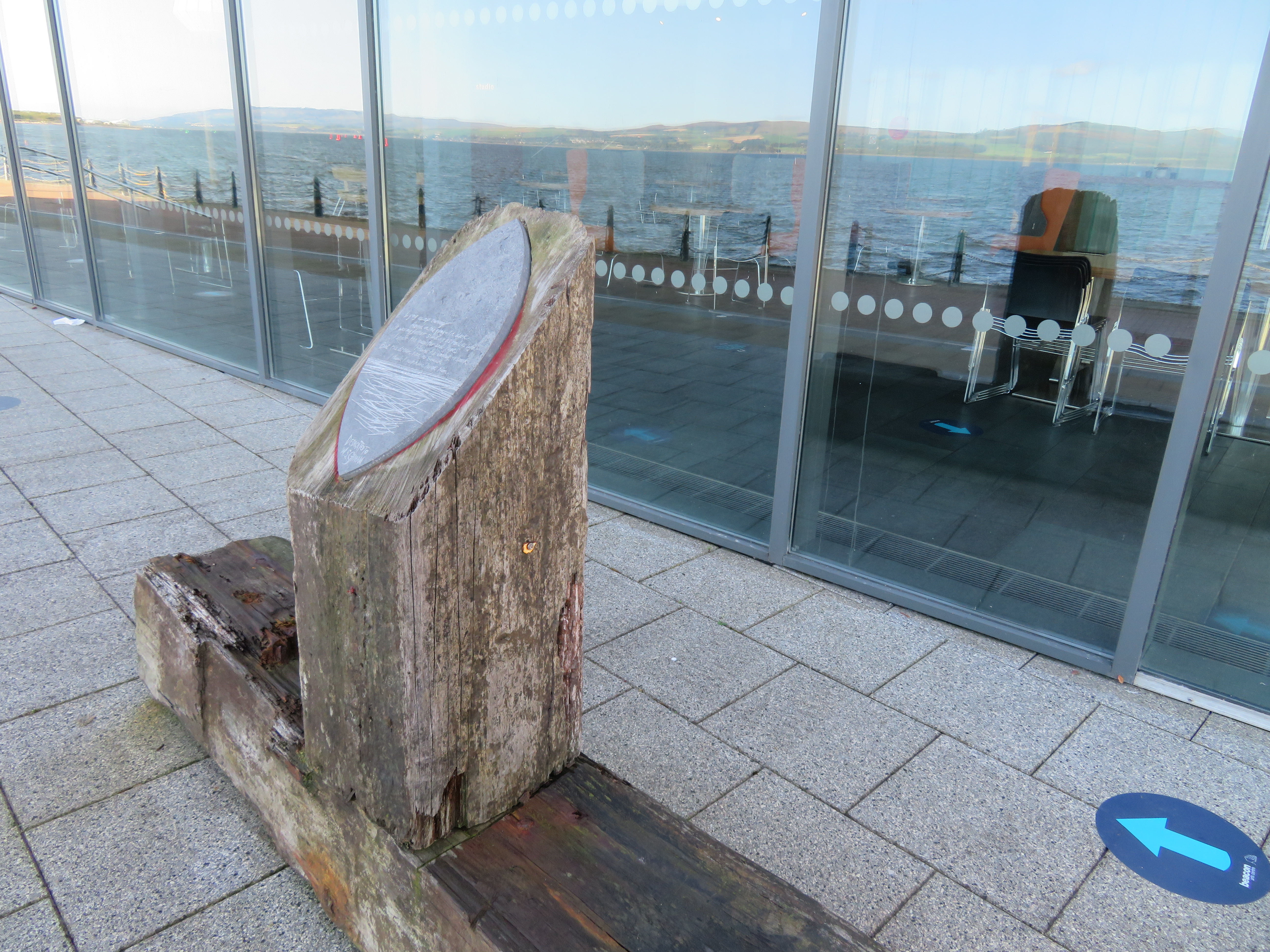
Greenock poet William Sydney Graham (1918-1986) is commemorated down at Greenock's Customhouse Quay with this lovely plaque.  It can be seen right beside the Beacon Theatre.  It has a quote from one of his poems etched into it.

I've already written about the plaque on the wall of his former home in Hope Street Greenock.  You can read about it here.

Plaque on wall of house 1 Hope Street, Greenock.

River Clyde reflected in the glass wall of Beacon Theatre, Greenock

He often mentioned Greenock and the surrounding area in his poems and you can read more on my blog post from 2017 - Greenock Poet's Plaque.

Greenock's former Custom House in background.

The Greenockian can be found on Facebook, Instagram and YouTube.

Friday, 9 November 2018

Achilles in the trenches


The poetry of those who fought and died in the Great War is quite special.  Usually it is the same works that we hear year after year.  Recently I came across a poem written by a man with links to this area - Patrick Shaw-Stewart.  


The poem itself is a reflection of his classical education as well as a  reminder that many of the battles of World War I were fought in places which had seen much conflict in antiquity.  The poem is called 'Stand in the Trench, Achilles' and was written at Gallipoli.

I saw a man this morning
     Who did not wish to die
I ask, and cannot answer,
     If otherwise wish I.

Fair broke the day this morning
     Against the Dardanelles ;
The breeze blew soft, the morn's cheeks
     Were cold as cold sea-shells

But other shells are waiting
     Across the Aegean sea,
Shrapnel and high explosive,
     Shells and hells for me.

O hell of ships and cities,
     Hell of men like me,
Fatal second Helen,
     Why must I follow thee ?

Achilles came to Troyland
     And I to Chersonese :
He turned from wrath to battle,
     And I from three days' peace.

Was it so hard, Achilles,
     So very hard to die ?
Thou knewest and I know not-
     So much the happier I.

I will go back this morning
     From Imbros over the sea ;
Stand in the trench, Achilles,
     Flame-capped, and shout for me.

Patrick Shaw-Stewart died in battle in France in December 1917 aged just 29.  This is how he met his death -
             "It was in the early morning, about dawn; he was going round his line; the Germans put up a barrage.  The gunner pressed him to send up the S.O.S. rocket, but Patrick refused, and maintained that it was only a minor raid on another part of the line, and that if he sent up the S.O.S. signal the people would only think he was "windy".  As a matter of fact, they did make a big attack about an hour later, and his battalion was the only one that did not give ground.
He was hit by shrapnel, the lobe of his ear was cut off and his face spattered so that the blood ran down from his forehead and blinded him for a bit.  The gunner tried to make him go back to Battalion H.Q. to be dressed, but he refused, and insisted on completing his round.  Very soon afterwards, a shell burst on the parapet, and a fragment hit him upwards through the mouth and killed him instantaneously."

Patrick Shaw Stewart was the great-grandson of Sir Michael Shaw Stewart (5th Bart) of Ardgowan and Blackhall.  Sir Michael's son, John Shaw Shaw-Stewart married Jane Stewart Heron Maxwell and their son John Heron Maxwell Shaw-Stewart (1831-1906) was Patrick's father.  His mother was Mary Catherine Bedingfield Collyer who died in 1909.  Patrick's older brother, Basil survived the war.

Patrick seems to have had a keen intellect and had the typical education of an upper class boy of his era - Eton followed by Balliol College at Oxford where he graduated with a First in Greats.  He joined Barings Bank and became a managing director before the age of twenty-five.   From the beginning of 1914 until just before the start of the war he was in America and Canada on business with the Bank.  On his return he became an interpreter for the Naval Division in Dunkirk.  He was a member of Hood's Battalion.

His biographer was Robert Arburthnott Knox whom he had known since he was young and with whom he corresponded throughout the war.

Source
Knox, Robert Arburthnott, Patrick Shaw Stewart, Collins 1920

Saturday, 25 March 2017

Greenock Poet's Plaque

As a Greenockian I am ashamed to admit that until today I had never heard of the Greenock born poet William Sydney Graham.  It wasn't until I had downloaded my photograph of this plaque that I did a bit of research to find out who he was.  The plaque is attached to the wall of 1 Hope Street in Greenock where Graham was born in November 1918.


According to most of the writings about him, he is was of the most underrated poets of the 20th century.  After studying engineering in Glasgow he had several jobs around the country.  In 1947 Graham travelled in the United States and later lived for a while in London.  However Madron, Cornwall was his home where he mixed with the St Ives artistic community.


He married Agnes Kilpatrick (Nessie) Dunsmuir (1909 - 1999) in 1954, the couple had known each other since 1938 when they met at Newbattle Abbey College, Nessie also wrote poetry.  His best known book "The Nightfishing" was published in 1955.  William Sydney Graham died in 1986.  More information about the poet can be found at the Scottish Poetry Library website.  You will also find some of his work there,  However, of the ones I've read, this really stood out for me, it moved me to tears.  It is called "To Alexander Graham" -

"Lying asleep walking
Last night I met my father
Who seemed pleased to see me.
He wanted to speak.  I saw
His mouth saying something
But the dream had no sound.

We were surrounded by
Laid-up paddle steamers
In The Old Quay in Greenock.
I smelt the tar and the ropes...."

You can read the remainder of the poem here.  Another of his poems "Loch Thom", in which he remembers outings from his childhood, is also worth a read.

Monday, 27 February 2017

The poem that left John Galt speechless!

Even in the latter days of his life which he spent in ill health at his sister's house in Westburn Street, Greenock, John Galt still showed a remarkable capacity for a good put down! 

The Renfrew poet, Andrew Park (1807-1863) had the audacity to write a poem about Galt "Answers to the Stanzas of the Celebrated John Galt on the Calamitous State of his Health" which commenced;

Thou may'st be helpless, sad, and lame,
On one lone seat compell'd to stay,
And muse on youth and dreams of fame,
And hopes and wishes all away.

The verses go on to let Galt know what he'll miss -

"Thou may not see the lark arise …",

and assure him that after he dies, his name will be remembered -

"But, Galt, thy name is not forgot!
Posterity shall hand it down …"
and finishes -
Then cheer thee, Galt - thy worth, thy name,
And merits, shall live after thee;
And echo, with the trump of fame,
Shall sound thy requiem o'er the sea.

Galt's stinging reply -
"Sir,
I have seen this morning your obliging, and, I presume to add, sympathetic verses, which are not the less acceptable in coming from an author personally unknown to me.
It has been very flattering to me to have received so much kindness, of late, from the public press; for a man who has suffered from nine attacks of a strange species of paralysis, who has thrice lost his speech and once his sight, and now moves in continual dread, is really an object of compassion, especially one who has been very active.
I am much better, as this testifies; for I could not sign my name at one time; and the improvement came on me as quickly as the disease.  Ten minutes before I wrote this I was almost speechless.
I am, Sir, yours, very truly,
John Galt"
John Galt
John Galt is often perceived of as a dour man, but humour flows through much of his work, especially in his wonderful characters.

But who was Andrew Park?  Paisley Museum and Art Gallery have a portrait of the poet.  Born in Renfrew in 1807, Andrew Park worked in a commission warehouse in Paisley before moving to Glasgow where he was employed as a hat salesman.  Business failing, he moved to London, but returned to Glasgow in 1841 where he became a successful bookseller.  He spent some time travelling in Egypt. You can read another example of his verse at the National Library of Scotland website.


Andrew Park's grave, Paisley Cemetery
He died in 1863 and was buried in Paisley Cemetery, over two hundred people followed his coffin to the grave.  It would appear that he was a very popular and convivial man.  


His obituary in the Glasgow Herald reads:-

"Death of Mr Andrew Park - Many amongst us will note, with much regret, the announcement of the death of Mr Andrew Park, who had attained local celebrity as an extensive poetical writer.  It is too much to expect that Mr Park will be remembered as a poet; but it is due to him to say that he produced some pieces in which pretty sentiments were worked out in pleasant lines.  He was a man of simple and inoffensive character, and his attractive social qualities and his fine musical voice rendered him a welcome guest at the social board."

John Galt was long dead by this time, but perhaps he would approved of the wording!

(Poem and letter reproduced in Fraser's Magazine, June 1835.)