Wednesday, 15 March 2023

Westburn Parish Church, Greenock

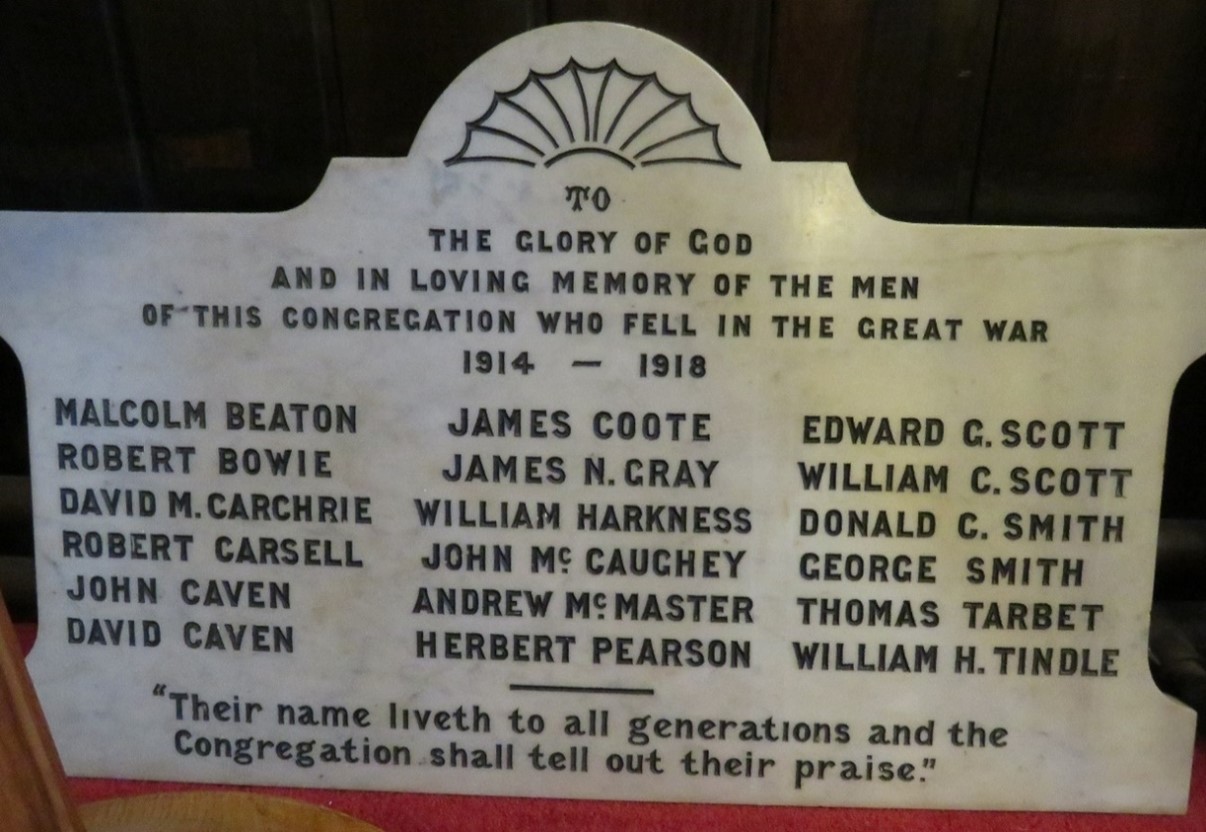
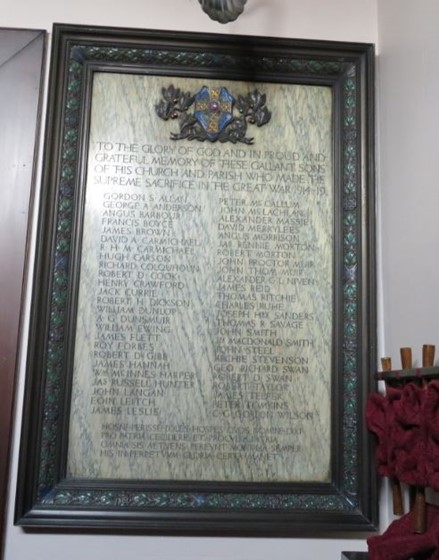
Westburn Parish Church can be found on Nelson Street in Greenock.  Built in 1841 it has a wonderful history.  Over the years many other congregations have joined this church often bringing much of their important pieces of church furniture with them.  As a result of this, Westburn has over 24 memorial plaques within the building.  Most of them in memory of those whose families belonged to the church and lost their lives in World War 1 (1914-1918) and World War II (1939-1945).  Perhaps your ancestors are among them.

Download the Westburn Parish Church History and Memorial Plaques document (click on highlighted text) and you will find an alphabetical list of all those names as well as a photograph of the plaque on which they are mentioned.

You will also find an interactive plan of the church showing exactly where each plaque is situated.  You might be able to find out more about your family history from the site Inverclyde's Great War (click on highlighted text) which has details of many of the locals who lost their lives in conflict.  Often there are photographs and family details of the various local service personnel who served their country.  

Westburn Parish Church is still used as a place of worship and therefore is open most Sundays (check their website for details),

Tuesday, 14 March 2023

Resources for Greenock family history research

I often get inquiries from people researching an Inverclyde connection in their family history.  Greenock, Gourock and Port Glasgow, as well as the villages of Inverkip and Kilmacolm were once part of Renfrewshire which makes things a wee bit confusing sometimes.  I've updated my Family History Research Leaflet because many of the links (especially those of Inverclyde Council) were no longer working or had been moved.


If you are interested in researching your family history, then here are a few online resources to get you started.  You can download my Family History Booklet here.  It contains more resources and information.

Inverclyde Council
Our local council have an incredible amount of online information available.
Check out the Inverclyde Council website.

Of specific interest is the Intimations section which contains all the birth, death, and marriage details which were posted in the local press from 1800-1918.

Another section contains Post Office Directories for the area from 1783-1912.  These list people, their occupations and addresses - a bit like a telephone directory.

Inverclyde Council have a huge collection of old photographs of the area which give an amazing insight into the old streets and living conditions of the area.

Inverclyde’s Great War - lots of information about local people who fought and died during World War I.  Some biographical details and photographs are included.

Old Local Maps
Greenock has seen many changes over the years and perhaps the street where your ancestor lived doesn’t appear on modern maps.  The National Library of Scotland has a site which has old town plans and maps for all of Scotland.

Modern Maps
Just type in the street and town and Google will find it for you and show you a map of the area.

Census Information
A good, free site for some census information for a lot of Britain (only certain years in some places) is FreeCen.  It has census information for Renfrewshire for 1841, 1851, 1861 and 1871.

Family Search
Run by the Church of Jesus Christ of Latter-Day Saints, Family Search contains lots of information of births and marriages in Renfrewshire.

Local News
Our local newspaper is the Greenock Telegraph.
Inverclyde Now also provides local information.

Hope this helps!

Thursday, 9 March 2023

A Wyllieum welcome to Greenock

Update - The Wyllieum art gallery in Greenock is now open.  

Check website for details of opening times.

Named after George Wyllie, artist who had a long association with the area.  You can see plans and more of how the building will look by clicking here on the Richard Murphy Architects site. The building is in Greenock's Waterfront area adjacent to the Waterfront Cinema.  Read more about Greenock Ocean Terminal by clicking on link.


The Wyllieum will welcome cruise passengers from all over the world here to Greenock and will be a great asset to the people of Greenock too.  There is going to be a restaurant on the upper floor which will have wonderful views of the River Clyde.  There will also be an exhibit of Wyllie's work.

You can see Wyllie's work - Caged Bird - in the grouds of the Watt Institution in Kelly Street in Greenock.


Wednesday, 8 March 2023

Rum, the Revenue and a rammy

Smuggling was part of everyday life in a port like Greenock in the early 18th century.  Local seafarers knew all the best places locally to land some of their cargo before having to declare the goods to the customs officials or Revenue.  This report of rum smuggling and revenge appeared in The Scots Magazine of 1776.

Ninian Scott was a shipmaster of Greenock.  He and his father owned the brigantine Bell which returned to the Clyde from a trip to Barbados with a cargo of rum.  At Cape Clear in Ireland and at Arran in the Clyde quantities of rum were smuggled from the ship.  As the vessel approached Greenock harbour, Alexander Thomson, Customs Officer at Greenock boarded and discovered that not all the cargo was present.  He placed some of his men on board so that no more of the cargo could be “disposed of”.  He then went off to chase the boats which had taken the rum to Arran managing to seize one of them. 

After consulting the Collector and Comptroller of Customs at Greenock, he seized Scott’s vessel, put his own men in charge of her and took her into Greenock harbour.  Some casks of rum which did not appear in the ship’s books were seized.  Scott “threatened vengeance against Thomson and his men and returned to his ship on 12 August and demanded that his ship be returned to him.  He was told that the Board of Customs would have to agree to this, he again threatened violence.  Thomson went ashore to report Scott’s behaviour at the Custom House.  Scott followed him and “struck him two blows on the head”.  One of Thomson’s men on coming to his defence was also attacked and this started a “rammy” between the Scott's friends and the customs officers.

Greenock harbour

The Board of Customs called in the Sheriff and Captain Scott was charged with the offences.  Scott retaliated by bringing an action against Thomson.

Scott did not appear at the trial, which proceeded in his absence.  During the trial it was discovered that Scott had also managed to “persuade” two material witnesses for Thomson not to appear.  A warrant was issued for the apprehension of Scott and the witnesses.  The witnesses had disappeared, but Scott was found and taken to the court.  He stated that he knew who the witnesses were and had walked down the street with them, but denied that he had spoken to them about the trial.  On further questioning he admitted that the had “carried away” the witnesses and bribed them to “conceal themselves until the trial was over”. 

Thomson and his men were acquitted and found entitled to expenses of £100.  Scott was committed, but later liberated on “finding caution” – paying expenses.

It would appear that Captain Thomson, the customs official was not a popular man.  A year later in 1777, a report in the Glasgow Journal states that he and his men were attempting to board a ship that was smuggling spirits.  The crew assaulted them with sticks and stones and one of the customs men fell overboard and died, another had a broken arm and bruised head the rest of the men gave up and returned to their ship.  The article ends “It is thought that the perpetrators will be brought to condign punishment”.

Just a couple of the many smuggling stories from Greenock.


Saturday, 18 February 2023

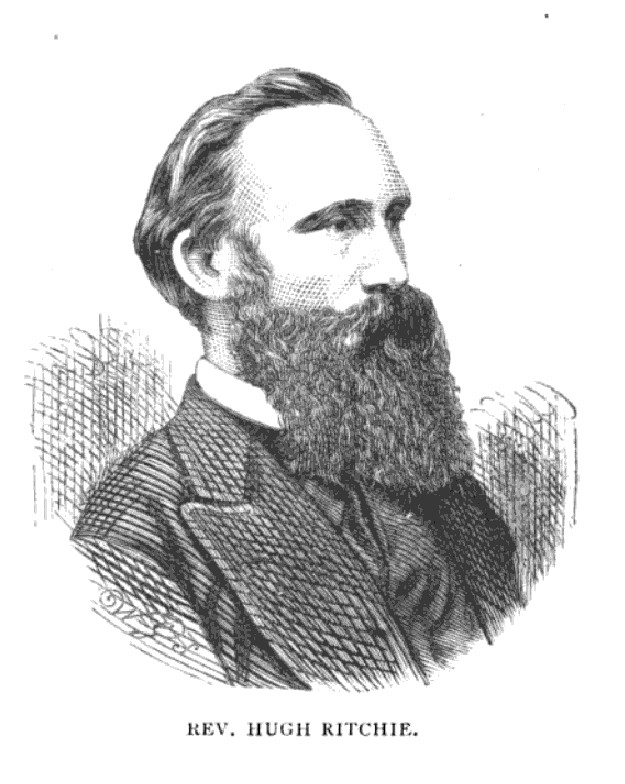
Hugh Ritchie - from Greenock to Formosa

Hugh Ritchie was born in Millport in 1841 (parents Robert Ritchie and Sarah Crawford) but was brought up by his aunt later moving to Greenock where he found work as a shop assistant.   However, deeply involved in St Thomas' Free Church, he became a teacher in the church's Mission School in the old church building in Dalrymple Street (later the Free North Church).  The 1861 Census shows him living at West Stewart Street with his sister, Sarah Ritchie. 

He was drawn to missionary work and through the Foreign Mission Committee of the English Presbyterian Church studied for the ministry at Glasgow and London.  He was licensed and ordained in 1867 and immediately set sail for his first post in Takao Formosa, now Taiwan.  Before leaving, Ritchie had married Eliza Caroline Cooke (1828), daughter of Lancelot Cooke, shipping merchant, Cape of Good Hope.

In Formosa Ritchie travelled and explored the area, writing of his experiences to friends back in Greenock.  Some of these reports were published in the local newspaper and various other publications.  Providing medical aid to the local people was also part of the mission overseas and he writes:-

"Day by day we were surrounded by scores of these poor people who wanted medicine - many of them wanted it badly ... I was well furnished with lotions for washing eyes and ulcers ... but when difficult or serious cases were presented, they were recommended to attend our hospital, as a passing visitor could do such cases no good." (From The Chinese Recorder & Missionary Journal 1875.)

Hugh Ritchie died in Formosa in 1879.  His young son Robert had died six years previously.  Both were buried in the Takow (Kaohsiung) Foreign Cemetery.

His widow Eliza Caroline Ritchie remained in the country greatly involved in the education of women, establishing a Girls School Her health was poor but she continued her work, eventually retiring in 1884.  She settled in Glasgow with her son, William Laughton Ritchie.  Eliza died in 1902 at the age of 73.

Lancelot Cooke, Eliza's father - an interesting article can be found here.

Monday, 13 February 2023

Tiger Dunlop and the Twelve Apostles

Dr William "Tiger" Dunlop (1792-1848) was born in Greenock.  His father was Alexander Dunlop of Keppoch (1766-1840) and his first wife Janet Graham.  William Dunlop led a fascinating life before finally setting up home near Goderich, Ontario, Canada.  He called his house Gairbraid after a family home in Glasgow.


The "twelve apostles" were twelve one gallon glass jars which belonged to Dunlop.  One can be seen at the Goderich Museum.  It is said that eleven of the jars were filled with whisky and the twelfth, which he called "Judas", filled with water!

When I visited, the wonderful museum at Goderich had a whole section dedicated to Tiger Dunlop showing his portrait and many exhibits from his home.


William Dunlop was with John Galt at the founding of the city of Guelph in Ontario.  

Sunday, 12 February 2023

MV Pentalina at Customhouse Quay

Customhouse Quay, Greenock had an interesting visitor earlier in the week - MV Pentalina.


Operated by Pentland Ferries, catamaran Pentalina used to sail between Gills Bay, Caithness (just west of John o' Groats) and Orkney.


Saturday, 11 February 2023

Mysteries at the McLean Museum - Model Aircraft

Another visit to the McLean Museum in Greenock (Watt Institution, Kelly Street) and another mystery object.  Obviously a model aircraft shoved in a display case with a variety of objects, none of which have any written sign or information as to what they might be or what their link to the local area is.


Of course I asked at the desk what the object was and its relevance to Greenock.  No one knew anything about it except that it had been put in the display case because it looked interesting!  What kind of aircraft is it?  Who made it?  Why was it donated to the museum?  No answers!


I've written before about the lack of information regarding objects on display at the McLean Museum.  Nothing has changed - many of the objects I have previously written about are still in cases without any written details.

No information in display case about these objects, but you can read about them here.

Whenever I go anywhere now I always visit local museums.  I thought perhaps that this lack of information was modern museum practice - but that does not seem to be the case in other places ... just Greenock.

It is very frustrating to be in such a wonderful building, surrounded by so many fascinating and interesting objects and not have a clue as to their significance to Inverclyde's wonderful history and heritage.

Friday, 10 February 2023

New Parish Church, Port Glasgow

The New Parish Church in Port Glasgow is proudly celebrating the 200th birthday of its present building.  (Formerly St Andrew's Church.)  However, the history of the church in Port Glasgow goes back even further - to the beginning of the town itself.  Having secured land from the Maxwells of Newark Castle to build a port, the magistrates of Glasgow then set about building up a town.  Of course, the moral state of the people who settled in this New Port for Glasgow had to be taken into consideration.

In June 1694 John Corse, Dean of Guild, Glasgow and John Anderson of Dowhill attended the Presbytery of Paisley to obtain authorisation for the Presbytery of Glasgow to supply the people of Port Glasgow with “preaching by some qualified young man … from time to time”, because Port Glasgow being a great distance from the parish church of Kilmacolm and the road being in a bad state of repair, many did not attend any form of worship and spent their Sundays in “idleness and debauchery”! It was decided that the Presbyteries would try to resolve the matter. 

It was arranged that George Lyon and six other feuers in Port Glasgow would guarantee the sum of fifty pounds as a yearly stipend for a minister as well as providing him with a house. They also agreed that the money acquired by putting seats in a meeting house to use as a church, and renting them would pay part of the minister’s stipend. 

In June 1696 the Commission for the Plantation of kirks granted permission for the building of a church at Newport Glasgow with the following conditions. The magistrates and town council (of Glasgow) would provide the minister and pay his stipend and that the parish of Kilmacolm would not have to pay anything towards the provision of a minister or any of his successors. The Commissioners for the Plantation of Kirks disjoined the parish of New Port Glasgow from Kilmacolm on 1 July 1696. Next the magistrates and town council of Glasgow called upon the minister at Killellan, James Hutcheson along with several members of the council to “do all other things needful and convenient anent the settling and establishing of an eldership and minister in the parish of Port Glasgow”. 

The feuers intimated their wish to call the Reverend Robert Millar as their minister. He was ordained minister of Port Glasgow in 1697. Many from Glasgow attended the ordination service. Worship services were held in the “meeting house” (also described as a sail loft) in the town and the Minister was provided with a dwelling paid for by the feuers of the town.  In 1709 the Presbytery of Paisley intimated that Robert Miller would be moving to the Abbey Church in Paisley.

It took some time to fill the vacancy at Port Glasgow, but eventually the magistrates and town council presented Thomas Davidson to be minister in the town. However the Earl of Glencairn who was patron for the church at Kilmacolm opposed Glasgow’s choice of minister and insisted that he should have a say in who was appointed. It was argued that Port Glasgow had been disjointed from Kilmacolm, but the matter dragged on, the Glasgow officials unwilling to enter into and expensive law suit with Glencairn. Negotiations took place at Findlayston between Glencairn and representatives of Glasgow. Glencairn eventually agreed that the matter should be decided by arbitration. Time dragged on and eventually after the payment of a fee, Glencairn renounced any interest in deciding who should be minister in Port Glasgow. 

The Reverend John Anderson was then nominated as minister for Port Glasgow and it was agreed that a church should be built in the town. Francis Stevenson, wright was appointed to go to Port Glasgow and inspect the ground where the church would be built, meet with the feuers and agree to the conditions for the building of a church. The feuers would provide half of the expense of the building with the town of Glasgow paying the other half. James Baird, mason of Govan was to be the architect and John Hunter, mason in Port Glasgow was to be the builder.  The church was cruciform in shape.

The original lairs in the  kirkyard wall can still be seen today.

Provision was also made for a church yard around the church which was to be subdivided into burial places which could be bought by feuers in the town. Two of the feuers John Lyon and James Cooper would be responsible for the building of “a regular stone dyke three ells high from the foundation” enclosing the kirkyard. It would have “pillars at every eight foot distance and put a bosom stone in the middle betwixt each pillar for distinguishing the burial places … which are to consist of eight foot in breadth and twelve foot in length”. The prices for the burial lairs were to cover the construction of the kirkyard. A loft, opposite the pulpit was to be built and furnished with seats for the magistrates and inhabitants of Glasgow, this extra expense to be met by the magistrates and town council of Glasgow. Another loft was built for use by the feuers of Port Glasgow.

The original church building was demolished in 1823 because a new, larger building was required for the growing town.  There was one big problem - the new church was to be rectangular in shape and would take up some of the churchyard that had been used as burial places.  The problem was overcome by building the new church on plinths so as not to disturb the graves below.  There are still graves under the present day building.

New Parish Church, Port Glasgow

Constructed in 1823, the present building is celebrating its 200th birthday and it is a credit to its congregation and the people of Port Glasgow who throughout the years have ensured that the kirk remains at the heart of the town.

Friday, 3 February 2023

The Pitcairn Girls of Greenock

The Pitcairn family came to Greenock when Andrew Pitcairn (1784-1873) was appointed to the Greenock Customs.  The family originated from Kintillo in Perthshire.  In 1811 Andrew Pitcairn married Anne Tait (1796-1877) at Ayr.  The couple had a large family including four daughters who all married into shipping families.  The family lived at Ann Street in Greenock.

Custom House, Greenock

Margaret Pitcairn (1819-1866) married Captain Thomas Henderson (1820-1895), a year later her sister, Jane Pitcairn (1817-1908) married  David Henderson (1817-1893), brother of Thomas.  Both marriages took place at Greenock.  Jane and David Henderson's son, David (1862-1921) had a distinguished army career and is recognised as instrumental in establishing the Royal Air Force (RAF).

Lieutenant General Sir David Henderson

The Henderson family originated in Pittenweem later moving to Glasgow.  Thomas and David were the sons of John Henderson, shipmaster and his wife Janet Shanks.  (There were two other brothers - John Henderson (1823-1892) and William Henderson (1826-1895).)  All the brothers became shipmasters like their father later becoming shipbuilders and ship owners.


David
and William Henderson founded D & W Henderson & Co, Shipbuilders at Meadowside Yard, Partick in Glasgow in the 1870s.  Thomas and John Henderson founded the Anchor Line of ships in Glasgow in 1855.  

Another sister Anne Pitcairn (1821-1896) married Greenock ship owner Robert Little (1815-1909).  The family lived at Finnart Cottage in Greenock and later moved to Thorndean, Helensburgh.  The Greenock firm of James Little & Co (ship owners and steam shipping agents) was started by Robert's father in 1812.  They managed steamers travelling between Greenock and Liverpool as well as steamers connecting with various railway routes.  Robert Little was responsible for the Barrow Steam Navigation Company running a passenger service between Barrow and Belfast.  He was also involved in shipbuilding worked with his brothers in law, David and Thomas Henderson.

Photo - Greenock Burns Club

Anne and Robert's son, Robert W Little (1854-1944) became an artist.  Another son, James William Little was a former mayor of Barrow in Furness.  A daughter Jessie Cecilia Brownlie Little married William Hamilton Kidston (1852-1929) of Helensburgh in 1878. 

Isabel Pitcairn (1831-1908) the youngest sister married (in 1857) Harrington Robley (1824-1895) a ship stores merchant of Helensburgh and Glasgow.  Their daughter Annie Pitcairn Robley married in 1891 Andrew Bonar Law, Prime Minister from 1922-1923.  Bonar Law was connnected to the Kidston family of Helensburgh.

The Pitcairn girls of Greenock certainly married well and all had families of their own.  It is interesting to think of all the connections these families had throughout Scotland and worldwide.

Thursday, 2 February 2023

Crawfurd of Cartsburn - the beginning

 The lands of Cartsburn are situated at the eastern end of Greenock on the south bank of the River Clyde in Scotland.

The area known as Cartsburn was erected into a barony by King Charles II by a charter in favour of Thomas Crawfurd in 1669.  This gave the Crawfurd family the right to hold markets and fairs as well as giving the Crawfurds judicial powers in the area.  The Crawfurds built a home there - Cartsburn House.

Cartsburn House was the home or Mansion House of the Crawfurd family for many generations.  It was once surrounded by gardens and parkland and would have had beautiful views over the River Clyde.

The Barony of Cartsburn was bound on the east by a line from what is now Border Street north to the River Clyde at the James Watt Dock Marina (formerly Garvel Estate).  On the west, the line of the Carts Burn marked the limit of the Crawfurd lands, separating them from the land belonging to the Shaw family.  The Shaw family had also acquired the lands of Easter Greenock from an earlier member of the Crawfurd family so that in effect Cartsburn was a separate area surrounded by Greenock. 

The area was also known as Crawfursdyke and was at one time important because it contained a sheltered bay and “dyke” or quay where boats could tie up.  Fishing, especially herring, played an important part in the area’s economy in the 18th century.


The area was described by George Crawfurd in “A general description of the shire of Renfrew” -

A quarter of a mile west from the Castle of Easter Greenock, at the east end of a large bay, stands the town of Crawfurdsdike, built of one street, with a convenient harbour, capable to contain ships of a considerable burden.  It was erected into a Burgh of Barony, with the privilege of a weekly market and several fairs, in favours of Thomas Crawfurd of Cartsburn, by a Charter from King Charles II, dated the 16th of July 1669.  The town is chiefly inhabited by seamen and mechanicks.”

Cartsburn later became part of Greenock and the land was bought up for industrial purposes, especially those connected with shipbuilding and engineering.  Those industries having gone, the land is being put to other uses.

See also - An Invitation to Cartsburn House    The Cartsburn Thumbscrews    Kennedy's Mill


Wednesday, 1 February 2023

Shipbuilders of Port Glasgow

This striking sculpture Shipbuilders of Port Glasgow is to be found in Coronation Park in Port Glasgow.  It was designed and built by sculptor John McKenna who is based in Ayrshire.

Thirty-three feet high, it dominates the skyline and is a tribute to the local people who worked in the area's shipyards.

Made of stainless steel it is lit up at night by colourful lighting.  The area around the sculpture has a pathway and has now been landscaped.  


There doesn't seem to be a plaque giving details of the work to anyone visiting the area, but you can read more about it on the Inverclyde Council website here.


Ironically the troubled ferry MV Glen Sannox can be seen behind the sculpture.