Saturday, 8 July 2023

Wood Notes Wild - Robert Burns' Seal

Within Greenock’s Custom House is the Exhibition and Archive of Greenock Burns Club, the oldest Burns Club in the world and often referred to as the Mother Club.  It is open in summer on Saturdays from 12 till 2 and when large cruise ships visit Greenock.  Check the Greenock Burns Club website for opening times.  Robert Burns (1759-1796) is Scotland's national poet.

This wooden plaque, on the north-east wall of the Burns Exhibition and Archive in the Custom House, Greenock, shows what appears on Robert Burns’ personal seal.  Robert Burns did not matriculate his arms with the Lord Lyon, but had a great interest in what should appear on his seal.

In March 1793 Robert Burns wrote to his friend Alexander Cunningham, a lawyer in Edinburgh who later went into business as a jeweller with an uncle: -

There is one commission that I must trouble you with.  I lately lost a valuable seal, a present from a departed friend, which vexes me much.

He then goes on to describe what he would like on the seal -

I have gotten one of your Highland pebbles, which I fancy would make a very decent one; and I want to cut my armorial bearing on it; will you be so obliging as enquire what will be the expense of such a business?  I do not know that my name is matriculated, as the heralds call it, at all; but I have invented arms for myself, so you know I shall be chief of the name; and, by courtesy of Scotland, will likewise be entitled to supporters.  These, however, I do not intend having on my seal.  I am a bit of a herald, and shall give you, secundum artem, my arms.  On a field, azure, a holly-bush, seeded, proper, in base; a shepherd’s pipe and crook, saltier-wise, also proper in chief.  On a wreath of the colours, a wood-lark perching a sprig of bay-tree, proper, for crest.  Two mottos; round the top of the crest, Wood notes wild; at the bottom of the shield, in the usual place, Better a wee bush than nae bield.  By the shepherd’s pipe and crook I do not mean the nonsense of painters of Arcadia, but a stock and horn, and a club, such as you see at the head of Allan Ramsay, in Allan’s quarto edition of the Gentle Shepherd.

The "Highland pebble" referred to by Burns was a topaz given to him by Maria Riddell (1772-1808) who, in a letter to Dr James Currie (biographer of Burns) on 6 December 1797 writes:-

The seal I mentioned and which you propose engraving in the title page (of his first edition of Burns’ work) I fancy Gilbert Burns or the widow will have got in their custody.  I gave Burns the stone, and we arranged the devise between us.  I do firmly believe in despite and violation of all rules of Heraldry; a holly bush with a shepherd’s pipe suspended, crest a wood-lark, with the motto from Milton’s Allegro, “native wood notes wild” – it is all appropriate enough, and you must not omit to give the Poet’s chosen blazon”.

Maria Riddell  Source

Burns obviously put a lot of thought into the symbolism of his seal.  "Wood notes wild", at the top is a quote from L'Allegro by John Milton (1608-1674) (lines 131-134):- Then to the well-trod stage anon, If Jonson’s learned sock be on.  Oh sweetest Shakespear, fancie’s childe.  Warble his native Wood-notes wilde.”  The phrase also invokes bird song and Burns used it to describe his wife, Jean Armour having read "a book of “Scot’s poems which she has perused very devoutly; and all the ballads in the country, as she has … the finest “wood note wild” I ever heard."


Just under the phrase wood notes wild is a woodlark - a beautiful songbird.  Burns wrote Address to the Woodlark in 1795.

The bird is standing on a sprig of bay.  Bay or bay laurel is an aromatic evergreen plant symbolising victory or triumph.  A laurel wreath worn by heroes in Greek mythology and associated with the god Apollo (god of poetry).  Interestingly the title poet laureate also derives from the laurel.

Under the bird is a shied bearing a shepherd's pipe and crook.  The shepherd’s pipe, or stock and horn, is described in great detail by Burns who managed to acquire one, part of which which is now in the National Museum of Scotland : -

have at last gotten one; but it is a very rude instrument.  It is composed of three parts – the stock, which is the hinder thigh bone of a sheep, such as you see in a mutton-ham; the horn, which is a common Highland cow’s horn, cut off at the smaller end until the aperture be large enough to admit the ‘stock’ to be pushed up through the horn, until it be held by the thicker end of hip-end of the thigh bone; and lastly, an oaten reed, exactly cut and notched like that which you see every shepherd boy have when the corn stems are green and full grown.  The reed is not made fast in the bone, but is held by the lips and Plays loose in the smaller end of the ‘stock’ while the ‘stock’ and horn, hanging on its larger end, is held by the hands in playing.  The ‘stock’ has six or seven ventiges on the upper side and one back-ventige, like the common flute.  This of mine was made by a man from the braes of Athole, and is exactly what the shepherds were wont to use in that country”.

Scottish poet Allan Ramsay (1684-1758) mentions the stock horn in his work The Gentle Shepherd published in 1725:- “When I begin to tune my stock and horn, Wi’ a’ her face she shaws a caulrife scorn,”.  Burns mentions Ramsay in his letter to Alexander Cunningham (see above).  Both the shepherd's pipe and crook are probably references to Burns' life on the land.

Under the shield is a holly bush.  In The Vision, Burns describes being visited by his native Muse, Coila, and describes her:-

Green, slender, leaf-clad holly-boughs
I took her for some Scottish Muse, By that same token:
An’ come to stop those reckless vows, would soon be broken.
Were twisted, graceful’, round her brows.

Later he describes her as addressing him:-

"All hail! my own inspired bard!
In me thy native Muse regard;
Nor longer mourn thy fate is hard, Thus poorly low;
I come to give thee such reward, As we bestow!

She then winds holly around his head:- 

"And wear thou this"-she solemn said,
And bound the holly round my head:
The polish'd leaves and berries red Did rustling play;
And, like a passing thought, she fled In light away.

Burns was very insistent that it be a depiction of a holly bush rather than a tree and that could be because of the final part of his seal - Better a wee bush than nae bield” – an expression meaning better a small bush than no shelter.  Quite an interesting choice of symbols for his arms.  

Burns did not matriculate his arms.  After his death the seal was used by his eldest son, Robert Burns (1786-1857). He worked at the Stamp Office in London. He married Ann Sherwood in 1809 and had a daughter Eliza (1812-1878) who went to India with her uncle, James Glencairn Burns (1794-1865).  In 1836 Eliza married Dr Bartholomew Jones Everitt (died 1840) of the East India Company at Bangalore and had a daughter Martha Burns Everitt (1839-1906) known as Patty.  The seal was left by Robert Burns to his daughter Eliza, who passed it to her daughter Martha.  In 1889 Martha Burns Everitt married Matthew Thomas and lived at Martinstown, Killinick, County Wexford.  In 1896 James B Morison of Greenock Burns Club wrote to Martha asking for an impression of the seal in wax, which she sent to the Club, beautifully mounted and with an inscription "to Greenock Burns Club with Mrs Burns Thomas's compliments, 2nd October 1896"


Martha Burns (Everitt) Thomas bequeathed the seal to her cousin.  In 1907 the seal was put up for sale at Christies where it was purchased for £200 by William Hamilton Dunlop of Doonside for Burns Museum Trustees.  Dunlop was Secretary of the Burns Monument.


The seal can now be seen at the Burns Birthplace Museum, Alloway. 

Friday, 30 June 2023

The James Watt Tower

In 1856 Greenock's Watt Club (founded in 1813) proposed the building of this beautiful campanile in Greenock Cemetery as a memorial to the brilliant engineer, Greenock born James Watt (1736-1819).

The idea was put forward by Greenock Watt Club members - historian George Williamson (1813-1899) and John Gray (1797-1867), a local councillor and merchant.  The Club met on the anniversary of Watt's birth, 30 January, usually in the Tontine Hotel.  The proposal, written by George Williamson was:- 

at first to erect on this spot a vast structure of a lofty and imposing appearance, to be seen from every part of the surrounding neighbourhood; and that all the nations of the world should be invited to contribute the materials; that those materials should be simply blocks of stone more or less unchiselled, of every shape and colour and size, granite or marble, freestone or whinstone, piled aloft, and fastened with cement; each block to be inscribed with the name of the donor and the place or country whence it came”.

James Watt

The tower was designed by Robert Macintosh, the architect of Gabriel Wood Mariners Home.  A site at the top of the main pathway in Greenock Cemetery had been obtained, levelled and cleared for the foundations.  Donations of rock had been received from all over the world.


The memorial tower would have been a magnificent structure, standing 514 feet above sea level at the highest point in the Cemetery and would have stood:-  "forty feet square at the base rising to a height of 163 feet.  Surmounted by a turret or observatory for the further height of 52 feet making the total height 225 feet above the base line."

The upper turret would have contained an electric time-ball and could have been used for making nautical and astronomical observations.  “To make the structure useful to all engaged in the navigation of the noble estuary of the Clyde".  The inside rooms were to be 30 feet square connected by means of a circular staircase and open gallery.  Niches and recesses would have contained "statues, busts or other memorials commemorative of men eminent in science or philosophy."

Gifts of materials from every quarter of the globe, inasmuch as there is no portion of the civilised world which is not indebted to the genius of Watt."

James Watt cairn in Greenock Cemetery

Unfortunately it was not to be probably due to lack of funds and declining interest in the project.  Donations of stone continued to be sent to Greenock and eventually it was decided that using them to build a cairn would be the best way of commemorating James Watt.  

Watt family gravestones moved from Old West Kirk

When the Old West Kirk was removed to Greenock Esplanade, the remains of Watt's family and their gravestones were re interred beside the cairn.  The Watt Tower would have been a wonderful memorial to James Watt.

For more information about the Watt Cairn and the donated stones please read my previous post here.

Monday, 19 June 2023

Albert Harbour and Esplanade - the beginning

At this time of year Greenock’s Esplanade is a busy place.  With its beautiful views over the River Clyde to the north and historically interesting buildings on its south side, it is a popular place for a stroll and is also well used by cyclists and joggers.  Robert Bruce Bell (1822-1883) was the engineer who designed this wonderful promenade.

Robert Bruce Bell was born in Edinburgh the eldest son in the large family of Robert Fitzroy Bell (1791-1862) merchant and Hanna Bruce.  He later moved to Glasgow where he served his apprenticeship as a civil engineer with Murdoch & Aitken he also worked at Lancefield Foundry and Engineering Works as a journeyman engineer under Robert Napier.  About 1850 He entered a partnership with Daniel Miller (1825-1888) under the name of Bell & Miller.  One of their works was the construction of a slip dock for Black of Kelvinhaugh.  In the 1850s they built graving dock in Glasgow for Tod & Macgregor at Meadowside

In the early 1860s they were commissioned by Greenock Harbour Trust to survey what led to the construction in 1862 of the Albert Harbour (now Greenock Ocean Terminal) and Esplanade.  The Esplanade, just over a mile long, was built up with the spoil from the Albert Harbour.  They also designed Princes Pier containing the railway link from Glasgow to the Harbour (Glasgow & South Western Railway Co).

The company also undertook harbour improvements at Port Glasgow and the Saltercroft Graving Dock in Glasgow.  Overseas they worked for Antonio Lopez & Co Spanish steamship owners.  They were also responsible for designing the Albert Bridge in Glasgow.

For two years Robert Bruce Bell was President of the Institution of Engineers and Shipbuilders in Scotland.  He died at Croyden in 1883.  Daniel Miller died at Craigburn (Cragburn?) House, Gourock in 1888.

It is fascinating to think of the work and effort that was involved in constructing the Esplanade, a beautiful asset to the town that has been enjoyed by generations.

Saturday, 17 June 2023

Walter Ritchie's privateer ship "Neptune"

In early May 1805 there must have been some great excitement in Greenock as a great French East Indiaman, the Charles Maurice, was brought into the harbour.   The ship had been captured by the Neptune, belonging to the fleet of local merchants Walter Ritchie & Co. 

At this time Britain was on the alert over the threat of invasion by Napoleon Bonaparte.  Ports were especially concerned, and Greenock was no exception.  Some of the larger merchant companies in the town fitted out at least one of their ships with guns and cannon.  This was to protect merchant vessels who started sailing in convoys, but there was also the profitable side-line in capturing enemy ships, the proceeds from the sale of both the ship and cargo could be massive.  


These privately owned armed vessels were called privateers.  Many carried letters of marque which was a licence from the Government to attack and capture enemy ships.  

The Charles Maurice, returning from the East Indies, had been heading for Bordeaux with a valuable cargo before she was taken by the Neptune and brought into Greenock.  She also carried a packet of letters from Admiral Charles Linois (1761-1848) to Count HonoreJoseph Antoin Ganteaume (1755-1818) and French Vice Admiral Louis-Alexandre Berthier (1753-1815) Napoleon’s Chief of Staff.  These were passed to the Admiralty.  

The ship and cargo were taken to London and sold.  The French ship's cargo of exotic goods from the East Indies included – raw sugar, coffee, bales of galanga root, indigo, cotton, cinnamon, raw silk, gum copal, gum Madagascar, gum Arabic, mace, cardamom, pepper, saffron, cloves, sago, tamarinds, palm oil, incense as well as other spices and confections.  These were put up for sale at West’s Warehouses, Billiter Lane, London.The ship was put up for sale at Lloyd’s Coffee House, Cornhill, London – at the time the centre of shipbroking and marine insurance business.  This was the precursor of Lloyds as it is still known today.  In the advertisement for the sale the “good ship” Charles Maurice is described as “square stern, figure head, copper sheathed, measures about 500 tons, lofty ‘tween decks, a very fast sailer, well found, pierced for 18 guns, has a tier of beams for an orlop deck is a very handsome and good vessel, with warlike appearance … It was also stated that she was thought to have previously been the American sloop of war Trumbull (sold by the Americans in 1801), “built for Government service about five years since.”  The ship could be viewed at London Dock, Wapping.

London Docks

While Walter Ritchie & Co of Greenock would have made a lot of money from this prize ship, there were occasions when their ships were taken by French and American privateers.  

Friday, 16 June 2023

Captain James George of the ship "Robust"

This is the final resting place of Port Glasgow mariner, Captain James George.  The family grave marker can be found in the kirkyard of Port Glasgow New Parish Church.  James George married Margaret Barr, daughter of John Barr, merchant in Port Glasgow in 1801.  They had two sons, James (born 1802) and John (born 1804) both born in Port Glasgow.  In 1805 the family were living in Ritchie's Land, Princes Street.

James George was captain of the ship Robust.  In 1799 the ship sailed to Grenada in the West Indies. 

In September 1801 there was an advertisement in the Caledonian Mercury which read:-

For Demerary
The Ship Herberts Wm Hamilton Master
Is expected in Clyde in a few weeks,
and will be ready to sail for Demerary a
running ship, by the 20th October.
For Carriacow & Grenada,
The Ship Margaret, Richard Brown Master.
For Grenada, (to deliver goods at Levira and
Grenville Bay)
The ship Robust, James George Master,
For St Vincent
,
The Ship Eglintoun, William Douglas Master,
These last three ships will be ready to sail by the 20th October, to join convoy at Cork.  For freight or passage apply to the respective Captains at Port Glasgow, or to
JOHN CAMPBELL, sen & CO, Glasgow, September 1 1801
N.B. Wanted to go to the West Indies, under Indentures for three years, Three House Carpenters, and two masons.  To those who can be well recommended good encouragement will be given.

John Campbell Senior & Co was a huge company trading with the West Indies and the owners of the ships mentioned in the advertisement.  Based in Glasgow, the company was founded by John Campbell senior (c.1735 - 1807) who had previously been connected with John Glassford & Co, tobacco merchants, after the American War of Independence they changed their priority to the importation of sugar.  John's brother, Thomas was a merchant in Grenada and ran that side of the business along with other family members.  

This advert is in connection with their West Indies trade.  Manufactured and luxury goods for the planters as well as cheap clothing and salt fish for the workers would be shipped from Port Glasgow.  The ships would load with rum, sugar, cotton, indigo and coffee for the return journey to the Clyde.  The Captains could be assigned to various ships in the fleet.

The ship Herberts, Captain William Hamilton is described as a 'running ship'.  This is an armed ship which could sail without a convoy but in this case accompanied a convoy of merchant ships as protection from privateers.


The ship Margaret, Captain Richard Brown (probably the son of Robert Burns' friend) was heading for Grenada and Carriacow (Carriacou), north-east of Grenada where cotton was grown and there were many Scottish settlers.  Captain George's ship, Robust was also going to Grenada, to deliver goods at Levera and Grenville Bay. The Eglingtoun, Captain William Douglas was heading for St Vincent.

An interesting footnote to the advertisement is the notice that three house carpenters and two masons are required in the West Indies under indenture for three years, with good references, of course.  Indentured servants undertook a written contract to work for a certain amount of time, the employer would pay their passage and they would be provided with food, clothing and shelter.  This could be seen by many young Scots as a way to a new life abroad, or for some a way to escape their responsibilities at home.  Of course, the journey itself was often hazardous and once they had arrived, the heat and exposure to different diseases could prove fatal.

It is remarkable that Captain James George survived many journeys from the Clyde to the Caribbean.  He was just one of Port Glasgow's many intrepid mariners.

Sunday, 11 June 2023

The Greenock Ripper!

Late on the 7th of March in 1903, a Saturday night, a woman made her way to Greenock Police Office in Dalrymple Street.  She was bleeding heavily and reported that she had been stabbed by a man while in a close in Dalrymple Street near an empty building.  Her name was Elizabeth (Lowden) O’Neill, forty-one years old and known to the police as a woman who frequented the shebeens and closes of that part of Greenock.  Her injuries, which the local press delicately described as being “to the lower part of her body” were severe, and she was rushed to Greenock Infirmary. 


Just an hour and a half later, at 1am, Bridget (Gordon) Baker appeared at the Police Office bleeding profusely, to report that she had been stabbed by a man in a close at 20 Vennel, just across from the side entrance of the public library.  She was 52 years old and also well known to the local police.  She had a seven-inch gash in her hip and had been cut by a knife.  She was also immediately rushed to the Infirmary to have her wound treated.

1. Dalrymple Street   2. Vennel   3. Public Library    4. Police Office

Both women described their attacker as between twenty and thirty years of age, tall and “respectably dressed”.  Needless to say, the attacks caused some commotion in the town with the attacks being likened to those attributed to “Jack the Ripper” in Whitechapel, London in the previous decade.  Just as in that case, no arrests were ever made in the “Greenock Ripper” case. 

Greenock Infirmary, Duncan Street

The women were discharged from the Infirmary a couple of weeks later having been successfully treated for their injuries.  One of the victims Bridget (Gordon) Baker was quite a character.  She had frequently been in trouble with the police and in 1877 had even been charged with theft of a petticoat from the local prison!  She died in the poorhouse at Smithston in 1911.  Elizabeth (Lowden) O’Neill was from Glasgow and seems to have left the town shortly after the assault. 

Greenock’s closes, or narrow lanes, which led down to the quays and harbours had a bad reputation and despite the recent improvements, there were still areas of the town that were known to be the haunt of prostitutes and crooks.  (Read more about Greenock's closes here.)  

@Greenock Burns Club

Interesting that the offences were carried out by someone described as "well dressed" and that they took place not in the heart of the Vennel, but on the edges, like Dalrymple Street and near the library (at Wallace Place).  Perhaps the perpetrator would have looked out of place in the deeper heart of the closes.  The young man could have been just passing through and perhaps left the town on one of the many ships that sailed the next morning.  Many places in Britain and abroad reported “copycat” assaults and murders in the wake of the sensational Whitechapel Murders.  Greenock was no exception!

Listen to the Greenock Ripper Podcast by the Greenockian.
Greenock Library, Wallace Place


Monday, 29 May 2023

Greenock Waterfront Walk

If you would like to take a short walk with lovely views and some interesting history then this Waterfront Walk is just right for you.  The circular route only takes about an hour and passes some of Greenock's more interesting buildings and sculptures.  You can download the fully interactive map and information here.

The route takes you from the new Greenock Ocean Terminal along the waterfront to the Beacon Arts Centre then up to Cathcart Street and along to Cathcart Square.  From there the route returns back to the Waterfront.

It would be ideal for cruise ship visitors who would like to find out a little about Greenock and its history and I've also provided travel information for buses and trains to Glasgow.

So, with the lovely weather we've been having recently, why not take the Waterfront Walk, stopping off at the Beacon Cafe & Bar for a cup of coffee or snack on the way.

All the information can be downloaded here.

Sunday, 28 May 2023

Dr Pentecost at Greenock

In 1889, Dr George Frederick Pentecost (1842-1920) of Brooklyn USA, was on a speaking tour of Britain.  He was a celebrated evangelist (couldn't have had a better name!) and colleague of Dwight L Moody.  His British tour attracted such attention that many Christians in Greenock wrote to him asking if he would conduct a mission in the town.  A notice appeared in the local newspaper.  

The meeting took place in the Pillar Hall of the Temperance Institute in Greenock, presided over by Rev Young.  Many local ministers and prominent Greenockians, including ex-Provosts Campbell and Lyle attended the meeting.


On Sunday 26 January 1890 the first meeting in Greenock took place in George Square Baptist Church where "he delivered an earnest address to Christian workers."  Later in the day he spoke at the West Parish Church followed by an evening talk in the Town Hall to an audience "which filled the spacious building in every part.  He was accompanied on the platform by ministers Robert Bell (East Congregational Church), David Boyd (Free North Church), Alexander Corbet (Orangefield Baptist Church), Peter Thomson (Crawfurdsburn Free Church) and John Young (Trinity United Presbyterian) as well several local “big-wigs”.

On Monday afternoon he was back in George Square and in the evening spoke at the Free Middle Church, again accompanied by a large number of local ministers and "prominent laymen".  A conference later in the evening was attended by about a hundred ministers and Christian workers. 

Dr Pentecost stayed in the town for a couple of weeks giving lectures in various churches, all very well attended, according to the local press.  On 18 February a notice appeared in the Greenock Telegraph advising that lectures were cancelled that day owing to Dr Pentecost's "indisposition".  There followed another two days of Bible readings and meetings before Dr Pentecost returned to America. 

Over the next few years he paid several visits to Britain and in 1892 accepted a call to Marylebone Presbyterian Church in London where he worked for five years.  After London he became minister of Yonkers Presbyterian Church in New York.  He was involved in foreign mission visiting India, China, Japan and the Philippines.  In 1914 he became minister of Bethany Presbyterian Church, Philadelphia.  He was the author of books on Bible Study.  Dr Pentecost had entered the ministry in 1862 but is seems that although his preaching time was short, he managed to reach many people all over the world.  He certainly had a big following in Greenock and spoke in many local venues attracting large crowds to hear his Christian words.  It seems appropriate to post this, as today is Pentecost Sunday (the seventh after Easter) in the Christian calendar.

Thursday, 25 May 2023

Alfred Lord Tennyson - the Greenock connection

Mary Tennyson, sister of Alfred Tennyson, married barrister Alan Ker who was born in Greenock in December 1819.

Alan Ker (1819-1885) was the eldest son of Robert Dow Kerr and Augusta Buchanan.  The Ker family of Greenock were merchants (Ker & Co) who traded and travelled all over the world.  Robert Dow Kerr and Augusta married in Greenock in 1819 and went on to have 15 children, all born in Greenock.  Ker Street in Greenock is named after this family.  The family lived at Finnart House.  Later the family moved to Clifton, Gloucestershire.

 Alan Ker attended the Grammar School in Greenock and later Glasgow University.  In 1838 he studied at the Middle Temple in London and in 1842 became a Barrister at Law.  He moved to Cheltenham, home of his brother Claudius Ker who was a doctor in the town.   It is here that he met the Tennyson family and in 1851 married Mary Tennyson.  After their marriage they moved to the West Indies where their son, Walter Charles Alan Ker was born in 1853 in Antigua.  Mary travelled back to Britain she was not particularly happy living abroad.  Walter received his education in Britain at Cheltenham College and Trinity College, Cambridge.  Read more about the Tennyson sisters here.

Alan Ker remained abroad.  From 1851 to 1854 he was Attorney General of Antigua before moving to Nevis where he was Chief Justice from 1854 to 1856.  From 1856 to 1861 he was Chief Justice of Dominica before becoming, in 1860, Puisne Judge of the Supreme Court until 1885.  He had retired from his position and was about to return to Britain when he became ill and died at Kingston, Jamaica in March 1885.  Mary Tennyson Ker died at Margate in 1884.

Their son, Walter Charles Alan Ker (1853-1929) was said to resemble the Tennysons in looks.  He became a barrister but spent his time translating and editing books.  He married in Julia Susan Christiana Holmes (1862-1900), daughter of Robert Holmes of Moycashel, Westmeath.  The couple had a daughter, Dorothy Mary Ker (1886-1965).  The family lived at Vicarage Gardens, Kensington, London.

A Kensington Mystery!     However all was not well in the Ker household.  On Boxing Day 1900 the body of Julia Susan Christiana Ker was found floating in the Thames.  She had been missing since 7 December.  

The body was found by John Harved, a picture frame maker of 30 Stowe Road, Shepherd’s Bush.  He stated that he had been standing talking to someone near Biffen’s Boat Yard at Hammersmith Bridge on Thursday morning about 9.30 when he noticed something floating down the river from the direction of “The Doves”.  He went down to the boat raft and rowed out into the stream catching the body on an oar as it swept past.  The body was then conveyed to the shore and the police were sent for.  When asked how the body was dressed he described a black dress and jacket with a fur boa round the neck and that she was wearing gloves.  When questioned whether the the dress was grey, he relied that it had been black but that “there was a lot of mud.”

PC Robert Sears 683 T stated that he had been called to the riverside at 10 o’clock on the Thursday morning when the body was brought ashore.  He called for Dr Musson and the body was removed to the mortuary.

One of Julia’s friends, Margaret Butterworth of 47 Camden House Road had known her for two or three years and had heard that she “suffered mentally” and described her as “a very delicate woman”.  She said that when Julia returned from Yorkshire she had remarked that she looked very well, to which Julia had replied “Yes, in my body.”  When asked about her home life, Margaret stated that - “ Her home life was very happy, and her husband was kindness itself to her.”  Margaret had last seen Julia on 21 November.

Walter Ker stated that his wife had been suffering from “hysterical delusions” or “aberration of mind”.  She had been admitted to a “home” in  Ilkley, Yorkshire which she had left on 17 November 1900 and returned to her home in Kensington.  Her doctor Sir John Williams had given a good report on her health and all had assumed she had completely recovered and she was in good physical health.  On 7 December Walter Ker returned home and was told by his niece who was living with, them that Julia had gone out and had not returned.  No one knew where she had gone.  When asked by the coroner if he had ever heard her threaten to take her own life he said that he had not, but he believed that she had told her sister who had not taken her seriously and indeed had laughed at her.

Kate New, a servant with the Kers said that she had seen her mistress go out about 4.30 in the afternoon but she had not said where she was going.  She was wearing a grey costume (suit) and seemed very well.  When asked by the coroner  if her mistress “seemed strange at times”, the woman replied “Oh, yes, sir.”

Dr W E C Musson of 61 Bridge Avenue described her clothing the same as Harved and stated that two old letters, a gold wedding ring and a purse containing £1 4sh 5d had been also been found with the body.  He had performed a post mortem examination and found no external signs of violence upon the body which had been in the water for at least two weeks.  He stated that “the brain was congested, but there was no water in the lungs.  The valves of the heart were affected and might cause sudden fainting at any time.  There was an abrasion on the right side of the head, caused just before or immediately after death, which, in his opinion, was due to asphyxia and shock from immersion.”

The coroner Mr H R Oswald said that there was no evidence to show how the deceased came into the water and the jury returned an open verdict.

Walter Ker and his daughter Dorothy Mary Ker (1886-1965) continued to live at Vicarage Gardens until his death in 1929.  He left the residue of the property in trust for his daughter, Dorothy, for life, with "the remainder to her issue as she may appoint, or failing appointment to her children equally or on failure of issue", then he directed the trustees to cause to be erected in the parish or other church at Greenock a tablet bearing the following or a similar inscription:-

Sacred to the memory of Alan Ker, the eldest son of Robert Dow Ker of Finnart in this burgh, who was successively Chief Justice of the Supreme Court of Jamaica from 1860-1884.  As a Judge he was distinguished for an inflexible firmness of principle and independence of character, as a man for his earnest solicitude for the welfare of his fellow-men, which was the guiding star of his life, and to which he sacrificed his private interest and his ease and comfort.  He was born on December 7th 1819 and died at Kingston, Jamaica, on March 20, 1885, being accorded the honour of a public funeral – R.I.P. The memory of the just is blessed.

Dorothy Mary Ker died in 1965.

Saturday, 6 May 2023

State of the Art

What a terrible state the lovely little art works down at the Waterfront area of Greenock are in!


This is "Ebb and Flow" which I described in my blog here.  The little seal has gone.  It had been broken and now it has completely gone.  The explanation about the mosiacs on the benches has also gone!  This area is not far from where cruise ships berth when they are visiting Greenock.  Here's a photograph of how it used to look.

The Yardmen, representing Greenock's shipbuilding heritage has been vandalised.  Now it is just a shadow of its former glory.  Here is a photograph of how it used to look.  See more photographs and read about it here.


How it looks now -


It must be very disappointing for the artists who put so much time and talent into producing these works for everyone - both locals and visitors - to enjoy.

Thursday, 4 May 2023

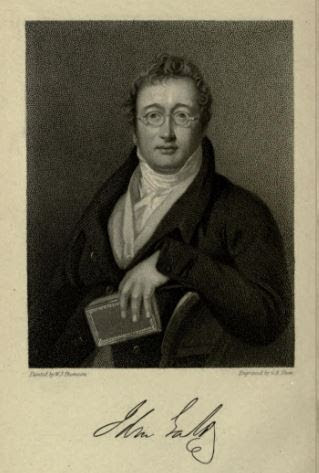
John Galt and the Coronation bunfight

John Galt (1779-1839) Greenock author, always raises a smile in his writing especially his characterisation and the pomp of ceremony which he readily and wryly describes.  Galt was actually in London at the time of the Coronation of George IV in July 1821 and gave a very down to earth account of the proceedings.   In his collection of stories -  “The Steamboat” - published by Blackwood in 1822, there is a short story entitled “Preparations for the Coronation” about a Scot, Mr Duffle, visiting London for the great event.  His opening sentence sets the tone of the work: - “London being, as is well known, a place of more considerable repute than Greenock, or even Port Glasgow …”!

Galt’s Mr Duffle describes his adventures in London and discussions with the various characters he meets during his visit for the Coronation of King George IV.  One conversation he has with “… a man in a suit of shabby black, of a clerical cut …” who gives his opinion - “The ceremony has survived the uses which gave it sanctity in the eyes of the people.  It will now pass like a pageant of the theatre, and be no longer impressive on its own account, but merely on account of the superior quantity of the silk and lace that may be shewn in the dresses.  Some things just don't change!

Mr Duffle takes his place in the grandstands to witness the arrival of the lords and ladies attending the King and then the arrival of King George IV himself “who entered with a marvellous fasherie, as I thought it, of formalities … for I could see he was now and then like to lose his temper at the stupidity of some of the attendants.  But it’s no new thing for kings to be ill served; and our Majesty might by this time, I think, have been used to the misfortune, considering what sort of men his minister are. 

After the ceremony, Galt goes to the balcony to view the banqueting hall.  Of the actual feast Galt writes of the dishes:- “… the King tasted but little of them; it was therefore supposed that he had got a refreshment behind the scenes”.  After the King and nobles leave, the general company were invited to come and enjoy the leftovers!  Or as Galt puts it:- “But the best part of the ploy was after his Majesty had retired,for, when he departed, everyone one, according to immemorial privilege, ran to plunder the table …” including Mr Duffle.  He  “was content with a piece of a most excellent bacon ham, and a cordial glass or two of claret wine, and a bit seed-cake.  The crowd seized not just the leftover food and drink, but ornaments and table decorations.

John Galt, Writer

In his later writing “Remarks on the Steamboat”, Galt reflects:- “If anything were calculated to inspire laughable contempt for the melodrama of earthly grandeur, it was the hurly-burly in Westminster Hall subsequent to the King’s departure.  I can neither repress my derision at the commotion, nor conceive why it was permitted, thought “the swinish multitude” were in court dresses.  But there is a stronger infection in folly than in wisdom, and, though I despised the pastime, I could not resist joining in the game.  In the plunder of the tables I got hold of a golden Britannia as big as a doll, with which I made proud a Bishop’s lady and gave to another “gorgeous dame” of high degree, a really beautiful basket of crystal, and bestowed gilded vessels on longing ladies.  But what added to the delight was the discovery that all the magnificence was as artificial as courtesies!  The goblets and imagery, the plates and epergnes, at the coronation festival of the greatest monarch on the earth, were gilded wood and pewter trenchers!  This, however was wise, and showed the improved intelligence, alias the political economy of the age; but wherefore cheat the eye?  At the time, the coronation afforded me inconceivable pleasure, for I could only see things, bating the occasion, worthy to provide heart-easing laughter; the remembrance, however, like many other sweets, sours in the rumination.  It did more to lessen my respect for the tricks of state than anything I ever witnessed."

John Galt had a wonderful eye for detailing the absurd and seeing through the conventions and characters of his day.  Throughout his description of the Coronation he constantly compares the proceedings and characters to those in King Crispin processions, very popular in his day.