The Greenockian
Friday, 30 May 2014
Friday, 23 May 2014
Infinity Reflected
Actually it is the reflection of the cruise ships Celebrity Infinity which visited
Greenock last week.
The
Greenockian
The photograph was taken just as she was berthing and the
men were out to attach the ropes. She is reflected in the entrance way to Greenock Ocean
Terminal.
Joining up with Weekend Reflections.
Thursday, 22 May 2014
Wartime Remains
It
is not just the town of Greenock that has an interesting history. The hills above the town are full of history
too. Up at Loch Thom are some
interesting wartime remains.
The engine is part of a Cheeta engine from an Avro Anson
trainer plane which crashed in the hills above Greenock on 26 July 1939. It had been taking part in a formation
exercise. One crew member died but the
pilot walked away unharmed. The second
engine can still be seen at the site of the crash.
Avro Ansons were designed for maritime reconnaissance. It had retractable landing gear that had to
be hand-cranked 160 times by the crew to unwind it!
A little piece of the past in Greenock's hilly hinterland.
The Greenockian
Wednesday, 21 May 2014
Municipal Sculptures
Here are some of the incredible sculptures from Greenock's
Municipal Buildings, which was completed in the 1880s.
Greenock's motto - God Speed Greenock.
These are on the front (south facade) of the building at
Clyde Square.
The Greenockian
Thursday, 15 May 2014
Greenock is back on the map!
The cruise ship season got underway on Monday with the
arrival of Thomson Spirit to
Greenock and yesterday's visitor was Mein Schiff.
Fortunately our local volunteers, Inverclyde Tourist Group,
have some wonderful maps to help visitors find their way around!
Lots more ships to come!
The Greenockian
Friday, 9 May 2014
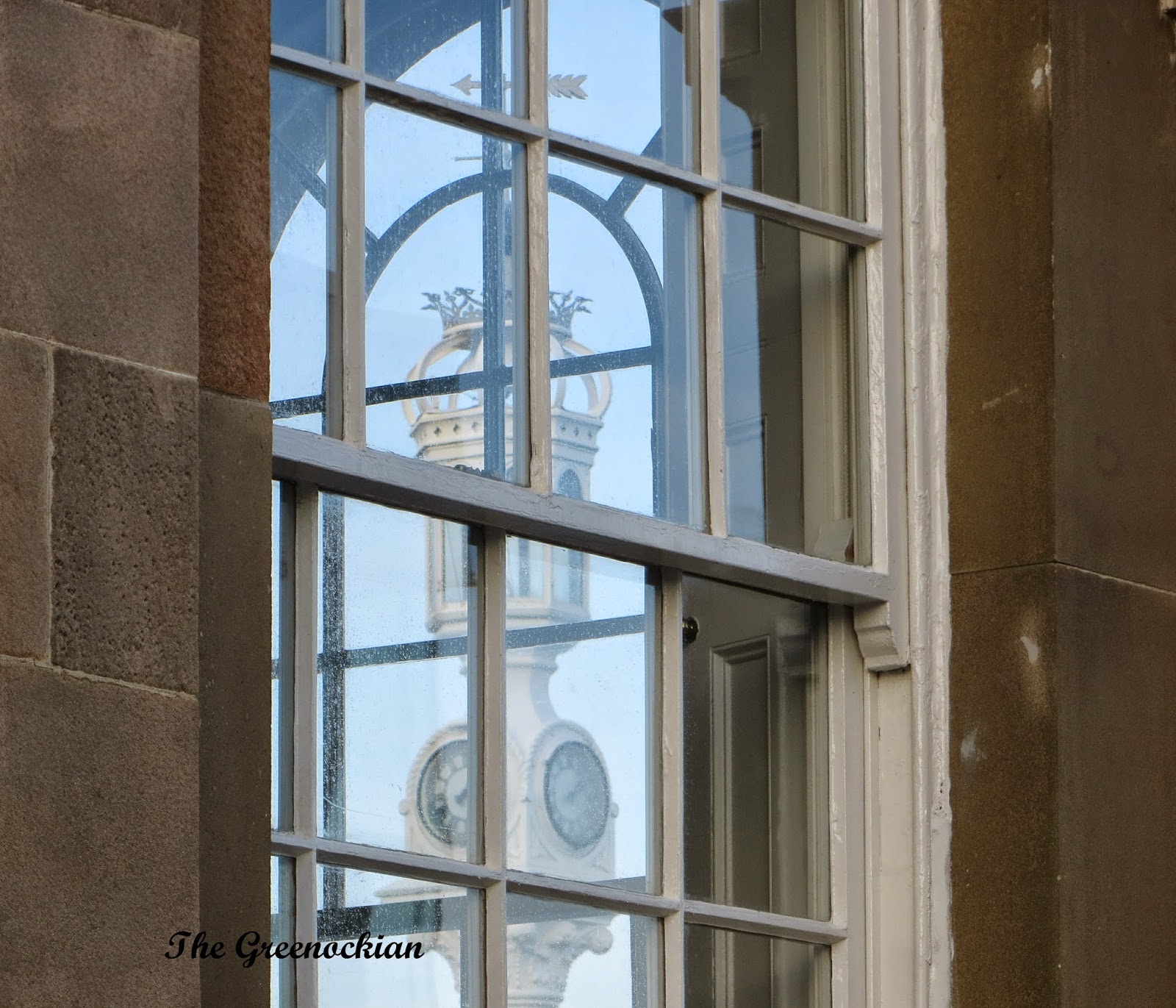
Beacon Reflected
Greenock's Beacon clock tower reflected in the windows of the
Custom House.
Joining Weekend Reflections.
The Greenockian
Wednesday, 7 May 2014
Greenock - Port of Departure
In my last post I mentioned the Scottish Diaspora, those
Scots who travelled far and wide across the world in search of new lives. Many of them would have sailed in the
thousands of ships which left the port of Greenock each year taking folk away
to all corners of the globe. I came
across this poem recently -
Wilfred Campbell (1860-1918) was a Canadian poet, and lived
in Ontario. You can read about him here.
I'm ashamed to admit that I hadn't heard of him before. But these few verses from his poem The
World-Mother (Scotland) appealed to me (if we ignore the fact
that for each of the Scotsmen who moved away, there were an equal number of
Scotswomen with them who contributed just as much!).
Of course his poetry is of its time and appears very old fashioned and
romanticising to us today. But in this
year of Homecoming Scotland I thought that the last line was quite apt.
The Greenockian
Monday, 5 May 2014
Greenock Has Been Wiped Off the Map!
I picked up a brochure yesterday - it is called Welcome
to Scotland. However, I was shocked to
discover that on the main map of central and southern Scotland - Greenock is not there!
The port of Greenock will welcome at least forty cruise
ships this year bringing over 100,000 passengers and crew from all around the
world. Many will probably pick up this
booklet at some point on their visit to Scotland, good luck to them if they try
to find the port which welcomed them!
Greenock has truly disappeared off the map!
Port Glasgow which is home to the beautiful Newark Castle is
missing too!
This is the year of Homecoming Scotland, which will attract
many descendents of the Scottish Diaspora back to their ancestral homeland, anyone
picking up this booklet will have a problem with the map if they try to find
the place that thousands of families sailed from to start new lives overseas!
OK - here's my map - here's where to find Greenock and Port
Glasgow - where you are sure of a wonderful welcome!
The Greenockian
Labels:
Greenock,
maps,
Port Glasgow
Thursday, 1 May 2014
A Tax On Your Windows!
The Window Tax was introduced in Scotland in 1740 and
householders with more than a certain number of windows would be taxed on each
additional window.
Inside the house, their position was often marked by an alcove as in this photograph.
Of course these false windows may also have been added to maintain the symmetry of the look of buildings.
This led to many houses being built like this -
False windows were put in place - these were set slightly
back externally so that glazed windows could be easily added as the householder
required and often were painted to look as if they contained panes of glass. Inside the house, their position was often marked by an alcove as in this photograph.
Of course these false windows may also have been added to maintain the symmetry of the look of buildings.
The tax was stopped in Scotland in 1798, but this extract
from Hutcheson's Greenock Register of 1841 shows that some sort of local variation
was still in place in Greenock.
This notice gives a fascinating glimpse into the rules and
regulations associated with the tax -
No windows deemed stopped unless with stone, brick, or
plaster.
Opening windows without notice forfeits £10. (I presume this means unblocking!)
Glass doors, or lights over doors, considered as windows.
Windows of out-houses to be reckoned.
A window lighting two rooms, or in two frames, to pay as two windows.
Every window more than 12 feet high, including the frame, or 4 feet 9 inches wide, if more than 3 feet 6 inches high, must be charged as two windows, except where belonging to shops, warehouses, or licensed public-houses.
Opening windows without notice forfeits £10. (I presume this means unblocking!)
Glass doors, or lights over doors, considered as windows.
Windows of out-houses to be reckoned.
A window lighting two rooms, or in two frames, to pay as two windows.
Every window more than 12 feet high, including the frame, or 4 feet 9 inches wide, if more than 3 feet 6 inches high, must be charged as two windows, except where belonging to shops, warehouses, or licensed public-houses.
In Greenock there are still may examples to be seen of this, even in buildings constructed after the mid 19th century. I think they add a fascinating glimpse into
the past and actually make the buildings look a bit more interesting!
The Greenockian
Tuesday, 29 April 2014
Rev Dr John Adam of the Mid Parish, Greenock
Rev Dr John Adam was only the
second minister of the Mid Parish Kirk in Greenock, arriving here when the
church had only been open for nine years.
Until this church was built, Greenock had only one other church - the
West Kirk. As trade and industry grew in
Greenock, so did the population and it was decided that another church was
required. Lord Cathcart gave the land in
the centre of the commercial part of the growing town, Cathcart Square, and
this beautiful church was completed, the first service taking place on 12 May
1761.
The model for the church was
St Martin's in the Field in London. The
building was constructed by Greenock mason James Ewing from stone quarried locally
(just behind what is now Newton Street).
The interior of the church was set out to a plan by James Watt, father
of Greenock's famous engineer, James Watt.
When Rev Dr James Adam took
over the charge on 12 July 1770 the church had no steeple. This was added in 1787 and is 146 feet high,
originally it had a golden cutter ship at its top as befits a port, but
unfortunately this was damaged in storms and had to be replaced. A bell and clock were also added.
Rev John Adam brought his
wife, Elizabeth Parker and young family to Greenock from West Kilbride. They would have lived in the manse
nearby. Elizabeth died in 1779 and in
1783 John married a local woman, Agnes Anderson. When John died in 1792, Agnes remained in Greenock. His obituary reads -
"Unaffected devotion, universal benevolence, warmth and affection with respect to his friends, attention to the distressed, and charity to the poor, were the leading features in Dr Adam's character."
His character was also noted -
"Unaffected devotion, universal benevolence, warmth and affection with respect to his friends, attention to the distressed, and charity to the poor, were the leading features in Dr Adam's character."
I have already written about
Rev John Adam's eldest son, Robert who moved to North Carolina and became a
successful merchant there. However a
younger son, John William Adam (born 1768) remained in Greenock and had many
business interests in the town.
It was not unusual at that
time for members of the same family to represent business interests in
different parts of the world, in fact it made life much easier - cutting out
the middle man! Crops of tobacco and
cotton grown in America were despatched across the Atlantic to a port like
Greenock in ships owned by consortiums of family members and then sold and processed
this side of the Atlantic by other family members. Fathers ensured that their sons and daughters
married well - especially into families who shared their trading interests. It is a story that repeats
itself many times in Greenock's commercial history.
This beautiful church, now known as Wellpark Mid Kirk, has a
wonderful history and is still a great landmark in our town.
The Greenockian
Friday, 25 April 2014
Doocot at Newark Castle
Doocots (or dovecotes) were
once an important addition to any Scottish estate. This beautiful example is part of Newark
Castle in Port Glasgow. Built in a
conical shape, the roof was open and inside are nesting boxes for doos or
pigeons which would have provided the castle inhabitants with a good source of
food in the lean winter months. There
would have been a ladder for someone to go up and collect the eggs from the
boxes.
The meat and eggs could be
eaten - a very good source of protein in winter at a time when cattle had to be
slaughtered and the meat preserved in some way to last throughout the winter,
which was not always successful. The
accumulated bird droppings could be used as fertiliser in the fields.
Doos were such a valuable resource that various laws were brought into place during the 15th and 16th centuries imposing strong penalties on anyone breaking into a doocot and stealing the birds. The shooting of doos by bow or gun also incurred harsh punishments. However, as their popularity increased, problems arose - the birds could decimate crops, leading to shortages. Eventually by 1617 a law was brought in to ensure that there was only one doocot on each estate, depending on its size. Once methods of feeding cattle over winter came into place, the need for bird meat declined and doocots fell into disuse.
It is believed that the
original inhabitants of doocots were rock doves which nested on rocky cliffs,
most of the earliest doocots were on the coast built to attract these wild
birds.
This lovely and picturesque
example at Newark Castle in Port Glasgow which once stood at a corner of the
outer wall was also used as a lookout post.
Because the door could be locked it was a convenient place to keep
prisoners and other undesirables!
The
Greenockian
Wednesday, 23 April 2014
John Galt - Founder of the City of Guelph
On 23 April (St George's day) 1827 John Galt, William Dunlop and Charles Prior
took part in a ceremony which marked the founding of the beautiful Canadian
city of Guelph in Ontario. John Galt
wrote in his autobiography -
"... a
large maple tree was chosen; on which, taking an axe from one of the woodmen, I
struck the first stroke. To me at least
the moment was impressive, - and the silence of the woods, that echoed to the
sound, was as the sigh of the solemn genius of the wilderness departing for
ever."
The town was named Guelph in honour of the British King
George IV and was laid out to a precise plan drawn up by John Galt. Although he is probably best known in
Scotland as a novelist, Galt is esteemed in Guelph as the city's founder.
Galt's plan reserved land for churches and schools. As this extract from his autobiography shows,
Galt considered education to be extremely important -
perhaps his own school days in Greenock had something to do
with this.
He was part of the Canada Company, set up to develop land
and encourage settlers to what was then known as Upper Canada.
In his novel Bogle Corbet (1831), John Galt describes life as a settler - leaving homeland and family, starting in a new, unknown place, clearing forests, building homes, the extreme weather conditions - it is not an autobiography, but Galt was writing from his own experiences and that of many of the people he met during his time in Canada.
Galt and the Canada Company had many differences, and he returned
to Britain and died here in Greenock in 1839.
However Guelph is not his only legacy in Canada. His sons settled there and became very much
part of society in their adopted land.
The Greenockian
Subscribe to:
Posts (Atom)