Tuesday, 22 April 2014

The First Flashing Buoy!

One of Greenock Esplanade's landmarks, the buoy, has had a new coat of paint and looks really smart.  It has a bit of a history. 


The plaque on it reads -

Clyde Lighthouses Trust
This buoy was laid down by the Trustees at Rosneath Patch in 1880.
It was the first flashing Buoy to be established to aid navigation.
D & T Stevenson
Engineers to the Trust

 The Trust engineers were David and Thomas Stevenson, from the famous engineering family.  Their father, Robert was the builder of the Bell Rock lighthouse and many more.    His son, Alan, famous as the builder of the Skerryvore lighthouse among others, wrote of his father -

"There is scarcely a harbour or  navigation  in Scotland about which at some time he did not give valuable advice." Biographical Sketch of the Late Robert Stevenson (1861).


David and Thomas designed and built lighthouses as well as inventing aids to navigation like the flashing buoy pictured, which used compressed gas to light the lamp.  They were an inventive and hard working family.  The next generation also produced engineers.


 The writer, Robert Louis Stevenson was the son of Thomas and you can read his account of the history of this remarkable family here.

The Greenockian

Friday, 18 April 2014

On the Clyde - Yachts

It has been the most beautiful day here in Greenock.  The sky was blue and you could see across the river very clearly.  There were lots of small yachts out sailing.


In this photo you can see Dumbarton rock to the left of the yacht and the Erskine Bridge on the right.


The River Clyde at its best!


The Greenockian

Monday, 14 April 2014

Blockade Runners from the Clyde

Anyone who has found the recent BBC Scotland series "Clydebuilt: the ships that made the Commonwealth" interesting would do well to look out for the book of called "Clydebuilt"  written by Eric J Graham (ISBN 9781841585804).  First published by Birlinn Limited in 2006 it is a fabulous account of the Clyde built ships which became blockade runners during the American Civil War.


Being a Greenockian, I was particularly interested in the part played by Greenock ship builders and owners in this trade.  Many of the blockade runners started off as mail boats taking mail and passengers around the west coast of Britain.  Shipbuilders were always competing to make their boats faster, so that their owners could win the lucrative mail contracts.  They also had to be strong enough to sail across to Ireland.  The Giraffe was one of these ships built in Glasgow.  Her first trip was from Greenock carrying a group of Glasgow businessmen.  Having proved her worth, she was sent to a Glasgow yard to be converted to a blockade runner.  All this was reported back to the United States by spies who staked out the Clyde shipbuilding yards and kept track of likely vessels.


Giraffe sailed to Nassau, Bahamas at the end of 1862 with a cargo of munitions and machinery as well as some Scottish lithographers.  There her Scottish crew were paid off and a new crew taken on under the leadership of John Wilkinson, a well known blockade runner.  She got through the blockade and arrived at Wilmington.  There she was renamed the Robert E Lee and had a very successful time as a runner.  At the end of 1863 she was captured by USS James Adger, acquired by the US Navy and renamed Fort Donelson.  You can read the fascinating account of Wilkinson's time as a blockade runner here (Narrative of a Blockade Runner) and particularly the exciting trip aboard the Giraffe.


This is just one of the amazing stories told in this book.  Tales of spies, clandestine sailings, and the money that could be made by taking chances on running the blockade make "Clydebuilt" a very interesting read, especially as the many shipbuilders and owners names are very familiar in the west of Scotland.  Eric  J Graham had done a tremendous amount of research and it is refreshing to read about such a fascinating subject purely from a Scottish perspective.


The Greenockian

Monday, 7 April 2014

On the River Clyde - Aasvik

Greenock got a couple hours of beautiful sunshine (well, almost) yesterday and I went walking along the Esplanade.


Got some photographs of the bulk carried Aasvik passing the Pilot Station at the Campbell Street end of the Esplanade.

The Greenockian

Sunday, 6 April 2014

Inverclyde Tartan

It is Tartan Day today.


This is the tartan for Greenock - it is the Inverclyde Tartan.  Tartans come in all colours and mixes.  There are tartans for clan names, countries, organisations - all sorts of tartans!

If you would like to find out if there is a tartan for your name or area then go to the Scottish Register of Tartans where you can search a fabulous database to find out your tartan.  You will be amazed at the selection on offer.


The Greenockian


Friday, 4 April 2014

Robert Adam, Merchant - Greenock and Fayetteville, North Carolina

A brief obituary in the Watt Library's archive index of family notices recently caught my attention.  It read -
Robert Adam born Greenock c 1759.emigrated to
America, merchant in Fayetteville, N.C. died 1801
A bit of research later and I came up with the fascinating story of Robert Adam and his life in Fayetteville.  I am indebted to Craig Harmon of the Fayetteville Independent Light Infantry Company of North Carolina for much of the information which appears in this post.


Robert Adam was the son of Rev Dr John Adam, second minister of the Mid (or New) Parish in Greenock, now Wellpark Mid Kirk.  While his brother John stayed in Greenock, Robert went to North Carolina and became a prosperous merchant there, trading across the Atlantic.  He married a widow, Jennet Burgess and they had three children - John Robert Adam, Eliza Ann Adam and Margaret Jane Adam.


It is perhaps as the first Commanding Officer of the Fayetteville Independent Light Infantry (FILI) that Robert Adam is best remembered in his adopted land.  On 23 August 1793 the Company was founded with Robert as its leader and offered their services to the then President, George Washington.  They adopted the motto -

"he that hath no stomach to this fight, let him depart".

The Company drilled regularly, undertook guard duties and took part in public events.


Unfortunately Captain Adam died on 11 June 1801 at the Sound near Wilmington.  He was buried at the Old Cross Creek Cemetery, opposite the old FILI parade ground.  The stone that covers Captain Adam's tomb reads as follows -

Beneath this stone are deposited the mortal remains of Robert Adam,
a native of Greenock, Scotland,
for many years a merchant of Fayetteville and Wilmington,
who departed this life 11th June 1801 aged 42.
He was universally beloved and regretted.
In his conduct and department through life
was combined all that should adorn the Christian character
and constitute the honorable man,
the kind husband and affectionate parent.

Such a wonderful testament to a fine Greenock man.  The Company held a Memorial Service in 1989 in honour of their first Commander and a footstone was unveiled at his tomb.  He will never be forgotten by the Fayetteville Independent Light Infantry.


The wonderful history of the Fayetteville Independent Light Infantry can be read on their fabulous website here and blog here.  Once again I would like to express my thanks to the members of the Company who helped by sending me information about Robert Adam and especially Craig Harmon for photographs of the grave.

Friday, 28 March 2014

Greenock Skyline

The old and the new - churches and cranes.

The Greenockian

Tuesday, 25 March 2014

Chimney Sweeps

The rooftops of the older houses in the west end of Greenock abound with chimney pots of all shapes and sizes. 


In previous times, only the rich could afford to have fireplaces in every room.  You can tell from the number of chimney pots on this building, that it was of high status and the owners could afford to have servants to light fires in all the rooms and the coal to fuel them.


However, with coal fires came pollution.  This photograph is of Leeds, but shows how the smoke from a mix of domestic and industrial chimneys in towns, caused smog which hung around in the air.  Coal fires in the home also caused other dangers - fires without guards were a danger for children and for ladies with their large dresses!


If you had coal fires, there was the annual necessity to have the chimney swept of the accumulation of soot.  Some of the chimneys were very narrow.  Here's an extract from Charles Kingsley's story "The Water Babies".  The character Tom is a young boy employed by a chimney sweep - small boys could get up the narrow chimneys easier.  Boys as young as four were employed in this work, and it was an extremely dangerous job.  This extract sums up what these youngsters had to put up with -
 "Once upon a time there was a little chimney sweep and his name was Tom.  He could not read nor write, and did not care to do either; and he never washed himself, for there was no water up the court where he lived.  He cried when he had to climb the dark flues, rubbing his poor knees and elbows raw; and when the soot got into his eyes, which it did every day in the week; and when his master beat him, which he did every day in the week; and when he had not enough to eat, which happened every day."


It was not uncommon for the youngsters' elbows and knees to be rubbed with a brine solution in order to toughen the skin.  This was done even when they had open sores or blisters on their joints.  Boys could be burnt by cinders, stuck in chimneys or fall quite a distance.  This article from an English newspaper in 1864 describes a young lad getting stuck, and the chimney having to be dismantled to free him a day later.  There is also a report of another boy who died in similar circumstances - his master was fined!


Sweeps would sometimes pick up orphans or runaway boys to work for them.  There was a condition known as chimney sweeps cancer, identified as early as 1775, and caused by soot.  It wasn't until 1875 that chimney sweeps were licensed and prohibited from employing young boys. 


The Greenockian

Monday, 24 March 2014

Ginger the Horse, Greenock

This beautiful sculpture Ginger the Horse who is situated in the piazza at the east end of Cathcart Street in Greenock.  The sculpture is by Andy Scott.


We are told that Ginger represents all the horses who pulled carts down at Greenock's docks, and one in particular who was being backed up to unload his cart onto the dockside.  Unfortunately the cart did not stop and plunged into the river - taking poor Ginger with it.  Ginger could not be saved and his owner was distraught.  This, apparently is a true story and took place on 23 October 1889.  


Talking of cart horses, did you know that it was Greenock's own James Watt

who coined the term "horsepower"?


The Greenockian

Thursday, 13 March 2014

Greenock's Flatiron Building

New York and Toronto have their flatiron buildings - they are tourist attractions in their own right and must have been photographed millions of times.  Greenock has a building which is just as magnificent and is a wonderful (almost) triangular shape.  Here it is -


Not quite something tourists would really want to photograph!  The building was once a sugar refinery (or sugarhouse, as we call it) here in Greenock.  It is one of my favourite buildings in the town, despite its derelict appearance.  It is a fabulous shape and the brickwork is wonderful.


Built in the 19th century, it was the Glebe Sugarhouse in the days when sugar refining was an important industry in Greenock.  I've already written about Abram Lyle and the connection with Tate and Lyle sugar.  You can read it here.


The building has been unused for some time now.  It has been left ruinous.  Pigeons fly in and out of the broken windows.  It lies among waste ground abandoned and forlorn.  The windows facing the street have now been boarded up.  An Aldi supermarket has now been built right in front of it.


It is situated right across the street from the container terminal which is where the large cruise liners dock when they visit the west coast - bringing thousands of tourists to the area.  What a great first impression  …………………. not!


But how wonderful it could be and what a great asset for Greenock if only someone with money and vision would take it over.  Personally, I would turn this building into a heritage centre for Greenock.  I would have a first class café, with some pretty little shops on the ground floor.  Arts, heritage centre and gallery on the upper floors.  A bar and restaurant on the top floors which would have amazing river views! It could be magnificent!


In the meantime, I pass by and dream. 


I even think that it may be haunted ………….....!

The Greenockian

Monday, 3 March 2014

Endeavour, Port Glasgow

I love this piece of sculpture.


It is called Endeavour and is situated in front of Port Glasgow Town Hall just off the main road into the town.


Its by Malcolm Robertson and celebrates the town's proud shipbuilding heritage.


The colours are those of the Cunard shipping line - the Queen Mary, Queen Elizabeth and the QE2 (amongst hundreds of other ships) were built on Clydeside and had connections with Port Glasgow.  The dry-dock at Port Glasgow was large enough to take these ships for refitting and other work.


I think that this sculpture is just so evocative of the bow of a proud ship as she slips through the waves.  It looks amazing lit up at night.


Port Glasgow is so lucky to have this reminder of her wonderful history.


The Greenockian

Saturday, 1 March 2014

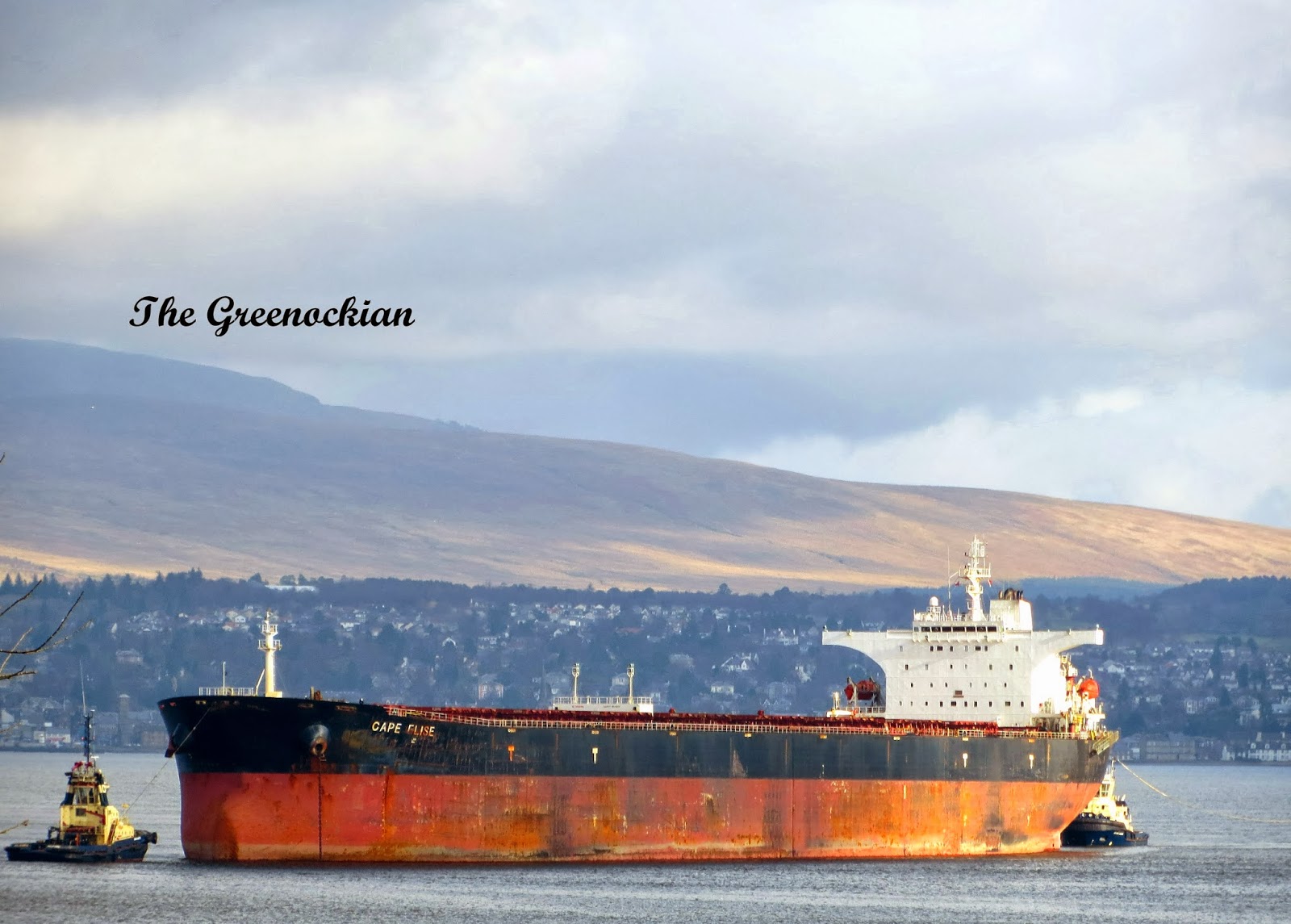
On the River Clyde Today - Cape Elise

The huge bulk carrier Cape Elise was on the river this morning.


Three tugs were helping her to turn.


Apart from cruise ships, I think she is one of the biggest ships I have ever seen at Greenock.  She measures 289m length by 41.5 breadth.  Gross tonnage 88853.


Amazing!


The Greenockian