Tuesday, 15 August 2023

"Concord" of Greenock - captured by the Americans

The following is the first hand account of Captain James Laurie of the ship Concord of Greenock, of his ship's capture and his subsequent treatment as a prisoner during the American Revolution.  He obviously had a horrendous journey before his ship was taken and he did not think much of his captors.  It is a fascinating read.

The newspaper article starts - "A correspondent has favoured us with the following Journal of Captain Laurie of Glasgow."

“I am happily satisfied with the sight of Old England once more, after eight months misery, from great losses and afflictions.  As I wrote you before, of my intended voyage, I sailed 25th September 1775, for Boston, with a cargo of coals, provisions, and sundry necessaries, for the use of the navy in America, after a very hard passage of ten weeks; four of which I beat on the coast, with strong gales and contrary winds."

You can read more about the Greenock ship Concord and her capture on my previous post - An Appeal to Heaven.  The article continues -

"On sounding on the 2nd of December, about twelve leagues south east from Cape Anne, at six in the evening, was boarded and taken by a schooner, of six carriage and twelve swivel guns, manned with about sixty piratical vagabonds, headed by one John Manley styling themselves American Cruizers.  I was, with the most of my people, bundled on board the schooner, and my ship taken possession of by the above crew."

Cape Anne is about thirty miles northeast of Boston.  The Concord was captured by Captain John Manley, a very successful American privateer.  His ship was the Lee.

"By break of day next morning, made our appearance off Marble Head, where a large body of people, who were throwing up a battery for defence of said place, shouted with joy at our appearance.  From thence proceeded to Beverley, where the people came in numbers from the country, much overjoyed at Manley’s great success.  In midst of the crew, we were told not to be afraid, for we should be treated like gentlemen, and meet with the best usage, crying out, “That it was not private property they wanted, but to hinder supplies going to the Ministerial Butchers”, meaning the troops at Boston; and I, with many others, think it great scandal to the British flag, so many of us were made sacrifices, after so severe a passage to be taken by such vermin, right under their noses."

Marblehead is just north of Boston and Beverley is now a suburb of Boston.  The British troops were under siege at Boston and could only get supplies by sea.

"Myself, and one gentleman passenger, and nine of the sailors, were landed, and put under the guard of a parcel of fellows, with guns and bayonets fixed, who marched us with fife and drum to Salem, where we were stared on by men, women, and children, as villains, shouting out, “see the prisoners”!  Our guard were styled the Rangers, dressed in checquered home spun; the Captain of which, during my imprisonment, made me two pair of shoes, for the common price, as a customer.  So much for the Yankee Captain."

Salem during the Revolutionary War was a centre of privateering.  The Rangers were a force which once was loyal to the British, but during the Revolution many fought on the American side.  Laurie mocks them as wearing "checquered home spun", during the War there was a ban on British imports and loyal Americans chose fabric made by their own people.  There's a very interesting article - "The Hands that Spun the Revolution" on the Library of Congress Blog.  (Click the link to read.)

George Washington

"It was, with much difficulty, unable to walk from fatigue, I procured carriage to Cambridge, to appear before Washington, whom they styled General and Commander in Chief of the United American army; a very hard and disagreeable circumstance, that must be performed by all whom they make prisoners, let the distance be even a hundred miles from the headquarters.  From the lameness  of the sailers, we could not reach the first day; but, on the second, by ten in the morning, two or three vessels crews of us entered Cambridge, amidst thousands, of all nations, ages, colours, and dresses, from a cobbler Captain, to a brother Jonathan with his pickaxe and hoe, crying out, “You see what we Americans can do; you may as soon pull the stars from the skies, as subdue us free-born Americans by force of arms."

Cambridge is now a suburb of Boston and home of Harvard University.  During the Revolution, George Washington had his headquarters in Cambridge.  The Cobbler Captain refers to the Captain of the men guarding Laurie who made him two pairs of shoes. "Brother Jonathan" was used a term used to describe loyal Americans, an early Uncle Sam. 

"We were brought to the house where Washington lived, but was not admitted to his presence, at that time, being engaged in other business, but all sent to confinement; the sailors sent to gaols, and sundry masters of us sent to a house, all under guards." 

Longfellow House, as it is now named, was Washington's HQ for a few years during the siege of Boston.  It got its name because the American poet, Henry Wadsworth Longfellow (1807-1882) lived there for much of his life.

Washington's HQ in Cambridge

"In three days time, we petitioned to know our destiny, as it was impossible for the men to live in the place into which they were crowded, not even having room to lie down to rest.  Offer being made, to give my parole, for self and sailors, to deliver ourselves up to a Committee of Safety at Concord, till further orders, we gladly accepted of the same, rather than be marched through the different towns, with such a gang.  After delivering ourselves up, we became much in want of necessary clothing.  I complained of such treatment, on behalf of self and people, as we had given them no cause of offence, without they made that one, of getting our daily bread; a doctrine very contrary to what they foolishly call their own (that is, liberty and property).  After begging and praying, and using every other interest I could, was permitted, by a fresh parole, to return to my ship for some clothing, for self and people; but how great was my surprise, after all that had been said, by people, who I thought from principle would not lie, to learn the cargo was taken out, and everything in the ship ransacked, chests, desks, etc broke open, and most of our things taken away, by an unlawful authority of men, calling themselves Agents for the Continental Cruizers.  What was remaining, was glad to put up with, and walk off."

Committee of Safety - during the Revolutionary War they were akin to local government.

"As there was no redress where rapine had taken place, in room of humanity and justice, after being marched and counter marched, sundry times to Cambridge and Concord, by several applications made, was permitted to the precincts of Salem, a prisoner on parole, without even bread or water to subsist on, but what I pay for.

I was not the only sufferer, sundry other masters will share the same fate; and what may appear very extraordinary, as I dare say unparalleled, a number of the poor sailors were marched, under guard, a hundred miles of the country, in frost and snow, and left to the mercy of the people, almost ready to destroy one another, much more prisoners, whom they looked on as enemies to their country and cause without the smallest means of support. 

After twelve weeks spent, and no views of recovering my employer’s property, or any provision made to subsist on, personal safety being daily in danger, I with several others, made application to Washington, who granted us a pass to get away the best manner we could, after giving our parole of honour not to go to Boston, or any other way where any of his Majesty’s ships were.


This letter from Robert Hanson Harrison (1745-1790) was in charge of Washington’s HQ during the war to William Bartlett who was Washington’s naval agent shows that Laurie and the others captured with him could have passage away from America.  It is interesting to note the statement that Washington  "would not wish too great a number of them should be in one vessel ... it is only right to guard against accidents."  The other men captured on the Concord of Greenock were, Archibald Templeton, James Crawford, Joseph Douglass, James Hamilton, and John McIver.

I took passage to Antigua, with John Bourke, Esq of said island, who had suffered the same fate, and was permitted to purchase a small sloop for that purpose and happy for us, we got away ere the advice of the restraining bill took place.  We left Salem 1 March 1776, arrived in Antigua 2nd April, where I took first opportunity for Britain, which was in his Majesty’s sloop of war Lynx; and got to Spithead on the 2nd June."

John Burke of Antigua had been travelling to Boston as a passenger in the ship Little Hannah, Robert Adams master, which, like Laurie's ship Concord, had been captured by John Manley of the ship Lee in December 1775.  The Little Hannah was carrying a cargo of rum and gineva.  Washington reported that the cargo was for "the use of the Army and Navy at Boston".  Sloop of war Lynx - more information here. 

"The manner of proceeding in America is almost beyond description; for instead of humanity, which the newspapers are filled with, some are compelled to enter their service, others have barely enough to keep life and soul together in gaols, and many left to shift for themselves or starve; men, women and children, suffer the same fate, whoever fall into their hands, as I to my woeful experience have seen; and was it not for some, who were not lost in their human feelings, the case of prisoners in America would be too shocking to relate; and what service they do is at the risk of their lives and fortune.  In some of my examinations before Washington, he seemed much dissatisfied, that I did not say the people of Britain were all in associations against Government, as he seemed to be advised to that purpose by private correspondence, whom they all depended much upon; but I took the hint, and excused myself, not being versant in politics.  Upon the whole, they seemed to be sickening of the frolick, as they called it.  None of them every expected that it would have come that length; and excepting those who keep their spirits up with Yankee rum, the rest appeared rather melancholy than otherwise, but they were all in hopes of their time of service being expired before the regulars landed from England, as they were only by the month till May".

So ended Captain James Laurie's woeful tale of his capture and imprisonment in America.  He does not give a positive description as to the morale of the people he meets during his time there.  As a first hand account, it makes very interesting reading.  However, there are factors which have to be taken into account.  Having lost his ship and his valuable cargo, he would have to face meeting the ship owners and merchants who had entrusted them to deliver the goods.  Not all of his crew would have made it home - perhaps still imprisoned in America or taken by press gangs to serve on other ships.  These and other factors give an insight into how he may have been viewing his capture.  It is not difficult to imagine that personal pride would also account for the tone of his writing.
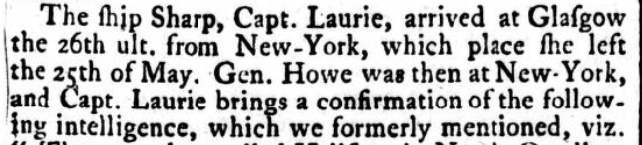
Glad to be home, he went back to sea shortly afterwards.  This notice dated July 1777 from the Manchester Mercury shows that despite his ordeal, he continued to voyage across the Atlantic after his return to Britain.  

Thursday, 10 August 2023

James Watt - a year in London

In June of 1755 James Watt (1736-1819) and John Marr (the son of his former teacher) travelled to London by horseback.  The journey, via Coldstream, Newcastle, Durham, York, Doncaster, Newark and Biggleswade, took 12 days.  Watt in a letter home to his father, written at York states - “I like the country very well, but think the people are very sharp”.

James Watt was in London to find a place with a mathematical instrument maker.  Nautical instruments were something that the young James Watt, with his skill in mathematics and astronomy, was very familiar with.  His father, also James Watt (1698-1782) was in business in Greenock as a shipwright and merchant supplying ships.  James helped with the business.  However, his father had suffered some financial difficulties and Watt’s mother, Agnes Muirhead (1703-1755) had recently died.  Watt had spent the previous year in Glasgow living with his mother’s relatives.  Here he met Dr Robert Dick, a professor of natural philosophy at Glasgow University who encouraged him to go to London to further his skill in making mathematical instruments.  He gave him that essential in those days, a letter of introduction to James Short, a Scottish astronautical instrument maker in London with a view to finding someone who would take Watt on and teach him the trade.

However, that proved more difficult than anticipated.  Watt wrote to his father soon after arrival – “I have not yet got a master; we have tried several; they all make some objection or other.  I find that if any of them agree with me at all, it will not be for less than a year and even at that time they will be expecting some money”.  Watt was anxious not to expect his father to pay out too much on his behalf. 

John Marr wrote to Watt’s father “your son began to divert himself in cutting letters and figures etc in the ship of Mr Neale, watchmaker, from whom I had the small patent globes.  Mr Neale is the frankest tradesman of any of the fraternity I have seen … In the meantime, I shall endeavour to see him employed at Mr Neale’s who inclines to have some of his work to show”.  That did not work out, but Watt soon found employment elsewhere.

Watt worked on the brass parts of Hadley’s quadrants for John Morgan, mathematical instrument maker in Finch Lane, Cornhill. Watt wrote of him as being “of as good a character, both for accuracy in his business and good morals, as any in his way in London … he can teach me most branches of the business, such as rules, scales, quadrants etc”.  Marr writes – “he could not have found a man better recommended for good nature and ingenuity than Morgan”.  With his father’s approval, it was decided that James would receive a year’s instruction from Morgan at a cost to Watt's father of twenty guineas. 

A hard worker, by August he was outperforming Morgan’s other apprentices.  In November he was working on azimuth compasses.  By the end of the year, he wrote to his father “I think I shall be able to get my bread anywhere, as I am now able to work as well as most journeymen, though I am not so quick as many".  Unfortunately, his health suffered as he strove to do his best for his master, his father and most importantly, himself.

Living in London, Watt paid eight shilling a week for food.  He writes home about the long hours and insufficient food, but was very aware that his father could not afford to pay out any more money.  He did not take much time out to explore the sights of London.  The French and Indian War was getting underway in America and there was a lot of rumours and unease around the country, especially in the city.  For Watt, an ever present danger was the threat from the press gangs who roamed the streets of London looking for men.  As Watt was a pupil, not an apprentice, he was particularly vulnerable.  He wrote to his father in the spring of 1756 – “I avoid a very hot press just now by seldom going out … they now press anybody they can get, landsmen as well as seamen, except it be in the Liberties of the City, where they are obliged to carry them before my Lord Mayor first; and unless one be either a ‘prentice or a creditable tradesman, there is scarce any getting off again.  And if I was carried before my Lord Mayor, I durst not avow that I wrought in the City, it being against their laws for any unfreeman to work, even as a journeyman, within the Liberties”.

At the end of his time with Morgan, Watt was looking forward to returning to Greenock.  His health had suffered, he described at various times “violent rheumatism” “a gnawing pain in his back” and “weariness all over his body.”  Before leaving London, he bought some tools and materials that would be useful in his career, along with two books “Bion’s Construction and Use of Mathematical Instruments” translated by Edmund Stone, a self-taught Scottish mathematician.

Greenock

At the end of August in 1756 he set off for Greenock.  On his return, he worked for Dr Robert Dick at the University of Glasgow and eventually set up on his own as a mathematical instrument maker and repairer.

Friday, 4 August 2023

The Wreck of the "Orion"

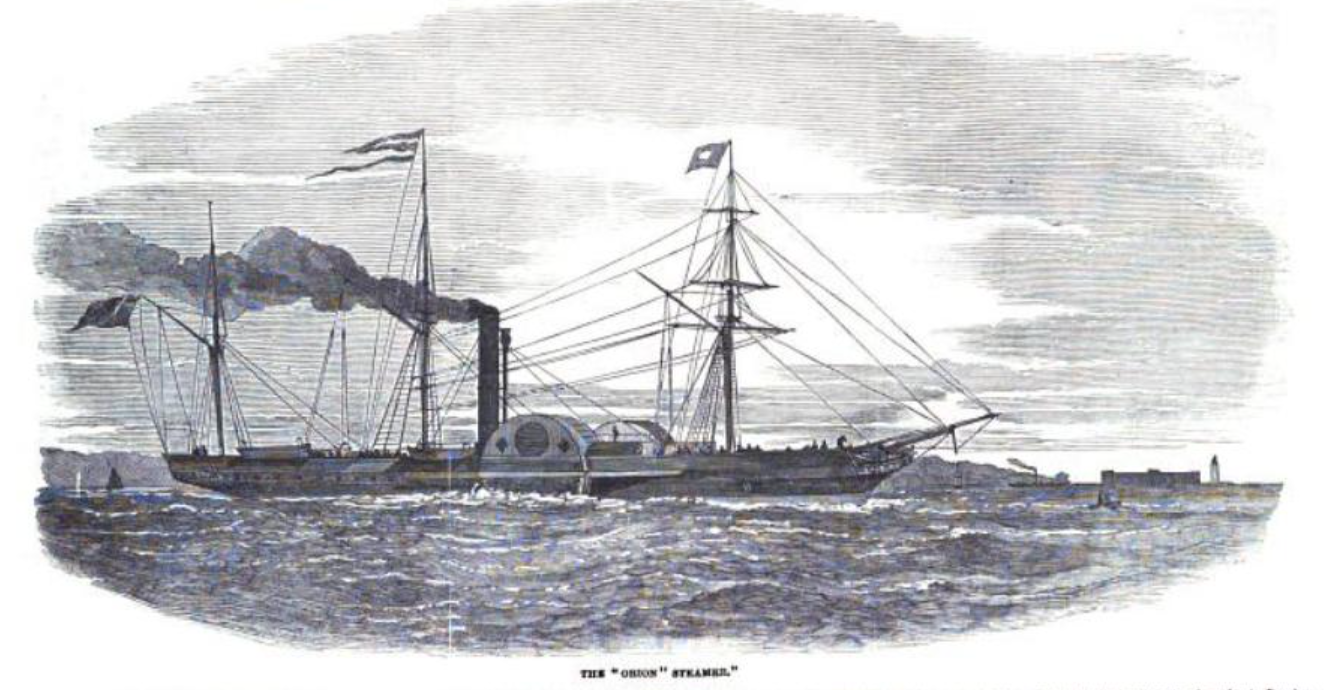
In December 1846 the steamship Orion, described as “the beautiful new iron steamer Orion of 900 tons, length of keel 215 feet”, was launched from the Cartsdyke Yard of Caird & Co in Greenock.  The launch itself went well – “She went off the ways in gallant style – the long run lending unusual effect to a spectacle always grand in itself.  Her model is of perfect symmetry, a high specimen of marine architecture.  This fine vessel is intended for the Liverpool trade, and is to be commanded by Captain Main, whose long sea experience, high capacity, and urbanity of manner, have justly rendered him an universal favourite with passengers.  We will be much disappointed if Orion does not eclipse every sea star in the firmament.”  A wonderful description from the local newspaper.

Orion was built for the Glasgow and Liverpool Steam packet Company.  Fitting out was completed in 1847. The main salon was described as “exceedingly spacious and the fittings are of the most gorgeous description.”  It was 40 feet long by 17 feet broad containing two rows of table which could set 80 diners.  The tables, state-room doors and panelling were of carved rosewood.  The sleeping apartments were described as “well-aired and well-ventilated”.  

George Burns

At a dinner to celebrate the completion of the ship, owner George Burns commended Captain Hugh Main who would have charge of the ship, stating that he had known him for over twenty years and held him in high regard.

By June 1850 Captain Thomas  Henderson was in command of the Orion.  At 3 o’clock on Monday 17 June the Orion sailed from Liverpool with approximately 200 people on board including passengers and crew.   About two o’clock in the morning, when most of the passengers were asleep, the ship suddenly struck a rock within 150 yards of the Portpatrick lighthouse.  Very quickly, the ship began to take on water and sink. 

There was great panic on board as the awakened passengers realised what happening.  Many ran on deck in their nightclothes.  One of the four boats on board was launched, but got caught under the paddle wheel and was swamped.  Two of the other boats were launched, each could carry just 10 people.  There was no time to launch the fourth boat.  The sinking ship was seen from shore and boats were sent out to assist, but she was sinking so quickly that they had no time to reach her. 

A newspaper report tells the story – “Cries of every description were heard … Around were thickly strewn the bodies of the living and the dead, the former clinging to floating spars and to the rigging of the vessel, which had sunk under about fifteen feet of water, carrying down both dead and living in her vortex, and causing the calm sea to heave into high rolling waves.” 

“Those who were saved were taken to Portpatrick were attended to by Captain Hawes of the Coast Guard and the inhabitants of the village".  Next day the survivors were taken to Stranraer .  The Princess Royal, Captain Crawford, which was also travelling from Liverpool to Glasgow had managed to pick up 40 of the survivors.  Captain Henderson, the second mate and some of the crew, who were last off the Orion, had survived by clinging to the rigging.  The scene on the shore was awful as survivors searched for their relatives and friends.  Those who survived were aided and given shelter by the local people.  Later they were taken to Glasgow. 

A young Duncan Darroch, the son of Major Duncan Darroch of Gourock, aged just 14, and his tutor Richard Price had been travelling home to Gourock on board Orion.  When they realised what was happening, both ran on deck and jumped clear of the ship into the water.  Duncan Darroch would later describe his experience in a letter to a friend:- 

“When I had swam about forty yards, I came to a chest, on which a man was supporting himself.  I made for it, and reached it; but the seaman was in such an agony of terror that he knew not what he did, and in foolishly endeavouring to get to the top of the chest he turned it round like a tread-wheel.  I could not shift my hands as quickly as he pulled it over, and so I was pushed right under the water for about two minutes.  At that awful time, I felt the water coming in my ears and nose and thought on home and my parents, and felt that I should never see them more, and was giving up; but just then I felt new vigour in my limbs, and determined not to relinquish life without a struggle.  I dived down till I got free of the man and chest, and swam to some things which were floating near, and got something like a desk under my arm and kind of a wooden grating under the other; with these I kept up a long while". 

He was spotted in the water and hauled on board a boat which had come from the shore.  He continued his narrative – “I sat down shivering like half a dozen drowned rats”.  Fortunately he got to the shore where he was given shelter at the home of Captain Hawes of the Coastguard.  His tutor also survived.  He describes his eventual homecoming – 

“When I got home, I told mamma that the Orion was aground, not to alarm her; but she was so glad to see me that she never noticed my dress; but when she went into the dining-room, she told them, laughing, that I looked like a shipwrecked mariner.  Papa soon came home and told her, and she was most awfully frightened when she heard the dangers I had escaped”.

Others were not so lucky.  It was thought that about fifty people died.  Among the dead was Dr John Burns, brother of the ship’s owners J & G Burns, who had been drowned.  (George Burns would later be a partner in the Cunard Line.) 

Dr John Burns
At a later enquiry into the sinking of the Orion, it was discovered that at the time of the accident, Captain Thomas Henderson had been in his cabin having left the ship in the hands of the second mate John Williams.  This led to criminal proceedings being taken against the two men.  There was a lengthy trial in Edinburgh.  On sentencing, Lord Justice Clerk (John Hope) (1794-1858) stated – 

“Thomas Henderson, you have been convicted by the verdict of the jury, of culpable neglect of duty as an officer on board ship, whereby the ship is wrecked, and many of the lieges deprived of life; and there can be no doubt … that had it not been for that neglect of duty this vessel would not have been wrecked.  The sentence of the Court is, that you be imprisoned for the period of 18 calendar months.”

The second mate John Williams was sentenced - 

“you have been convicted of culpable and reckless neglect of duty, under similar circumstances.  The sentence to be pronounced in your case is no doubt one that must produce a great impression … The sentence of the Court is, that you be transported beyond seas for the period of seven years.”  (Transportation did not stop as a sentence until 1857 but effectively ended in 1868.)

The two men were taken to Calton Jail in Edinburgh.  It appeared that Williams accepted his fate quietly.  Henderson was later transferred to Perth Prison.  He called his sentence “unprecedented, disproportioned and cruel”.  He thought his punishment severe and that he was being used as a warning to other officers.

A collection was later taken and the proceeds given to the people of Portpatrick for their assistance to the passengers who made it ashore.  Several of those who drowned were buried in the churchyard at Portpatrick.  There is also a memorial in Glasgow’s Necropolis Cemetery to some of those who drowned.

Ship's bell from Orion

The ship was extensively salvaged over the years  and a curious relic – the ship’s bell, remains in the Watt Institution in Greenock.  A sad reminder of the Orion, a ship proudly built in Greenock.

Thursday, 3 August 2023

To My Native River

To My Native River is a poem by Greenockian, Allan Park Paton (1818-1905).  Written in 1845, it is a beautiful tribute to the River Clyde.

The poem is too lengthy to put it all here, but there are some words which will surely strike a chord with anyone who has spent time in the area.

Upon thy shore alone I’ve been
In the rayless winter night,
When nothing of thee could be seen,
Save flying flakes of white –

I, too, shall lay my head
(Heaven grant it be in peace!)
Upon that silent, solemn bed,
Where life on earth shall cease.
And when it comes, as come it will,
Oh, may it be to me
To rest where I may look my fill,
Beloved Clyde, of thee!


The first words of the poem can also be seen on one of the panels at the east end of Cathcart Street in Greenock, beside Ginger the Horse sculpture.

Oh, thou sea-like, dark blue Clyde,
With mountains for thy banks!
A daily muser by thy tide,
Would sing to thee his thanks –

I have made a short video using the words of the poem along with some photographs of the Clyde.  You can find it on my YouTube Channel.  (Music from YouTube Audio Library)


Wednesday, 2 August 2023

So you think you know Greenock?

If you think you know Greenock well, then try this quiz!  Can you tell which buildings or public place  these architectural details are part of.  Every one is perfectly visible in Greenock.

Photograph 1

1    Quite unusual and relatively modern - from the 1970s.  Where can you find this sculptural    detail?  Answer here.

Photograph 2

2.    "The Pavement" - what can that mean and where what is this bird part of?  Answer here?

Photograph 3

3.  Interesting profile!  Who is it and where would you find it?  Answer here.

Photograph 4

4.  Thousands of people pass this in their cars every day. What is it part of?   Answer here.

Photograph 5

5.    A lovely sculptured owl.  Where would you find this?  Answer here.

Photograph 6

6.    What a face!  Which building in Greenock is this part of?  Answer here.

How did you get on?  How many of the six pictures did you recognise? 


Tuesday, 1 August 2023

Greenock Cemetery - Jewish Section

Over 50 people from all over Britain attended the re-dedication ceremony of the Jewish Section of Greenock Cemetery on Sunday 16 July 2023.  The area has been properly marked out and seven of the once broken and difficult to read gravestones have been beautifully restored.  In all, there are sixteen people in the burial plot and those not mentioned on the gravestones are commemorated on a plaque bearing their names.


The moving service of rededication was led by the Senior Rabbi of Scotland, Moshe Rubin of the Giffnock Newton Mearns Synagogue.  In attendance at the Cemetery were Hugh Currie, Vice Lord Lieutenant of Renfrewshire, Drew McKenzie, Provost of Inverclyde, along with members of Inverclyde Council.  Friends and family of those buried in this section of the Cemetery as well interested members of the public also attended.

Another attendee was local author Viki McDonnell who has done extensive research into Greenock’s Jewish community.  Her book “Greenock’s Jewish Community 1880-1940” was first published 10 years ago and has recently been updated.  It contains a lot of information about the Jewish families who once called Greenock home and is a fascinating insight into the origins and occupations of those who settled in Greenock.  There is a vast amount of genealogical information and many old photographs of the various families in the book as well as an Appendix listing all births, marriages, and deaths of the local Jewish population.

The idea of having a separate section for Jewish burials in Greenock Cemetery was first put forward by Israel Isek Temianka in 1906 during his time as minister to the local Jewish population.  In 2016 a beautiful bronze bust, now housed in the Watt Institution, was gifted to Greenock by the Temianka family in memory of their father, world-famous violinist Henri Temianka (1906-1992) who had been born at 63 Rue End Street, Greenock during his father’s tenure as minister.

Bust of Henri Temianka gifted to Greenock

Over time the gravestones had fallen into disrepair and were further damaged by a severe storm in 2018.  

The Jewish Section of Greenock Cemetery before restoration

It was through the efforts of Sammy Stein of Glasgow that the money was raised for their refurbishment.  In this he had the full co-operation of Inverclyde Council's burial grounds staff.  

A booklet containing a map of Greenock Cemetery as well as interesting information about many of those buried there (including the location of the Jewish Section) can be downloaded from the Inverclyde Council website. 

“Greenock’s Jewish Community 1880-1940” by Viki McDonnell (2023 edition) is available to purchase at the Scottish Jewish Archives Centre based at Garnethill Synagogue, Glasgow.  

Visit the Scottish Jewish Archives Centre for more information about Scotland’s Jewish Heritage.

Monday, 31 July 2023

Bank Street, Greenock - Town Trail 3

Greenock Town Trail, Plaque 3, Bank Street, Greenock.  Download a leaflet from Discover Inverclyde.

As may be guessed from the name, Bank Street once housed a local bank - The Renfrewshire Bank.  The original bank building can still be seen on the eastern side of the street.  The Renfrewshire Bank, was set up in 1802 by a group of local merchants.  Unfortunately it failed in 1842 causing deep distress in the town.

Former Renfrewshire Bank building, Bank Street

Steps up from Bank Street lead to the Wellpark.  Once part of the grounds of the Mansion House of the Shaw family, it still retain an old well dating from 1629.  The park also contains Greenock's magnificent war memorial.

Mansion House well, Wellpark, Greenock

On the west side of Bank Street, behind the Wellpark Mid Kirk, once stood the old Greenock Gaol or as it was also known, the Bridewell.  The building was demolished to make way for the railway line to Gourock.

Picture courtesy of Greenock Burns Club

At the lower end of the street is a sculpture entitled "Hands of the Fallen" by Angela Hunter.  It is a reference to those locals who were killed or wounded in a riot in Greenock in 1820.

Hands of the Fallen sculpture, Bank Street

Leading off from Cathcart Square, Bank Street is worth having a look at.  Read more about Bank Street on this Blog -


Sunday, 30 July 2023

Greenock's botched public hanging

At 3.15 on Friday 5 June 1812 a man, wearing “common clothes, vis a short blue coat, blue vest, white trousers and grey stockings”, stepped onto the scaffold which had been erected at the front of the Mid Kirk in Cathcart Square in Greenock.  His hands were tied behind his back, a white hood was put over his head and the noose adjusted around his neck.  There was a hushed silence from the large crowd assembled to view the hanging.  When he was ready, the man dropped a handkerchief as a signal to the hangman.  The drop was opened, and the condemned man fell to the ground.  There was a large gasp from the onlookers in the Square.  The unthinkable had happened – the rope had broken! 

Picture source - Greenock Burns Club

Half an hour later the process would be successfully completed and thus would end Greenock’s very first hanging.  The story which started some five months earlier, would have one more twist before drawing to its tragic conclusion.

On Sunday 11 December 1811, the Greenock police were informed that a burglary had been committed in Laigh Street (now Dalrymple Street) at the shop of James Jelly, grocer.  The area was described as “during the day a well frequented thoroughfare occupied by many respectable shopkeepers and men of business”. His shop, situated near the north end of what was formerly Harvie Lane, had been broken into.  About one o’clock in the morning the back door had been forced open and a large amount of goods had been taken.  The list of what was taken read – “a chest and a half of tea, 56 lbs of scale sugar, two loaves of refined sugar, 18 cheeses, 28 beef hams, 30 bacon hams; several flitches of bacon, value £15, 12 gallons of whisky, 6 pairs of bellows, 24 brushes, 10 stones of butter, 2lbs of tobacco £4 in British silver, 10 shillings in copper £2 in Irish Bank tokens, several shoe brushes, wine decanters crystal measures, tumblers, wine glasses, lamp oil, confectionaries, meal sacks and jars.  The whole valued at £130”.  Quite a haul!

With so much having been taken the police surmised that more than one person was involved.  A proclamation was read out in the town offering a reward of £50 to “any person or persons who will give such information as will lead to the recovery of the goods, and conviction of any of those concerned in the robbery.  Informants’ names will be concealed if required.”  Shortly afterwards Moses Macdonald “a quay jobber” and John Gray, were apprehended and charged with shop breaking.  They were imprisoned in Greenock and later indicted by the Lord Advocate to be tried at Glasgow on 29 April 1812 by Lords Meadowbank and Woodhouselee.  

In April 1812 at the Circuit Court of Justiciary Glasgow, before Henry Home Drummond (1783-1867), Advocate Depute, Moses Macdonald, John Gray and Alexander Gibson were indicted for breaking into the shop of James Jelly, grocer, Laigh Street, Greenock early on Sunday 15 December 1811 and stealing goods to the value of £130.  John Gray, defended by James Walker pleaded guilty, by being accessory after the fact.  Moses Macdonald, defended by John Jardine pleaded not guilty, and Alexander Gibson did not appear and was immediately outlawed. 

The jury consisted of “a number of country gentlemen and merchants" such as Colonel John Gerard of Rochsoles, William Napier of Miliken, John McAulay writer in Dumbarton John Lang, writer in Glasgow”.  Among the witnesses at the trial were the shop owner James Jelly and Catherine Clark, his wife.

The verdict was given the next day.  After deliberation the Jury found Moses Macdonald guilty by a majority.  John Gray was found guilty of aiding and assisting to remove the goods, knowing them to be stolen.  The court sentenced Moses Macdonald to be hanged at Greenock on Friday 5 June.  He was to be taken to Greenock and detained there until that date when he would be “hanged by the neck upon a gibbet, by the hands of the common Executioner, until he be dead, and ordains his whole moveable goods and gear to be escheat and inbrought to His Majesty’s use …”.

John Gray was sentenced to be transported for seven years with the addition that if he were to return before the seven years were up and found “at large in any part of Great Britain or Ireland without some lawful cause, and shall thereof be lawfully convicted, he shall suffer death in terms of the statute”.  He was to be taken to the prison at Greenock until “delivered over for transportation”.  The judge decided that the execution should take place in Greenock where the crime had been committed, as a warning to others.  Both men were sent to Greenock “in a cart” under military guard to be imprisoned until their sentences were carried out.  A petition had been addressed to the Prince Regent asking for a commutation of Macdonald death sentence.  Two days before the execution, Sheriff Campbell received a letter from the Secretary of State saying that His Royal Highness had “seen no cause to stay the execution on the sentence”.

Early in the morning of Friday 5th June 1812 a gibbet was erected on a raised platform at the railings in front of the Mid Kirk (then known as the New Church) in Cathcart Square in Greenock.  Greenock’s Chief Magistrate, Mr Crawfurd had previously been in touch with Edinburgh and asked to borrow their gibbet.  Four companies of the Ayrshire militia had arrived on the previous day and were stationed around the Square to prevent too many people coming in from the surrounding streets and congregating in the Square. 

Picture source - Greenock Burns Club

Described as being “a stout robust looking man about 35 years of age”, Moses Macdonald was a native of Ireland.  He had lived in Greenock with his wife and six children for several years.  He worked around the quays and harbours and “had lived a very ungodly life”.  Before the execution, at one o’clock on that Friday, ministers from various churches around the town visited the condemned man – it was reported that he was visited daily by a minister while he was imprisoned and that “every proper indulgence was allowed him by the Magistrates, and much kindness shewn by many of the inhabitants of the place”.

As they entered his cell, Macdonald was with his wife, three of his children and an official from the town.  He lay on a mattress with his leg shackled to an iron bar.  His wife sat with his head on her lap and “in silent agony she clasped him to her breast and kissed his forehead.”  He is reported to have said of her “she is an honest woman; and has been a good and dutiful wife to me, though I have used her ill”.

Psalms were sung and prayers offered up in the condemned man’s cell.  He was read a letter by Rev James Hervey of the Church of England and addressed to persons under sentence of death.  At 2pm he was taken from his cell to the front of the church.  It was reported that “During the whole of this awful transaction the man himself appeared perfectly firm and unmoved”.

Previously, on thinking about his actions he had said “I may blame my neglect of the Sabbath, I may blame my excess in drinking, and I may blame the bad company which I kept: but this would be to begin at the wrong end; for all the things I have to blame, as procuring my ruin, proceeded from this one cause – I had not the Fear of God before me.” (Many of the details appeared in a broadsheet published after the execution and written in very moralistic religious language.  These were commonly issued after hangings and emphasised the lack of religious thought in the minds of the condemned. The quotes from the prisoners can be taken with a pinch of salt!  This particular crime was considered especially bad because it had occurred on a Sabbath morning.)

At 2.15 pm, MacDonald was brought by a guard of soldiers from Greenock Gaol in a procession headed by the Sheriff and two Magistrates “with white staves in their hands” town officials and the Town Clerk, Ministers  Rev Robert Steele (Old West Kirk), Rev Dr John Gilchrist (East Parish Church) Rev John Hercus (Independent Church)  and Rev Bryan (Methodist Church), officers of the town along with Macdonald’s father, brother and sister all dressed in black.  In front of the Kirk, Macdonald was given wine by his sister.  The company sang psalms and prayed for almost an hour.  

At 3.10pm MacDonald “expressed his thanks to the magistrates and clergy for the kindness he had experienced and said goodbye to his family and friends".  He then stepped up to the scaffold accompanied by Rev Bryan who spoke to him as they walked to the “drop”.   His arms were tied at his back, the rope was put around his neck and a white cap drawn over this face.  When he was ready, he dropped a handkerchief as a signal to the hangman to open the drop.  Unfortunately, to the shock and horror of the onlookers, the rope broke, and Macdonald fell to the ground unharmed apart from some bruising.

Macdonald’s sister immediately ran to him, helped him up and supported him back into the church where it was reported “he nearly fainted, but soon recovered, and repeated distinctly the 51st Psalm and spoke with much firmness of his hope in the mercy of God through Christ”.  The gibbet was adjusted, and a new rope put in place.  At 3.40 he was brought back out and hanged without incident.  It was reported that “he made three or four feeble convulsive throes" – and was apparently dead in three minutes.  He was cut down at 4.20, placed in a coffin by his family and taken up to the bridewell (gaol) to be buried the following evening.

This being Greenock, there was much speculation in the town that the hangman, John High from Edinburgh, must have brought the rope with him as it had been faulty.  It was said that Greenockians knew all about ropes and it was eventually a Greenock rope that completed the task.  John High was accompanied by his “guide” or guard – a fee was paid by the town for his services.  John High was Scotland’s public executioner for nearly 40 years.  He died in 1817.

Just three months later the final twist in this story came to light.  In the Greenock Advertiser of 18 September 1812 there was an article stating that it had been discovered that James Jelly, the shop owner had “robbed his own shop and cellars of a variety of articles which he hid in various places.  The currency he gave to his wife to hide which she took to a neighbour’s house”.  Jelly aim was to defraud his creditors, he then absconded.  In order to avoid trial and punishment Jelly and his wife “petitioned for, and have been allowed to go into banishment, for and during the term of their natural lives under certification that if they are again seen within the liberties of Greenock, they will be committed to the Bridewell for thirty days, exposed on the pillory, and again sent into banishment”.  James Jelly and Catherine Clerk were married in 1807 in Ayrshire.  In March of 1812 Jelly had not seemed to have had money worries – he had feued ground from Sir Michael Shaw Stewart on the south side of Alexander Street (Roxburgh Street) and west side of Captain Street.  (Roxburgh Street Sugar Refinery was later built on that spot.)  He made over the ground “with a slated house of two storeys and garrets” to his wife and three sons.  But the property was seized by his creditors. 


Surely this raises several questions about the whole case.  Did Jelly pay the men to rob his shop and if so, could one of them be hanged for the crime?  Did Jelly and his wife petition for, and accept banishment as punishment to save the authorities the embarrassment of having a public trial and Macdonald’s execution be brought to the fore?  Was it all done quietly to get them away and stop any unrest that may have occurred in Greenock if the facts were known?  Was the quantity of goods taken from the shop not just slightly suspicious?  It must have taken quite a while to load the goods onto a cart to be taken elsewhere.  Later a woman named as Mrs Scott was accused to trying to sell some of the stolen goods.  There must have been more people than the three accused involved in hiding the goods or had Jelly found a cellar or safe place to store them?

Alexander Gibson, although named in court as being part of the theft, did not appear for trial.  Could he have taken the reward money and informed on his comrades in return for an agreed outlaw sentence? 

Unfortunately this was not the last hanging to take place in Greenock.