Showing posts with label Newark Castle. Show all posts

Friday, 23 August 2024

Grose at Newark

In 1770s the antiquarian, Francis Grose (1731-1791), visited Newark Castle.  Here's a drawing he made  of the castle at that time.

Newark Castle, Port Glasgow, Grose

Grose describes Newark Castle - "This was the castle or principal mansion of the barony of Finlaystun Maxwell, which about the middle of the fifteenth century, with diverse other lands, came to Sir Robert Maxwell of Calderwood, a younger son of the family of Nether Pollock, in right of Elizabeth, his wife, second daughter and co-heiress of Sir Robert Denniestoun, of that ilk.  It continued in the possession of the Maxwell family for several generations, till sold by George Maxwell alias Napier, of Kilmahew, Esq; to Mr Cockrane, of Kilmaronock, about the beginning of the eighteenth century.  It is at present the property of – Hamilton, of Wishaw, Esq; in whose family it has been for a considerable length of time. 

 This castle stands on the Eastern point of the bay, which contains the town and harbour of Port Glasgow and Newark.  It is now in ruins; but some part of it was inhabited about fifty years ago.  It consists of a square court, with high walls, round turrets, and battlements.  Over the main door are the arms of Maxwell, very much defaced, having beneath them this inscription:  “The Blessing of God be herein, anno 1597”.  On another part of one of the North windows is engraved the date 1599.  Over most of the windows are the letters PM, being the initials of Sir Patrick Maxwell, who probably built the modern part of it.  The tower is of more ancient date than the rest; when or by whom it was built is not known."

"The Blessings of God be Heirin" above doorway at Newark Castle.


Francis Grose

Francis Grose was a London born antiquarian and writer who travelled throughout Britain noting the historical buildings and ruins he visited.  In 1772 he published "The Antiquities of England and Wales" containing his drawings with a short description of the buildings they showed.  In 1788\1789 he travelled widely in Scotland and later produced "The Antiquities of Scotland" which included Newark Castle.  

The ruins of Alloway Kirk, Grose

While in Scotland in 1789, Grose met the poet Robert Burns who suggested that he included Alloway Kirk in his writings.  Grose agreed to this on condition that Burns would write a story about a witch to go along with the drawing.  This led, in 1790 to the famous Burns work - "Tam O'Shanter" being included in the second volume of Grose's "Antiquities of Scotland".  

The pair became good friends and Burns wrote to Frances Dunlop:- "I have never seen a man of more original observation, anecdote and remark ... If you discover  a cheerful-looking grig of an old, fat fellow, the precise figure of Dr Slop, wheeling about your avenue in his own carriage with a pencil and paper in his hand, you may conclude: "Thou art the man!".  (Dr Slop is a character in "Tristam Shandy" (1759) by Laurence Sterne.)

Burns and Grose kept up a correspondence.  Burns wrote a poem for his friend, and also this epitaph -

"On Captain Francis Grose
The devil got notice that Grose was a-dying,
So whip! at the summons, old Satan came flying;
But when he approach’d where poor Francis lay moaning,
And saw each bed-post with its burden a-groaning,
Astonish’d! confounded! cry’d Satan, “By God,
I’ll want him, ere I take such a damnable load!”

Grose was also the author of the very interesting and amusing "A Classical Dictionary of the Vulgar Tongue" (1775) and several other works.  Grose died in Dublin while travelling to find material for a book on the antiquities of Ireland.  One of his sons, also named Francis Grose (1758-1814) became Lieutenant Governor of New South Wales, Australia.

Friday, 15 April 2022

Newark Castle, Port Glasgow 2022

After being closed for two years Newark Castle in Port Glasgow is once again open to the public.  It was wonderful to visit the castle today and check out all my favourite rooms and views.  As ever, the staff were very helpful and friendly.

Newark does now have limited opening times - Friday, Saturday, Sunday and Monday 10 till 5.  Visitor numbers are limited, therefore Historic Environment Scotland advise booking in advance to guarantee entry.  For full details, please check out the Newark Castle page on the Historic Environment Scotland web site - here.

There are lots of new information boards around the castle and they really give a great insight as to what life would have been like when the castle was inhabited by the Maxwell family.  

If you visit then you really must climb the 64 stairs up to the battlements - the views are stunning.  It was a dull day today, but the views across the River Clyde were fabulous.

If you are going to be in Inverclyde over the summer then I would strongly recommend a visit to Newark Castle it is a fabulous place to visit.  Please check in advance to ensure that the castle will be open and remember to book tickets to ensure entry.  Here's the link to the Newark Castle page at Historic Environment Scotland.

Check out some of my other posts about Newark Castle - type the word Newark into the "Search this blog" box in the right hand column of the blog.

Friday, 4 May 2018

Newark Castle, Port Glasgow

If you are going to be visiting Inverclyde over the summer months, then the one place not to miss is Newark Castle in Port Glasgow.


Parts of Newark Castle date back to the 15th century, but it was adapted and added to over the years.


I love looking at the old timbers in the castle.  The roof of the upstairs gallery is spectacular.  When conservators dated the roof timbers they found that they were much older that the actual building and had been taken from somewhere else and reused here - recycling even then!  You can see numeral carved into this one - others have them too.  It is thought this was to help the carpenters assemble the roof when it was being built.


This old door certainly shows its age, but is absolutely wonderful.


Please don't leave Newark Castle off your Inverclyde itinerary.  The Castle is looked after by Historic Environment Scotland.  Check their site for opening times and entry prices.

Friday, 19 August 2016

Margaret Sharp Peace - Greenock Poet

Margaret Sharp Ferguson was born in Greenock on 8 January 1822.  In 1845 she married Robert Peace, a tinsmith also from Greenock.  Margaret and Robert would go on to have 10 children and travel widely, eventually settling in Auckland, New Zealand in 1865 after a time in Newfoundland.


Margaret published a book of poems "The Convict Ship and Other Poems" in 1850 (Robert A Baird, Publisher, Greenock).  The preface reads -

"The wishes of many friends induced the following sheets to be committed to the press.  The copies of this little work will chiefly, it is believed, circulate among the friends of the Authoress; it was therefore thought better by those who collated its pages to retain in every case her own thoughts in the very words she had chosen to clothe them with, than to attempt to give a stronger artistic effect by the use of language less homely than she had herself employed."

Among the many religious poems are several which seem very personal to her.  Many portray her thoughts on family life and loss - "My Wee Son" - "Dear laughing imp o'joy, thy een, Blue, blue as heaven's azure sheen."  Others depict sights she has seen and her life experiences. 

One of my favourites is "To Newark Castle, Port Glasgow".  Many of the verses are full-blown in their descriptive tone, but one or two capture the beauty of the place -
"All, all are mute; thou alone art remaining,
Sad wreck of the past, of the days that are gone,
Still towering sublime; lovely even in ruin,
None gaze on thee coldly, thou desolate one."


Margaret and her husband travelled on the brig Ann Johnson to St John's in Newfoundland where Robert set up business on Water Street as a tinsmith making stoves.  Margaret would have eight children there (not all survived).  She wrote poems of her life in Newfoundland.


However, by 1864 the family were once again on the move.  The Peace family along with the Foote family bought a 132 ton 3 masted ship, Clara, the set sail for New Zealand.  Can you even begin to imagine a journey like that - from Newfoundland to New Zealand with six children!  There's a wonderful description of the voyage written by a great-granddaughter of the Foote family.  You can read it here on the site for the Encyclopedia of New Zealand.  Margaret's sister Isabella Ferguson was with them and you can read some of Margaret's diary entries of the voyage here.

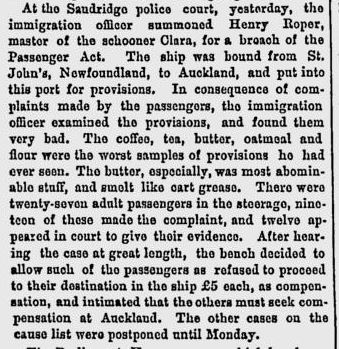
It wasn't all plain sailing.  The skipper, Captain Roper does not seem to have been popular with the passengers who complained during a stop over at Melbourne of the poor quality of the provisions on board.


On 30 June 1865 they arrived safely at New Zealand.  Robert once again set up in business as a stove maker on Shortland Street, Auckland.  


Margaret died at Auckland in 1897 aged 75 and Robert died in 1908.  They are buried at the Purewa Cemetery in Auckland.
I wonder if the young poet, Margaret Sharp Ferguson Peace from Greenock ever imagined that her life with Robert Peace would involve emigrating not just once, but twice with a large family in tow, to make a brand new life on the other side of the world.  What a remarkable woman!

Thursday, 7 May 2015

Back to Newark Castle

Now that the cruise season has started in Inverclyde, Newark Castle in Port Glasgow will be attracting a lot of visitors.


It is certainly worth visiting.  Building started in the 15th century and a whole new north range added by the then laird, Patrick Maxwell, this was completed in 1597.  In this photograph you can see his initials and the date above the doorway and the motto
"The blissings of God be heirein".


My favourite part of Newark Castle is the doo'cot.  It is all that remains of a defensive wall that would have run around the original keep.  You can just about see where the wall would have been on either side of the structure.


Newark Castle, Port Glasgow is cared for by Historic Scotland.


Friday, 15 August 2014

Newark Castle, Port Glasgow

Couldn't resist taking these photographs of the Doo'cot (dovecot) at Newark Castle in Port Glasgow.


It was such a beautiful day and the view of the hills of Argyll across the River Clyde was just fabulous.


Read more about Newark Castle's doo'cot here.

The Greenockian

Friday, 25 April 2014

Doocot at Newark Castle

Doocots (or dovecotes) were once an important addition to any Scottish estate.  This beautiful example is part of Newark Castle in Port Glasgow.  Built in a conical shape, the roof was open and inside are nesting boxes for doos or pigeons which would have provided the castle inhabitants with a good source of food in the lean winter months.  There would have been a ladder for someone to go up and collect the eggs from the boxes.


The meat and eggs could be eaten - a very good source of protein in winter at a time when cattle had to be slaughtered and the meat preserved in some way to last throughout the winter, which was not always successful.  The accumulated bird droppings could be used as fertiliser in the fields.  


Doos were such a valuable resource that various laws were brought into place during the 15th and 16th centuries imposing strong penalties on anyone breaking into a doocot and stealing the birds.  The shooting of doos by bow or gun also incurred harsh punishments.  However, as their popularity increased, problems arose - the birds could decimate crops, leading to shortages.  Eventually by 1617 a law was brought in to ensure that there was only one doocot on each estate, depending on its size.  Once methods of feeding cattle over winter came into place, the need for bird meat declined and doocots fell into disuse.


It is believed that the original inhabitants of doocots were rock doves which nested on rocky cliffs, most of the earliest doocots were on the coast built to attract these wild birds.


This lovely and picturesque example at Newark Castle in Port Glasgow which once stood at a corner of the outer wall was also used as a lookout post.  Because the door could be locked it was a convenient place to keep prisoners and other undesirables!
 The Greenockian