Showing posts with label Old West Kirk. Show all posts

Wednesday, 23 September 2026

Ballantine Memorial Window, Old West Kirk

This beautiful stained glass window can be found in the Old West Kirk, Esplanade, Greenock.

Entitled “Faith” and designed by the famed Pre-Raphaelite artist Sir Edward Burne-Jones produced by Morris & Co.  It was placed in the church in 1867 shortly after the building was fully renovated after lying disused for about twenty years.

The window is a memorial to the Ballantine family of Greenock.  The wording reads:-

”Erected by James Ballantine Merchant Greenock and Janet Haddow his wife in memory of their children—Robert, died 1853 aged 6 years; 
Janet Niven, died 1858 aged 19; Jeanie Carmichael, 
wife of T. B. Rowan Merchant Greenock 
died 1860 aged 24; James died 1863 aged 21.”

The window shows a beautiful female figure depicting faith with a book under her left arm and holding a cup in her right hand.  She is surrounded by a background of vines, foliage and fruit.  Among the greenery at her feet are five beautiful red flowers, probably representing the children of the family who died young and are mentioned in the wording beneath.  

James Ballantine (1801-1883), a merchant from Girvan married Janet Haddow (1809-1908) in 1831 in Greenock.  The family lived at Houston Street in Greenock.

Photo source - Greenock Burns Club

They had seven children – those mentioned in the memorial – Robert (1847-1853), Janet Niven (1839-1858) and James (1842-1863).  Also mentioned is their daughter Jeanie Carmichael Ballantine (1835-1860) who married Thomas B Rowan in 1859 and who unfortunately died just a year later.  Thomas B Rowan's mother was Agnes Ballentine from Irvine, perhaps a relative.

James and Janet Ballentine had other children –

Thomas Ballantine (1833-1872), distiller involved in the family business in the town married Margaret Doctor Crockatt in 1859.

John Haddow Ballantine (1837-1890) carried on the family’s distilling business in Greenock.  In 1866 he married Marion Russell, daughter of Captain Alexander Russell.

Photo source - Greenock Burns Club

A surviving daughter, Henrietta Haddow Ballantine (1854-1953) married Lewis Macfarlane (1849-1825) from Lochgoilhead.  She and her family lived with her parents at Houston Street in Greenock.  After her parents’ death they returned to Lochgoilhead.

James Ballantine came to Greenock from Irvine in about 1824 in connection with the Greenock Distillery Company which started about that time on the corner of Tobago Street and Inverkip Street.  (Check out distillery's position on 1857 OS map here.)  The premises, once a brewery, covered three acres of ground.  (You can read an interesting description of the premises here.)  He took active part in local affairs and was a member of the town council and JP. He died at Bridge of Allan in 1882 and was survived by his wife Janet, son John Haddow Ballantine, daughter Henrietta and many grandchildren.

The children of sons Thomas and John Haddow continued the Ballantine involvement in the distillery business in Greenock for many years and were also involved in sugar refining.

There is a very similar stained glass window depicting Faith in All Saints Church, Sculthorpe which you can view here.

Other Greenockian posts about the Old West Kirk's windows -

Sunday, 10 August 2025

An unpopular minister!

Back in the 18th century, church ministers were chosen by the local landowner.  Of course not every churchgoer was happy about that.  However, many congregations found ways of showing their disapproval when the lord of the manor chose a minister who was not liked.  Greenock was no exception.

Old West Kirk, Greenock

In 1786 John Shaw Stewart, the patron, presented the Rev Allan McAulay to the Presbytery as his chosen candidate for the vacancy at the Old West Kirk.  He was to be introduced to his new congregation on Sunday 19 May.  The day was not without incident.

When the beadle went to open up the church, he found that the doors had been barricaded shut and even the door into the pulpit had been fastened with nails and then the heads of the nails cut off.  The bell ropes had also been cut, so that the bell could not be rung on that morning.  Things were put right just in time for morning service.  Enquiries were made into who could have done this, but no culprits were found.  Some of those questioned stated that “those who had shut up the kirk were well warranted to do so from the word of God”.  It had obviously been a popular move.  Eventually, however, Rev McAulay was installed as the new minister. 

List of Ministers, Old West Kirk, Greenock

McAulay remained at Greenock for just three years, during which time he complained about the state of the manse, a new one was eventually built after he left.  He also disagreed with the Dr Adam, minister of the Mid Parish regarding when communion should be celebrated in the town.  He also caused some disquiet due to his “irregular marriage … and other scandalous conduct".  He was suspended from his post while an investigation took place and died shortly afterwards in 1791.  (Source - "Old Greenock", George Williamson (1888).)

For two years prior to his death during his suspension, pulpit supply had been provided by a number of different preachers.  Two months after McAulay’s death, much to their relief, the congregation got a new Minister – the Rev Robert Steele who remained their minister for 40 years.

Rev Robert Steele's gravestone Old West Kirkyard

A very similar scene is wonderfully described in the novel Annals of the Parish by John Galt, describing the introduction of the Rev Micah Balwhidder to his new parish in 1760:-

"First, of the placing – It was a great affair; for I was put in by the patron, and the people knew nothing whatsoever of me, and their hearts were stirred into strife on the occasion, and they did all that lay within the compass of their power to keep me out, insomuch, that there was obliged to be a guard of soldiers to protect the presbytery.”

He continues – “When we got to the kirk door, it was found to be nailed up, so as by no possibility to be opened.  The serjeant of the soldiers wanted to break it, but I was afraid that the heritors would grudge and complain of the experience of a new door, and I supplicated him to let it be as it was; we were, therefore obligated to go in by a window, and the crowd followed us, in the most unreverent manner, making the Lord’s house like an inn on a fair day, with their grievous yelly-hooing”!

John Galt

John Galt (1779-1839) moved to Greenock with his parents in 1789 and no doubt heard the story of McAulay’s welcome to the Old West Kirk.  Annals of the Parish was one of Galt’s most popular works and was published in 1821.


Saturday, 9 March 2024

Crawfurd of Cartsburn window

This beautiful stained glass window is to be found in the Old West Kirk in Greenock.

It shows the arms of the Macknight Crawfurd family and the motto -  quod tibi hoc alteri  - nil durum volenti - "do to others as you would have them do to you nothing is hard for the willing".

The Old West Kirk had a laird's loft especially for the Crawfurd family and a vault where many of the family were buried.  You can read about some of the memorials to the Cartsburn family on a previous post here.  

This stone can be found in the wall of the Old West Kirk, Esplanade, Greenock marking the Crawfurd burial vault.

On wall of Old West Kirk, Greenock

The Crawfurd coat of arms from the original Cartsburn House in Greenock can now be seen at Lauriston Castle in Edinburgh.  The Castle was owned by Thomas Macknight Crawfurd (1820-1909).

At Lauriston Castle, Edinburgh


Wednesday, 19 July 2023

Alexander Knox, Brewer of Crawfurdsdyke

These stones once marked the burying place of the family of Alexander Knox of Crawfurdsdyke.  Alexander Knox was a brewer and owned the large brewery in Crawfurdsdyke or Cartsdyke, which he took over in the early 1760s.  He was born in Glasgow in 1722, the son of Alexander Knox and Ann Duncanson.  In 1762 he married Mary Allason, the sister of tobacco trader William Allason of Virginia and half sister of Robert Allason of Port Glasgow.  He corresponded regularly with William Allason, keeping him up to date about family members here in Scotland.  Alexander Knox died in February 1774.

Alexander's wife Mary managed to keep the business going with the help of advice from her brother in law, James Knox, bookseller in Glasgow, until her son Alexander (1763-1789) was of an age to take over.  Alexander unfortunately died young, and his brother James (1771- c1800) then took over the running the brewery.  Mary died in 1790.  James Knox sent books and periodicals out to William Allason in Virginia.

The brewery was a very successful enterprise.  James Knox was a respected merchant in Crawfurdsdyke, which at that time was separate from Greenock.  He was one of the first members when a corps of local volunteers was instituted in 1794 and was appointed as a lieutenant.  He also kept up a correspondence with his uncle William Allason in Virginia.  (Read more about the Allason family here.)

In his book Old Greenock, George Williamson states that the inscription on the stone "is the only Latin inscription in the churchyard".  It reads -

1769
Hoc
Est solum sepulchrale
Alexandri Knox
Cer(e)visiarii in Vico
Crawfurdsdyke
Patet
In longitudinem Octo
In latitudinem totidem
Hoc est
Sexaginta quatuor
Quadratos pedes

Williamson translates this as " The burial-place of Alexander Knox, Maltman (or Brewer) in the village of Carwfurdsdyke … it is 8 feet in length, the same in breadth, or 64 square feet".  

Old West Kirk - illustration from Old Greenock by George Williamson

They can now be found on the south wall of the Old West Kirk, Esplanade, Greenock.  The church and burial ground once stood at the north end of Nicolson Street, Greenock.  


When that land was needed for an extension to the Harland & Wolff shipyard, the building was taken down and rebuilt on its present site in the 1920s.
The Crawfurdsdyke Brewery was once situated across from the old quay at Cartsdyke.  After James Knox's death it was taken over by James Watt (no relation to the famous engineer).  This James Watt was Provost of Greenock 1834-1837.

Saturday, 8 April 2023

A succession of Crawfurds

As this memorial tablet shows, sometimes the laws of succession of lands and titles can be a bit tricky to work out.  The tablet has a prominent place in the former Old West Kirk on the Esplanade in Greenock, which houses the Crawfurd family vault.  The Crawfurds owned the lands of Cartsburn or Crawfurdsburn in the east end of Greenock. 

The tablet reads:- Here are deposited the remains of THOMAS CRAWFURD of Cartsburn who departed this life 3rd February 1743 in the 81st year of his age.  Also Ann, his daughter and Margaret Semple his fourth wife. Also Archibald Crawfurd of Cartsburn who departed this life 13th January 1783 in the 74th year of his age and Margaret Cunningham, his spouse who departed this life 23rd August 1787. And Thomas Crawfurd of Cartsburn their son, who departed this life 24 September 1791 In the 46th year of his age.  This monument was erected to their Memory by Christian Crawfurd of Cartsburn, Daughter to the first, and Aunt to the last mentioned Thomas Crawfurd 1792.

The Thomas Crawfurd (1662-1743) named on the memorial is the second of Cartsburn. He succeeded his father in 1695.  (Read about the first Crawfurd of Cartsburn here.)  He was married four times.  First in 1682 - Rebecca Barns (1659-1694), the daughter of Provost John Barns of Glasgow who had business interests in Greenock.  They had a daughter Marion (1688-?) who married Patrick Hunter of Hunterston.  Second in 1695 - Bethia Robertson (daughter of Archibald Roberton of Bedlay), Third in 1717 - Beatrix Clark and fourth in 1729 - Margaret Semple (daughter of William Semple of Cathcart).

Thomas Crawfurd and Bethia Robertson had the following children - (a) Thomas Crawfurd (d.1732).   He became and advocate and married Cecile Forbes (daughter of John Forbes of Knappernay).  Thomas died before his father and without issue.  (b) Archibald Crawfurd (1710-1783)- succeeded his father.  (c) Christian Crawfurd (1705-1796) - succeeded her nephew. 

Third of Cartsburn - Archibald Crawfurd (1710-1783) succeeded his father in 1743.  He married in 1739 - Margaret Cunninghame (daughter of John Cunningham of Caddel and Thorntoun, Ayr). They had one son, fourth of Cartsburn – Thomas Crawfurd (1746-1791) who succeeded his father in 1783 and died in 1791.  Read more about Thomas Crawfurd here.  He wrote to Scottish poet, Robert Burns, in 1788  inviting him to visit Cartsburn.  Thomas was unmarried and died without issue. 


Thomas was succeeded in 1791 by his aunt, fifth of Cartsburn - Christian Crawfurd (1705-1796), daughter of Thomas Crawfurd and Bethia Robertson.  She married Robert Arthur (d. 1779) in 1743 at Greenock.  Robert Arthur was a merchant from Irvine who had business dealings with George Moore of the Isle of Man (among others).  The couple had four children - Bethia (1744-), Thomas (1745-), William (1746-) and Christian (1749-).  Arthur Street in Greenock is named after this family.

At her death in 1796, her only surviving child was her daughter, Christian Arthur Crawfurd and that's where the story starts to get interesting!

Monday, 20 March 2023

The Arbuckle window, Old West Kirk

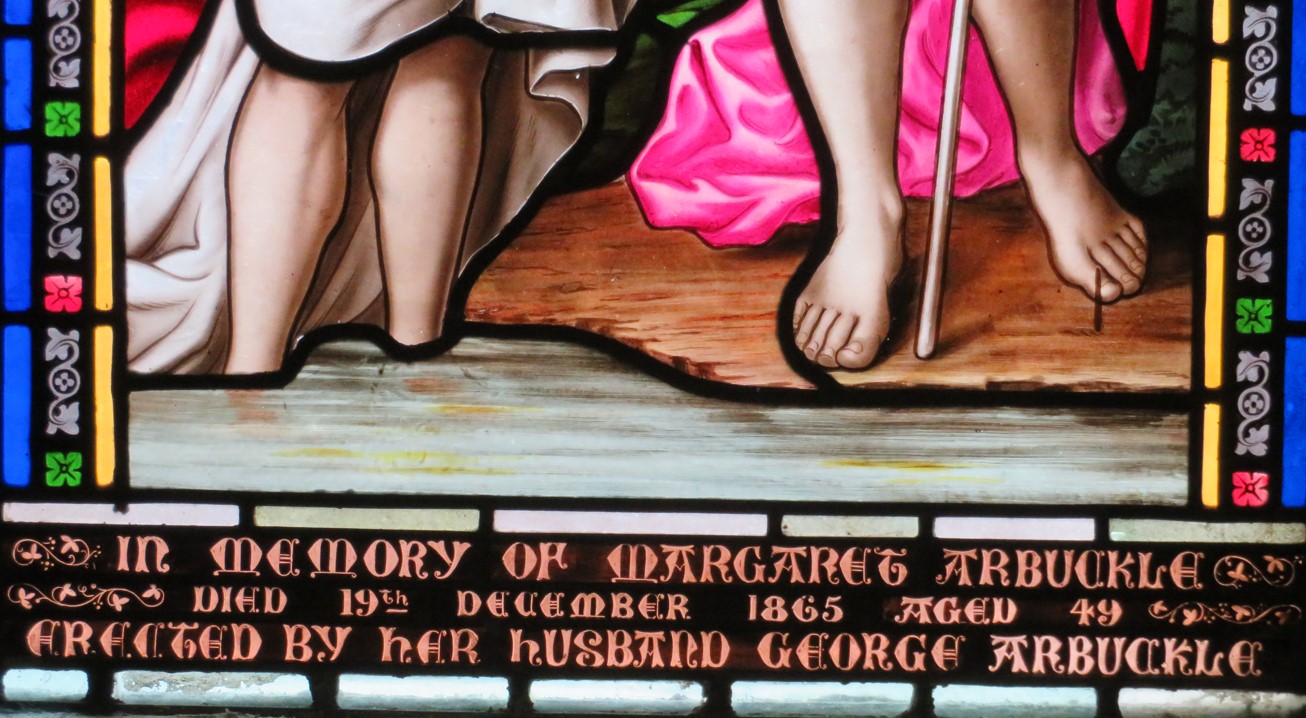
This beautiful stained glass window is to be found in the former church known as the Old West Kirk, Esplanade, Greenock.  It was commissioned by George Arbuckle in memory of his wife, Margaret Arbuckle who died in 1865.  The window shows the baptism of Christ in the River Jordan by John the Baptist.

The words of the memorial read "In memory of Margaret Arbuckle died 19th December 1865 aged 49.  Erected by her husband George Arbuckle".

George Arbuckle was born in Kilmarnock in 1818 and married Margaret Arbuckle in Ayr in 1842.  They moved to Greenock where their son, James Arbuckle was born in 1843.  James Arbuckle was a successful butcher in business with his cousin Matthew Arbuckle.  They had premises in West Blackhall Street.  He also owned property locally.  He was a member of Greenock Town Council for several years and was also a member of the Prison Board.  He took an active part in local affairs.

Source - Greenock Burns Club


He took a large part in the restoration of the Old West Kirk in the 1860s and became an elder, trustee and at one time treasurer of the church.  After the death of his first wife, he went on to marry Jessie Harvie in 1867.  Jessie was the widow of Captain Archibald McIntyre of the ship Julia.


George Arbuckle died in 1879 at Eldon Villa, Eldon Street, Greenock.  His memory lives on in this wonderful window.


Source - Greenock Burns Club

Monday, 30 May 2022

The first minister to preach in Greenock's West Kirk

The church now known as Westburn Parish Church in Nelson Street, Greenock was opened for public worship in 1841.  The first man to preach there was Patrick Macfarlan (1781-1849).  

Dr Patrick Macfarlan

He was the son of John Warden (family name later changed to Macfarlan due to a marriage) and Helen McDowal .  His father was minister of the Cannongate Kirk in Edinburgh and one of the founders of the Royal Society of Edinburgh (1783).  Patrick studied at the University of Edinburgh and was licenced by the Presbytery of Edinburgh in 1803.  His first charge was at Kippen and he later served at Polmont, St John’s Parish Glasgow and St Enoch’s Parish in Glasgow.  He was presented to what is now the Old West Kirk by Sir Michael Shaw Stewart in 1832.  In 1834 he was Moderator of the General Assembly.

At that time the Old West Kirk church building, at the north end of Nicolson Street down by the river, was in a very bad state of repair, and was not large enough to accommodate those who wished to worship there.  It was condemned by the Presbytery in 1837 and, at the urging of Patrick Macfarlan, it was agreed to build a new church in Nelson Street to be known as the West Kirk (now Westburn Parish Church).

On its completion in 1841 Patrick Macfarlan and his congregation locked the door of their old church and moved to the new premises in Nelson Street.

At this time, there was discontent within the Church of Scotland about the subject of patronage.  Many thought that congregations should be permitted to chose their own minister rather than have the local landowner decide who that would be (in many cases their own relatives).  Dr Patrick Macfarlan was one of those who agreed that congregations should be free to chose.  He wrote many pamphlets on this subject and other church matters.  He also wrote the article on Greenock in the New Statistical Account of Scotland.

Like the church, the old manse near the church down by the river, had not fared well over the years.  When Patrick Macfarlan came to Greenock he and his family first lived at Ardgowan Square at what is now the Tontine Hotel.  Later they moved to the beautiful Greenbank House in Kelly Street.  Forsyth Street was his next home then finally he moved to a house on the south west corner of West Stewart Street and Jamaica Street.

Greenbank House, @The Watt Institution

Dr Patrick Macfarlan, joined the Free Church in 1843 and “walked out” at the Disruption, taking many of his elders and congregation with him to start the Free West Church.  At the time, the West Kirk in Greenock was described as “the richest living in the Church of Scotland” and many admired him for leaving a beautiful, wealthy church to face the uncertainty of what life in the “Free Church” might offer.  But, like many ministers of his day, his faith and scruples overcame thoughts of an easy life.  It was not an simple decision either for elders and members of the congregation. 

Former Methodist Church, Ardgowan Street, Greenock

Having moved from the West Kirk, his new Free Church congregation needed a place of worship.  Land was bought and the foundation stone of their new church which was to be built in Ardgowan Street (where the former Methodist Church now stands) was laid later that year in August 1843.  The church was opened for worship in 1844.  In 1845 Dr Patrick Macfarlan was chosen as Moderator of the Free Church General Assembly.

In the following years his health declined and he himself paid for an assistant and missionary for the area.  In 1849 he caught a bad cold as a result of attending the funeral of an old gentleman, a member of his church before the Disruption.  He died shortly afterwards.

Patrick Macfarlan was the first to sign the Deed of Demission

Family  In 1808 Patrick Macfarlan married Catherine Clason (1784-1815), the daughter of Robert Clason, minister of Logie, Dunblane.  Children – Ann (1810-1831), Helen (1811-?)  Catherine (1813-1866) married Alexander Melville, minister of Falkirk in 1836.  He had previously been her father’s assistant in Greenock.  Their son, Andrew was born in 1839.  Alexander Melville died in 1839.  Catherine died in Paris (Rue de Balzac) in 1866.  John (1815-1891) – became minister of Middle Free Church, Greenock.  

Dr Macfarlane was described thus – “His head and face would have attracted observation in any assembly – suggesting the idea of culture and refinement, of mental acuteness and moral elevation.  His voice was clear and ringing rather than strong.  His speaking, both from the pulpit and in debate, was characterised above everything by clearness and precision.”

He became known as a "father of the Free Church".  His enthusiasm and dedication to his faith earned him a following not just in Greenock, but all over Scotland.  If you would like to know more about the history of Westburn Parish Church, then click here.

Monday, 4 November 2013

Daniel Cottier's Window of Hope

I've another beautiful stained glass window to show you today.  It is also from the same church, Lyle Kirk, Esplanade, Greenock (the Old West) as the Edward Burne-Jones window I've described previously.


It is called "Hope" and is by the Scottish artist, Daniel Cottier.  The little legend at the bottom of the picture reads:-

Daniel Cottier glass painter places this window in the Old West to the memory of his grandfather Archibald McLean master mariner of this Port who died in the year 1847 aged 80 years.

Cottier's grandfather, Archibald McLean married Mary Smith.  Their daughter, Margaret McLean who was born in Greenock, married a mariner, Daniel Cottier and had a son they also named Daniel.


The window was put in place in 1884 and depicts a beautiful woman.  Around her head are the letters SPES - this was the name of the Roman goddess of Hope.  She stands in what appears to be a walled garden in which are a few flowers.  Spes was usually depicted holding a flower, again this is a symbol of spring and with it fresh hope and new growth. 


The upper half of the window has greenery, behind which can be seen the masts and rigging of a sailing ship - reference to Cottier's grandfather's occupation as master mariner.


This seafaring imagery is also continued in the anchor (another symbol of hope and steadfastness) which is depicted in the little roundel which contains words from the New Testament book of Romans.  I am sure that for many of the mariners' wives and daughters, this would have been a comforting piece of scripture as at that time sea voyages lasted for many months, even years. 


I think that it is a beautiful window, so peaceful and serene.

Daniel Cottier was born in 1839 in Glasgow and served his apprenticeship with firm of glass stainers, John Cairney & Co.  Later he moved to London and studied under the famous artist Ford Maddox Brown.  He returned to Scotland and was responsible for the stained glass for many churches.  In 1869 he founded Cottier & Co in Regent Street in London.  In Australia he joined with fellow Scot to start the firm Messrs Lyon, Cottier & Co who had premises at 333 Pitt Street, Sydney.  He also opened a branch in New York.  He collaborated with and inspired Louis Comfort Tiffany.  A man of many talents, he worked on decorative interiors and furniture and was an important art dealer.  Cottier died in Jacksonville, Florida in 1891.  His body was taken back to New York where he was buried in Woodlawn Cemetery.


If you want to find out more, you can check out the website of the Cottier Theatre, the former Dowanhill Church in the west end of Glasgow, decorated by Cottier and William Leiper in 1865, and which has had extensive restoration work done recently. 

The Greenockian

Sunday, 13 October 2013

Beauty in Glass

This beautiful window can be found in Lyle Kirk, Esplanade, Greenock (formerly the Old West Kirk.

 
Entitled Music, it was designed by Edward Burne-Jones in 1867/68.  He was a member of the Pre-Raphaelite Brotherhood.  The window itself was made by William Morris & Co.

 
Isn't it absolutely beautiful?