Showing posts with label Customhouse Quay. Show all posts

Thursday, 6 June 2024

The Soldier's Return

These words from the poem “The Soldier's Return" by Scottish poet, Robert Burns is a fitting tribute to acknowledge the 80th anniversary of the D-Day landings of 6 June 1944.  Part of the poem is quoted on a little artefact which is on display in the Greenock Burns Club's Exhibition and Archive Room in the Custom House, Greenock. 

For gold the merchant ploughs the main,
The farmer ploughs the manor;
But glory is the sodger's prize,
The sodger's wealth is honor:
The brave poor sodger ne'er despise,
Nor count him as a stranger;
Remember he's his country's stay,
In day and hour of danger.

Source - The Soldier's Return

This poem tells the story of a soldier returning from abroad and looking for the girl he loved.  It also pays homage to those of his colleagues who did not return and those family members left behind:-

When wild war's deadly blast was blawn,
And gentle peace returning,
Wi' mony a sweet babe fatherless,
And mony a widow mourning;
I left the lines and tented field,
Where lang I'd been a lodger,
My humble knapsack a' my wealth,
A poor and honest sodger.

The legend on the wooden plaque in the Greenock Burns Club Exhibition and Archive room reads –

Made of Wood From
Burns’s Trysting-Thorn
Mill Mannoch, Near Coylton
“At length I reached the bonnie glen,
Where early life I sported
I pass’d the mill and trysting-thorn
Where Nancy aft I courted.”

A trysting thorn is a meeting place, usually romantic beside a tree.  The wood here comes from the trysting thorn tree (hawthorn) at the Mill of Mannoch in Coylton in Ayrshire where Burns had romantic meetings.  The actual tree died and the wooden artefact at Greenock was probably made from the wood of that original tree.  There are many similar pieces of Burns' trysting thorn around the world.   A sapling for the original was planted in its place and is now protected.  It can still be seen today.  

The poem has a happy ending when the returning soldier meets the lover he left behind and she still has feelings for him.  You can read the whole poem below -

When wild war's deadly blast was blown,
   And gentle Peace returning,
Wi' mony a sweet babe fatherless,
   And mony a widow mourning,
I left the lines and tented field,
   Where lang I'd been a lodger;
My humble knapsack a' my wealth,
   A poor and honest sodger.
 
A leal light heart beat in my breast,
   My hands unstain'd wi' plunder;
For fair Scotia hame again,
   I cheery on did wander.
I thought upon the banks o' Coil,
   I thought upon my Nancy;
I thought upon the witching smile,
   That caught my youthful fancy.
 
At length I reach'd the bonnie glen,
   Where early life I sported;
I pass'd the mill and trysting thorn,
   Where Nancy aft I courted.
Wha spied I but my ain dear maid,
   Down by her mother's dwelling?
And turn'd me round to hide the flood
That in my een was swelling!
 
Wi' alter'd voice, quoth I, Sweet Lass,
   Sweet as yon hawthorn's blossom,
O! happy, happy may he be,
   That's dearest to thy bosom!
My purse is light, I've far to gang,
   And fain wad be thy lodger,
I've served my king and country lang:
   Tak' pity on a sodger.
 
Sae wistfully she gazed on me,
   And lovelier was than ever;
Quote she, A sodger ance I lo'ed,
   Forget him shall I never.
Our humble cot and hamely fare,
   Ye freely shall partake o't;
That gallant badge, the dear cockade,
   Ye're welcome for the sake o't.
 
She gazed - she redden'd like a rose -
   Syne pale as ony lily;
She sank within my arms and cried,
   Art thou my ain dear Willie?
By Him, who made yon son and sky,
   By whom true love's regarded,
I am the man! and thus may still
   True lovers be rewarded.
 
The wars are o'er, and I'm come hame,
   And find thee still true-hearted;
Though poor in gear, we're rich in love,
   And mair we'se ne'er be parted.
Quoth she, My grandsire left me gowd
   A mailin' plenish'd fairly;
Then come, my faithful sodger lad,
   Thou'rt welcome to it dearly!
 
For gold the merchant ploughs the main,
   The farmer ploughs the manor;
But glory is the sodger's prize,
   The sodger's wealth is honour.
The brave poor sodger ne'er despise,
   Nor count him as a stranger:
Remember he's his country's stay,
   In day and hour o' danger.

Check out this short video - 


Remember D-Day 80 - 
Commemorating the heroes of the Battle of Normandy.

Sunday, 12 February 2023

MV Pentalina at Customhouse Quay

Customhouse Quay, Greenock had an interesting visitor earlier in the week - MV Pentalina.


Operated by Pentland Ferries, catamaran Pentalina used to sail between Gills Bay, Caithness (just west of John o' Groats) and Orkney.


Tuesday, 24 September 2019

Sailing ship at Greenock

A beautiful visitor to Custom House Quay in Greenock recently has been the wonderful sailing ship
Tenacious.  Great to see a sailing ship on the River Clyde.


She is part of the fleet of the Jubilee Sailing Trust who state "Aboard our voyages we liberate people facing challenges in their lives from feelings of being restricted, trapped or disconnected from people and the world around us."


Seeing Tenacious at such a historic setting in Greenock made me think of how this place would have looked back in time when this was a busy port.


I'm sure it impressed not just locals, but many of Greenock's overseas visitors from the cruise ships who were here when Tenacious was in residence.


I would have loved to have seen her in full sail!


What a wonderful ship.

Sunday, 11 February 2018

Famous wardrobe malfunction


I don't suppose when the Countess of Salisbury's garter fell down while she was dancing with King Edward III sometime in the 1340s she ever thought that the occasion would still be talked about over 670 years later.  But it is! 

Coat of Arms above the north door of Greenock Custom House
A quick glance at the Scottish version of the royal arms shows the usual unicorn, Scotland's national animal, and the lion, that of England.  This recently refurbished version appears over the north door of Greenock's Custom House.  It really is bright and absolutely gorgeous!  Look at the thistles between the unicorn and the motto and the red roses on the other side.
But it is the motto in the middle which tells the story of the Countess of Salisbury's unfortunate wardrobe malfunction.  


The words "Honi soit qui mal y pense" are clearly visible and can be translated as "Shame be to him who thinks evil of it" - which are supposed to have been the words uttered by the then King - Edward III who was dancing when the Countess of Salsibury's garter slipped.  Being a gentleman, he picked it up and turning to the laughing crowd shamed them with his words.

Edward III as Head of Order of the Garter - source
The phrase then became the motto of the Order of the Garter - a special order or chivalry whose members are chosen by the monarch.  The current members still parade in Windsor on "Garter Day" in dark blue cloaks (just like the one in the picture above), fancy hats with white ostrich feathers and with the badge of the order, the insignia on their cloaks.  There are some great photographs of Queen Elizabeth II and her family in the procession here.

Greenock Custom House
There's another motto on a scroll at the bottom of the sculpture "Dieu et mon droit" (God and my right) which is the monarch's motto.


Friday, 24 April 2015

Inverclyde Tourist Information

There are a lot of new signs in Inverclyde which are part of the Inverclyde Heritage Coastal Trail.


There's even a new bench at Custom House Quay - not sure how you would manage to read the information if folk were sitting on it!


Information about the Custom House itself.


Information about the Quay and how many, many Scots left from here to start new lives abroad.


Two "Great Greenockians" - Abram Lyle of sugar fame - Lyle's Golden Syrup


James McLean, founder of Greenock's museum and art gallery.


Great information for tourists to Greenock.

Friday, 9 May 2014

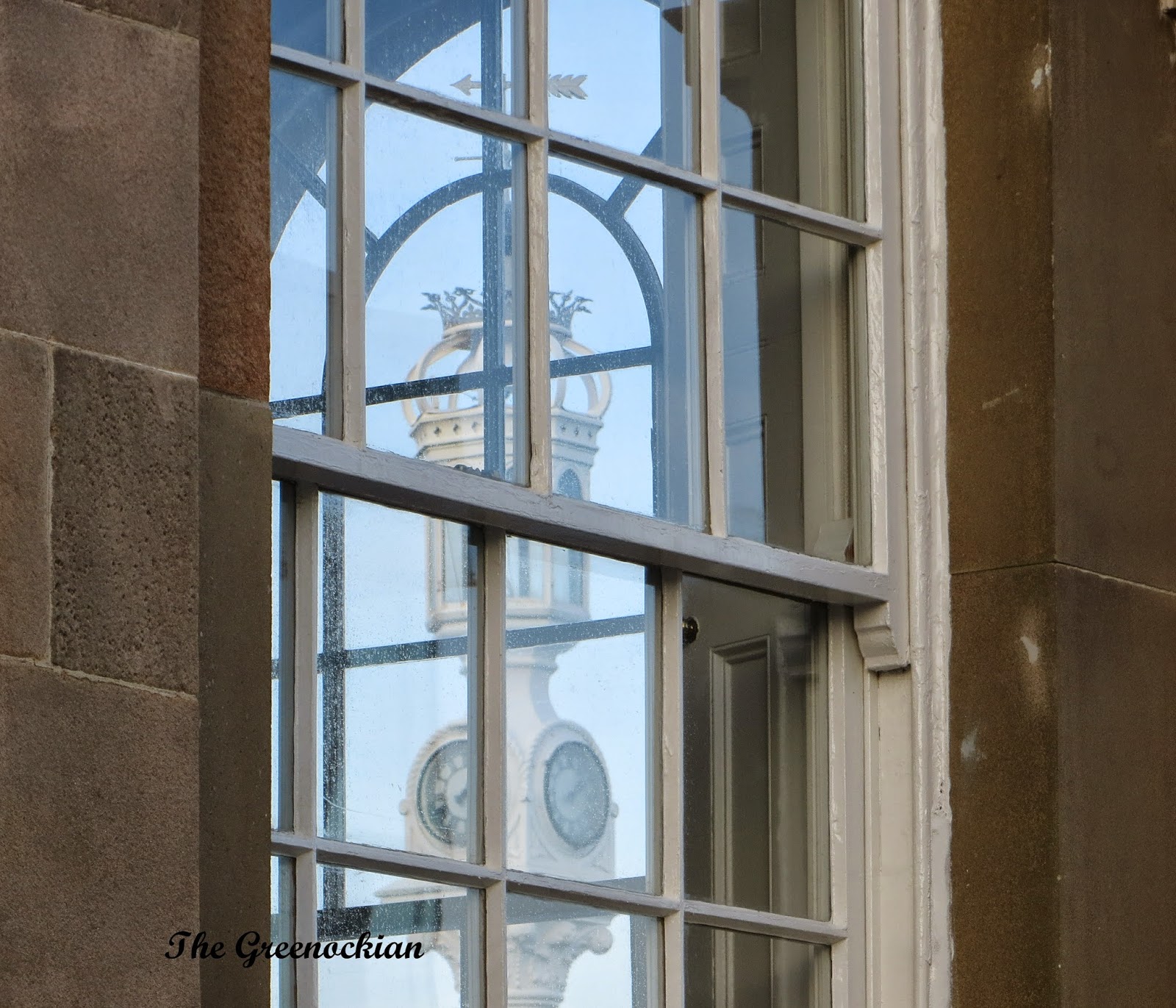
Beacon Reflected

Greenock's Beacon clock tower reflected in the windows of the Custom House.


Joining Weekend Reflections.


The Greenockian

Wednesday, 5 February 2014

Crinoline Capers

I ended my last post wondering about the stories Customhouse Quay could tell.  Perhaps this is one escapade from  August 1859 it would be better to forget!


Yes - the unfortunate woman's crinoline became detached - how embarrassing!  But how funny that some little scamps captured it, and attached it to a steamboat to be towed away goodness knows where!


The fashion for crinolines reached its height (or should I say width) by the mid 1860s.  While they were fashionable, they attracted a lot of criticism - mainly from male commentators.  One imaginative writer in 1858 wrote an amusing, and decidedly tongue in cheek, article entitled "Crinoline for Criminals" in which he condemns crinolines for encouraging their wearers to theft, explaining that items could be easily concealed under the skirts!  


One paragraph in particular caught my attention:-
"Concealed beneath the skirts of a fashionable dressed female were, the other day, discovered by a vigilant detective the following choice proofs of her propensity to plunder;"
A vigilant detective, eh??!! 

Death by crinoline was not uncommon, the unruly items could be caught in machinery and drag their unfortunate wearers with them - fashion victims indeed!  Boating accidents and high winds were also detrimental to crinoline wearers, as can be imagined.


I suppose the only people to gain from this particular fashion, aside from the satirists, were the fabric manufacturers - yards and yards of the stuff must have been used for each dress to cover such wide hoops!

The Greenockian

Sunday, 2 February 2014

The Beacon Clock Tower and So Much More

On Friday I described the top part of the Beacon  clock tower at Customhouse Quay in Greenock, designed by William Clark, marine artist.  There was a weather vane, a fog bell, a fog light and clock.  Today it is the turn of the lower section which is just as interesting and contains an amazing amount of detail.


This was a drinking fountain with a beautiful lion's head and crest with the words "God Speed" - very apt considering many there would be going on a journey, as well as being part of Greenock's own motto.


There was also a letter box.  I wonder how many tear-stained last words were sent from here before folk went off to different lives in far flung corners of the globe.


The Beacon itself was made at Rankin & Blackmore's Eagle Foundry in Greenock (Baker Street). 


This is a view of the Beacon with the magnificent Custom House behind it.  It must have been a very welcome sight for people returning to Greenock to meet with old friends and family. 


The stories this could tell!

The Greenockian

Friday, 31 January 2014

Versatile Victorians

One of the things I love about Victorian builders and designers was their ability to merge the functional with the decorative. 


The Beacon clock tower at Customhouse Quay in Greenock is a fabulous example of this.  Designed by local marine artist William Clark (1803-1883) and erected in 1868, it is wonderful to look at and also contains features essential to its position on a busy quay.  I'm only going to describe some of them and leave the others for another day.  Let's start at the top -

weather vane

fog bell
fog light

clock

 This picture shows the Beacon as it was in 1878.


(The photograph comes from the book  "Greenock From Old Photographs" (ISBN 950068713)by Matt Anderson and Joy Monteith, published in 1980 by Inverclyde District Libraries.)


The Greenockian

Friday, 3 January 2014

Reflected In Puddles

I took these photographs at the weekend down at Customhouse Quay in Greenock.

 
Great reflections of the fence in the puddles.

 
Joining Weekend Reflections – pop over and see more fabulous photographs from around the world.


The Greenockian