Showing posts with label Inverkip Street Cemetery. Show all posts

Wednesday, 16 April 2025

Rev Dr John Scott of the Mid Parish, Greenock

John Scott became the minister of the Mid Parish Church (or the New Church) in Cathcart Square, Greenock in May 1793 as successor to Rev Dr John Adam.  (The Mid Parish Church is now called Wellpark Mid Kirk.)

Rev Dr John Scott - notice picture of Mid Parish Church in background.

Born in Logierait, Perthshire in 1763, he was educated locally before attending the University of Glasgow.  He was licenced to preach by the Presbytery of Glasgow in 1787.  Like many newly qualified young ministers, his first job was as a tutor to the large family of John Wallace, father of the well known Greenockian, Robert Wallace. He was ordained in 1793 and became minister of the Mid Parish Church in Greenock. In 1803 he was awarded the degree of Doctor of Divinity by the University of Glasgow.

In 1796 he married Susan Fisher and the couple had several children.  Unfortunately only one son, Alexander John Scott (1805-1866) and a daughter, Margaret lived to adulthood.  Their other children died very young - three of them dying in 1811.

George Williamson in “Old Greenock” describes  him as “an eloquent and evangelical preacher, a very presentable person, dignified and formal in manner.  He was among the last of the town ministers who wore long black silk stockings, and short trousers buttoned or tied with silk ribbon at the knee.  In the pulpit he wore black gloves, silk or leather, in conformity with ministerial etiquette, and it used to be remarked that the glove of the forefinger of the right hand had a small slit near the end, to admit of his easily turning the leaves of his Bible or manuscript while reading or preaching.  His congregation stood in considerable awe of him.”

Mid Parish Church, Cathcart Square, Greenock

He was appointed chaplain in the early days of the Loyal Greenock Volunteers and was instrumental in the setting up of the Ann Street Charity School for the free education of children who were "orphans, fatherless or had no prospect of being educated elsewhere."

In 1813 the Scott family moved to their new manse in Houston Street (at the corner of Kelly Street) in Greenock.  Previously the manse had been near to the church, just to the west in the appropriately named, Manse Lane.  In 1829 Susan Scott died and in the same year John Scott suffered from a stroke while attended the General Assembly in Edinburgh.

Rev Dr John Scott died in Greenock in 1836 and was buried with his family in Inverkip Street Cemetery.  The inscription on the gravestone reads - 

John Scott DD aged 43 minister New Parish died 26.3.1836.  Wife Susan Fisher died 1.11.1829.  Daughter Susan Hutchison born and died 1801.  Mary died 7.3.1811 aged 14 y 4 m.  Jean died Gourock Bay 18.9.1811 aged 7.  John died Gourock Bay 21.10.1811 aged 12.

In his later years in Greenock from 1831-1834 he had an assistant, Rev William Cunningham who later went on to become one of the leaders of the Free Church movement which led to the "Disruption" of 1843.


Tuesday, 11 April 2023

Sir Gabriel Wood and the compensation claim

This interesting notice appeared in many newspapers both in Britain and overseas in 1891 in connection with Sir Gabriel Wood (1767-1845), founder of the Mariners' Home in Newark Street, Greenock.

Former Sir Gabriel Wood Mariners' Home, Greenock

It reads:- HEIRS WANTED - Wanted, the next of kin, or heirs, of the late Sir Gabriel Wood, Commissary General of the Forces, some time residing in Greenock, in Scotland and latterly in Bath in England where he died without issue on 29th October 1845.  Sir Gabriel Wood was a son of Gabriel Wood, merchant, Greenock, who died in Greenock in 1822.  In 1796 he was Vice-Consul for the State of Maryland.  He afterwards resided in the West Indies, and before finally returning to Great Britain was resident in various places in Canada as Commissary-General of Accounts for British North America.  He had a number of brothers and sisters, some of who went abroad, and they may have descendants living.  Should any of the relatives of Sir Gabriel Wood be alive and will communicate with the subscribers they will receive information which will be of advantage to them.  J. C. Smith, Macdonald & Crawford, Solicitors, Greenock, North Britain.

In 1891 a firm of Solicitors in Baltimore had contacted the “Mayor of the town of Greenock” asking for information about a one time Maryland resident, Gabriel Wood.  Gabriel Wood is best known in Greenock as the founder of the Sir Gabriel Wood Mariners' Home in Newark Street, Greenock.  He was born in Gourock in 1767 to merchant Gabriel Wood and his wife Ann Stuart (Stuarts of Castlemilk, owned Gourock estate).  Gabriel Wood worked for the Government and in 1796 he accompanied Sir Robert Liston (1742-1836) to America where he was vice Consul for the State of Maryland. 

While in Maryland he set up business as Gabriel Wood & Co, owning several ships.  He was a partner in the firm of Findlay, Bannatyne & Co, running the Baltimore branch of the company trading between Britain, America and the West Indies.  Several of his ships had been captured by the French during what is know as the “Quasi War” with France.  A claim had been made by the American Government against the French Government for the value of all vessels owned by American citizens captured by the French.  Somehow Gabriel Wood was listed as due compensation for his lost ships.

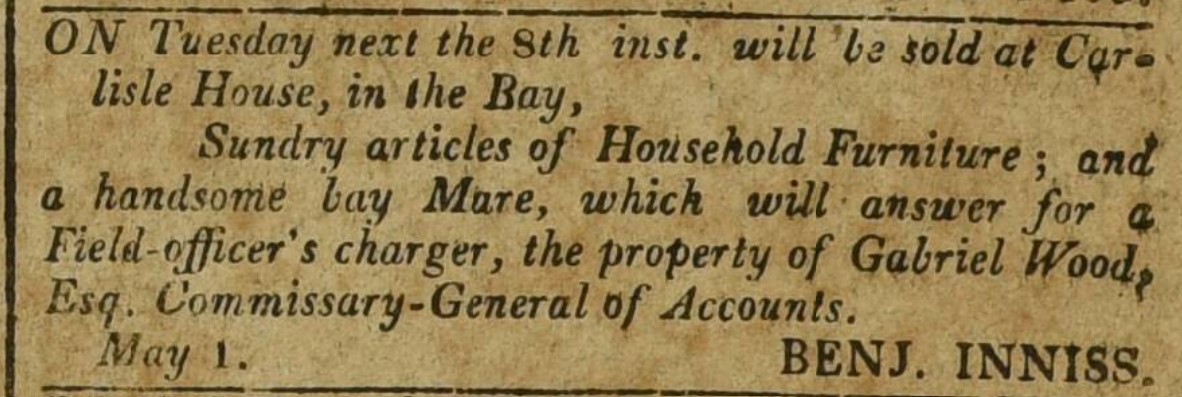
From the Barbados Mercury 1810

He returned to Britain in 1806 and was shortly afterwards sent to the West Indies as Commissary General of Accounts.  In 1811 he was stationed in the Mediterranean, returning to Britain in 1816.  His next appointment was as Commissary General of Accounts in Canada, but had to return to Britain in 1823 because of ill health.  He received a knighthood in 1825.  In 1830 he married Louisa Augusta Fanning, eldest daughter of General Edmund Fanning (who had inherited land in Prince Edward Island from her father). The couple did not have any children.  After his marriage he resided mostly in Bath until his death in 1845.  In his will he bequeathed a sum to be used in establishing a Home for Mariners.  Lady Wood  and Sir Gabriel’s sister, Frances Ann Wood were responsible for the establishing of the Mariners Home.  Presumably, over the years, the compensation claim had been forgotten.

However, in 1891 the Baltimore solicitors were looking at unclaimed funds and had contacted authorities in Greenock.  When the notice of "Heirs Wanted" appeared none of the immediate family were still alive.  The beautiful Mariners' Home was their legacy in Greenock.  It was reported that the Solicitors dealing with the matter received over 200 letters from people claiming to be heirs of the Wood family.  Only one was true - a man named Gabriel Watson from Paisley was able to prove to the American Government that his great grandmother was a sister of Sir Gabriel Wood’s father.  The money, compensation for those ships captured almost 90 years previously, was split between Watson and the Mariners' Home.  The Mariners' Home received the sum of £778 from the American Government.

Wood Family grave in Inverkip Street Cemetery, Greenock

Monday, 12 July 2021

William Simons, Shipbuilder, Greenock

William Simons a shipbuilder and his brother, Peter Simons (1785-1869) who was a sailmaker started shipbuilding in Greenock in 1810 under the name William Simons & Co.  In 1810 they built the brig Janet Dunlop (180 tons) which sailed to Quebec.  The ship was commissioned by James Dunlop - a Scot (from Glasgow) and who also had business with Alan Ker & Co of Greenock.  He was a rich merchant who had settled in Montreal and often travelled back to Glasgow where he had family. The ship was meant for trade between Scotland and Canada (via Jamaica).  On one of her return journeys to the Clyde she had a general cargo amongst which was flour, beef, tar, candles staves and hoops for barrel making.  It was probably through this contact with James Dunlop that the Simons brothers travelled to Canada in 1812 at the start of the British-American war.  (James Dunlop was also a major shipbuilder in Canada.) 

HMS Linnet - source

The Simons brothers went to Ile-Aux-Noix situated in the Richelieu River which was the site of a Royal Naval Shipyard and fortifications during the British War of 1812-1815.  It was in an important strategic position near the Canadian border and gave access to the interior.  The Americans were trying to gain territory from the British and had positioned warships in Lake Champlain.  As a reply to this threat, the British build a shipyard on the Island and started building warships and gunboats there.  William Simons built the warship HMS Linnet, originally called Niagara which was launched in 1814.  HMS Linnet was a 16-gun brig and was commanded by Commander Daniel Pring RN.  The ship was captured by the Americans in 1814 at the Battle of LakeChamplain (also called Battle of Plattsburgh).  Another of Simons’ ships HMS Confiance was also captured in the same battle with Admiral Sir George Prevost on board.  (After the war, the Canadian shipbuilder John Goudie sent his son James to Greenock as an apprentice to William Simons to learn about steamship construction.) 

Ile-Aux-Noix map - Library of Congress
William’s brother Peter Simons and his wife Margaret McNeil remained in Canada.  Peter’s son John opened a small general store at Lake Beauport, Quebec importing goods from Britain.  That business was continued by his son William and  grew into what is now a large department store business in Canada - La Maison Simons.

On his return from Canada, William Simons (?-d1839) married Margaret Denniston (1789-1852) in 1816 in Greenock.  The couple would go on to have five children who grew to adulthood – John (1817-1888), William (1821-1902), Mary (1823-1903), Margaret (1825-1907) and Peter (1827-1875).  As can be seen from the family gravestone in Inverkip Street Cemetery, Greenock, other children died in infancy.  In Greenock, the family lived at St Andrew’s Square – just across Rue End Street from where Simons’ shipbuilding yard was situated (just west of Robert Steele’s yard).  The shipbuilding yard later became part of the Victoria Harbour in Greenock.

The Victoria Harbour from St Andrew's Square, Greenock 2021

William Simons ran a busy and successful business, building a variety of ships for various merchants for trade all over the world.  In 1819 the ship Robert (316 tons) was launched in Greenock.  It was built for G & R Denniston & Co of Glasgow.  In 1825 the brig General Wolf was built at Greenock.  In 1826 the company started building steamships as well as wooden vessels.  One of the first was Fingal (290 tons) built for owners in Belfast.  The company also built yachts for private individuals.

William Simons died in Greenock in 1839 and was buried in Inverkip Street Cemetery.  On the death of their Mother Margaret in 1852, the family sold their extensive property in St Andrew’s Square and moved away from Greenock.

William Simons’ sons John and William successfully continued the shipbuilding business.  Their shipyard at St Andrew’s Square was required when the local authorities decided to build a large new harbour in the area.  The family business was moved to Whiteinch.  In 1860 the firm moved again to Renfrew – the LondonWorks.  William took on a new partner, AndrewBrown (1825-1907) of Renfrew.  They began to specialise in dredgers which were extensively used on the River Clyde and exported worldwide.  The firm were internationally know as innovators in all types of shipbuilding.  

William Simons retired from the business in 1880.  In 1862 he had married Margaret Montgomery Neilson the daughter of James Beaumont Neilson (inventor and engineer) and his wife Barbara Montgomery of Queenshill, Tongland in Kirkcudbright.  William and Margaret Simons lived for a while at Yoker Lodge before retiring to Tighnabruaich.  William Simons took an active interest in public affairs in Renfrew and was a member of the Town Council.  He died at Sherbrooke, Tighnabruaich in 1902 and was buried in Greenock Cemetery.  The company continued in various forms having been taken over by Andrew Brown (William’s father in law) and two of his sons – William and Walter.  In 1959 it merged with G & J Weir and then with Lobnitz & Co Ltd and became Simons-Lobnitz Ltd, Shipbuilders.  The company ceased trading in 1964.

After the move to Renfrew in 1860, John Simons, eldest son of William Simons became involved with the Royal Renfrew Militia and began to take a back seat in the running of the company.  In 1861 he married Janet Crammond (daughter of Peter Crammond of Carnoustie).  They had two daughters Jessie and Joan.  John died at 7 Hunter Place, Monifieth Road, Broughty Ferry in 1888.  His brother, Peter, studied to be a Church of Scotland Minister but did not actually take up a charge.  He married Cecile Easton in 1865 at Meadowbank Place, Partick, Glasgow. (Cecile was the daughter of Dr William Easton of Glasgow and his wife Agnes Strang.)  They lived at Beechfield House, Bothwell Road, Hamilton with twins William Easton and Agnes Simons who were born in 1871 and Cecile born in 1872.  Peter Simons died in 1875 at Montgomerie Terrace, Cathcart. 

Of the two Simons daughters – Mary married the Rev Peter Richardson of the Free Church, Dailly in Ayrshire in 1854.  She died at Edinburgh in 1903.  Her sister Margaret did not marry and died at Dunoon in 1907. 

Gravestone of William Simons and his wife Margaret Denniston, Greenock
The Simons family were an important part of Greenock’s shipbuilding heritage.  It is such a shame that the gravestone of William and Margaret Simons in Inverkip Street Cemetery is in such a sad state of repair.

Thursday, 1 July 2021

The Greenock Galts

John Galt is perhaps the most well-known of the inhabitants of Inverkip Street Cemetery.  He is buried alongside his family here.  The grave (now very overgrown and difficult to read) consists of three large flat stones.

The first stone marks the burial place of  John Galt (1750-1817) and his wife Jean Thomson (1746-1820).  John Galt (1779-1839), writer, explorer and founder of the city of Guelph in Canada is added on at the end - almost as an afterthought -

Here are deposited the remains of John Galt, formerly shipmaster, and afterwards merchant in Greenock.  He died 6th August 1817 in the 67th year of his age having uniformly enjoyed the esteem of all who knew him.  Also Jean Thomson his spouse who died 18th July 1826 in the 80th year of her age.  Also John Galt their son who died on the 11th April 1839 in his 60th year, author of The Annals of the Parish etc etc.

John Galt and Jean Thomson were married in Irvine in Ayrshire in 1776.  Their son John was born in 1779 at Irvine.  

The family moved to Greenock when John was 10 years old.  As a shipmaster, his father found it more convenient and probably more financially rewarding to sail from Greenock.  He was connected with trade to the West Indies .  John Galt (senior) built a house with a garden at the north west corner of Westburn Street and West Blackhall Street in Greenock.  There's a plaque on the wall where the house once stood.  At that time the area would have been much quieter, and not as built up as it was later to become.

John and Agnes Galt had three children - John, Agnes and Thomas.  John Galt described his parents - 

"My father was one of the best, as he was one of the handsomest men, but he was of an easy nature.  My mother was however a very singular person possessing a masculine strength of character with great natural humour ..."

I suppose his mother would have to have been a strong woman with her easy-going husband being away at sea for much of the time.  She had educated John at home when he was younger and they lived in Irvine.  He had many memories of those days which he wrote about in his autobiography.

John Galt was educated in Greenock and then went to work as a clerk in the Custom House.  He later moved to London where he had a variety of jobs and also had several of his novels published.  He married Elizabeth Tilloch (1781-1851) in 1813.  Elizabeth Tilloch was the daughter of Alexander Tilloch (1759-1825) a Scots born printer and writer whom Galt met in London.

Annals of the Parish, which is perhaps his best known work was published in 1821.  Well worth reading if you are interested in Scottish social history, it is mentioned on his grave stone.

He later became involved with the Canada Company set up to encourage the settlement of Crown Land there.  He travelled over much of Upper Canada and was the founder of the city of Guelph in 1827 along with a fellow Greenockian, Dr William (Tiger) Dunlop who was the son of Alexander Dunlop of Keppoch, whose family are also buried in Greenock's Inverkip Street Cemetery. 

After some time in Canada Galt returned to Greenock in ill health.  He lived with his wife and sister Agnes in the family home in Westburn Street.  He died there in 1839 and was buried with his parents in the Inverkip Street Cemetery.  His wife returned to Canada where their three sons lived.

The third gravestone marks the burying place of John Galt's sister Agnes Galt  (1781-1855).  

This stone is erected in affectionate remembrance by Agnes Galt, widow of Robert Andrew Macfie, late merchant in Greenock who died 28th October 1811 esteemed by those who knew him best.  Surviving all parents, brothers, husband and children, during a long pilgrimage throughout which upheld by Christian hope she bore with patience, much bodily suffering and sealously sought the kingdom of God on earth.  This old disciple finished her course in peace 30th April 1855 and was buried here.  Phil III, 20.21.

Agnes married Robert Andrew Macfie in Greenock in 1806.  Robert was a grocer and merchant in Greenock, son of Robert Macfie sugar refiner in Greenock and his wife Mary Andrew (he was one of 11 children) .  He died in 1811 and is buried here.  Agnes Galt Macfie died at 7 Brougham Street in Greenock in 1855.  She is buried here with her husband.  She had outlived all her family as the gravestone poignantly mentions.

The middle stone marks the burying place of the three children of Agnes and Robert Macfie.  Their son, Robert Andrew and daughters Mary and Jane Thomson died relatively young. 

Robert Andrew McFie, fell asleep in Jesus 28 October 1824 in the 17th year of his age and Mary, his sister 13th May 1826 having just copleted her 15th year.  Both died in faith with joyful hopes of a blessed immortality.  Also their sister Jane Thomson Macfie who departed this life with longing desire to be with Christ.  She died 5th September 1831 age 22 years.  The Saints in early life removed in sweeter accents sing and blessed the swiftness of the flight that bore them to their King.


That ends the story of the Galts of Greenock.  However John Galt's three sons  - John Galt (1814-1866), Thomas Galt (1815-1901) and Alexander Tilloch Galt (1817-1893) all played their part in the formation of Canada.  You can read an excellent article about them by the Guelph Historical Society here.  I'm sure their father would have been very proud of them.
I've uploaded a short presentation to YouTube about the Galt family graves in Inverkip Street Cemetery.  Check out my channel Greenockian for more short presentations.

Tuesday, 22 June 2021

The Dunlops of Greenock

In Inverkip Street Cemetery in Greenock is the gravestone of some members of the Dunlop family who were associated with Greenock.  The gravestone has a lengthy list of those buried there.  It also mentions some revered family elders, thus establishing the Dunlops reputation as one of Greenock’s “first families”.  

Source

The legend on the stone reads -

The burial place of John Dunlop Esq late Tide Surveyor Greenock

At this spot lie the remains of his brother Major Hutchison Dunlop 53 Reg Foot Obit May 1790 Age 45

Mrs Janet Graham wife of his son Alexander Dunlop merchant in Greenock now of Keppoch.  Obit 7th June 1795 age 26

John Dunlop Tide Surveyor Greenock obit 1 Jan 1805 – age 75

Sarah Dunlop his sister - daughter of Alexander Dunlop Professor of Greek in Glasgow University

Son of Principal Dunlop and nephew of Principal Carstairs obit April 1805 age 87

Henry Liston Dunlop son of Alexander Dunlop first mentioned obit 10 May 1808 – age 7

Robina Liston Dunlop daughter of the same obit August 1815 – age 3

Mrs Jean Dunlop or Fisher spouse of John Dunlop above mentioned and daughter of Mr Fisher minister of Maybole obit March 1817 - age 79

An infant son of John Dunlop writer in Greenock son of Alexander Dunlop first mentioned obit 1819

Thomas Dunlop son of John Dunlop last mentioned obit June 1826 – age 1

An infant daughter of John Dunlop last mentioned obit 1829

Margaret Jean Dunlop daughter of John Dunlop last mentioned obit 6 September 1835 – age 16

Mary Janet Dunlop daughter of John Dunlop last mentioned ob 23 Feb 1834 – age 7

(The mural can be found on the north wall adjoining John Galt House of Inverkip Street Cemetery.)

Principal William Dunlop

So, who were these Dunlops and what was their connection with Greenock?  Originally from Ayrshire, the family’s connection with Greenock goes way back to the days of the Covenanters – a  presbyterian religious group persecuted in Scotland in the 17th century because they did not agree with the religious practices being forced on the people of Scotland at the time.  (This is my very simplistic view of “The Killing Times” as it was called.)  For more information the BBC has some interesting information.  The Dunlops were involved in the Covenanting movement – William Dunlop left in a ship called the Carolina Merchant which left from here in 1684 taking 35 prisoners accused of being Covenanters to America as indentured servants to work in the British colony in South Carolina.  You can read my blog post about the event here. 

WilliamDunlop returned to Scotland and eventually became Principal of Glasgow University.  He was married to Susan Carstairs (died 1733), the sister of William Carstairs.  William Carstairs was also a Covenanter who had been imprisoned and tortured for his beliefs.  Carstairs moved to Holland where he became Court Chaplain to William Prince of Orange and on their return to Scotland he became Principal of Edinburgh University.  That is why they are named on the stone as "Principal Dunlop" and "Principal Carstairs".

Alexander Dunlop (died 1747), Professor of Greek at Glasgow University was the son of  Principal William Dunlop.  He married (second wife) Abigail Mure (died 1762) and their son - John Dunlop (1730-1805) is the first name on the grave marker.  He was Tide Surveyor in Greenock.  Tide Surveyor was an important customs position, especially in a busy port like Greenock.  The Tide Surveyor kept an eye on ships arriving and what was being landed – making sure that customs duties were being paid.  He worked from the West Quay in Greenock.

He lived in Greenock and married Jean Fisher in 1763 in Ayrshire.  Jean Fisher (died 1817) was  the daughter of the Reverend Robert Fisher, minister of Maboyle Church in Ayrshire.  Jean is also buried here in Greenock.  The Tide Surveyor and his family seem to have lived somewhere in the Dellingburn area of Greenock (situated on the main road from Greenock to Crawford’s Dyke).  John was said to have been a very convivial, good humoured man.

Source
Alexander Dunlop of Keppoch (1766-1840), mentioned on the stone is the son of John Dunlop and Jean Fisher.  He was a merchant and banker in Greenock and was involved in the Renfrewshire Bank, set up in Greenock in 1802 by Dunlop and several other merchants.  (You can read my blog post about this by clicking on the link.)  He was also a Senior Magistrate in the town and Chairman of the Chamber of Commerce.  A member of the local Volunteers, Alexander Dunlop was in charge of the Greenock men who were sent to help quell the Riot of 1820.

Alexander's first wife was Janet Graham (also buried here).  She was the daughter of Robert Graham and Mary Hill (of Gairbraid, Glasgow).  On her death in Greenock in 1795 she was buried here at the Inverkip Street Cemetery.  In 1796  Alexander married Margaret Colquhoun (died 1818) (Edinbarnet, Dumbartonshire).  Alexander Dunlop bought the estate of Keppoch (near Cardross in Dumbartonshire where he built Keppoch House).  He died in 1840.  His estate of Keppoch was sold off to pay some of the debts of the Renfrewshire Bank which failed 1842.

Bank House - premises of the Renfrewshire Bank, Greenock

Major Hutchison Dunlop (mentioned on the stone) was the brother of John Dunlop (Tide Surveyor).  He joined the Army at an early age, going on to become Major and fought in America during the French and Indian War (1754-1763) at Ticonderoga.  He was unmarried and retired to Greenock to live with his brother John.  He died in Greenock in 1790.

Some of the other names on the stone are members of the family who died young and were buried here.  The next generation of Dunlops would also be greatly involved in the fascinating history of Greenock.

Check out my YouTube Channel - Greenockian - to see a short presentation on the Dunlop Family of Greenock.

Friday, 25 October 2013

John Galt - Who Stole His Head?

John Galt (1779-1839) is perhaps one of Greenock's most famous inhabitants - chiefly known as a novelist and poet. 

 
Although he was born in Irvine, his family moved to Greenock when he was young, and he died here after a life spent in many other parts of Britain and abroad.  There are several plaques commemorating him in the town.

 
This plaque is on the wall of a building on the corner of Westburn Street and West Blackhall Street and marks the place where the house in which he died once stood.


 John Galt is buried in the Inverkip Street Cemetery in Greenock.  This plaque is at the entrance to the cemetery.  He is buried along with other family members - his parents and sister.


The grave is beautifully kept.

 
Galt is also commemorated by a fountain on the Esplanade at the bottom of Roseneath Street .  This was the idea of Allan Park Paton, former librarian of Greenock.


This is what should be in that space!
Unfortunately, the metal plate of his profile has been stolen by vandals.  Let's hope that a replacement will be put in place soon.

 
John Galt was a remarkable man.  I'll be writing much more about him in later posts.

The Greenockian