Saturday, 10 January 2015
Stormy Gourock
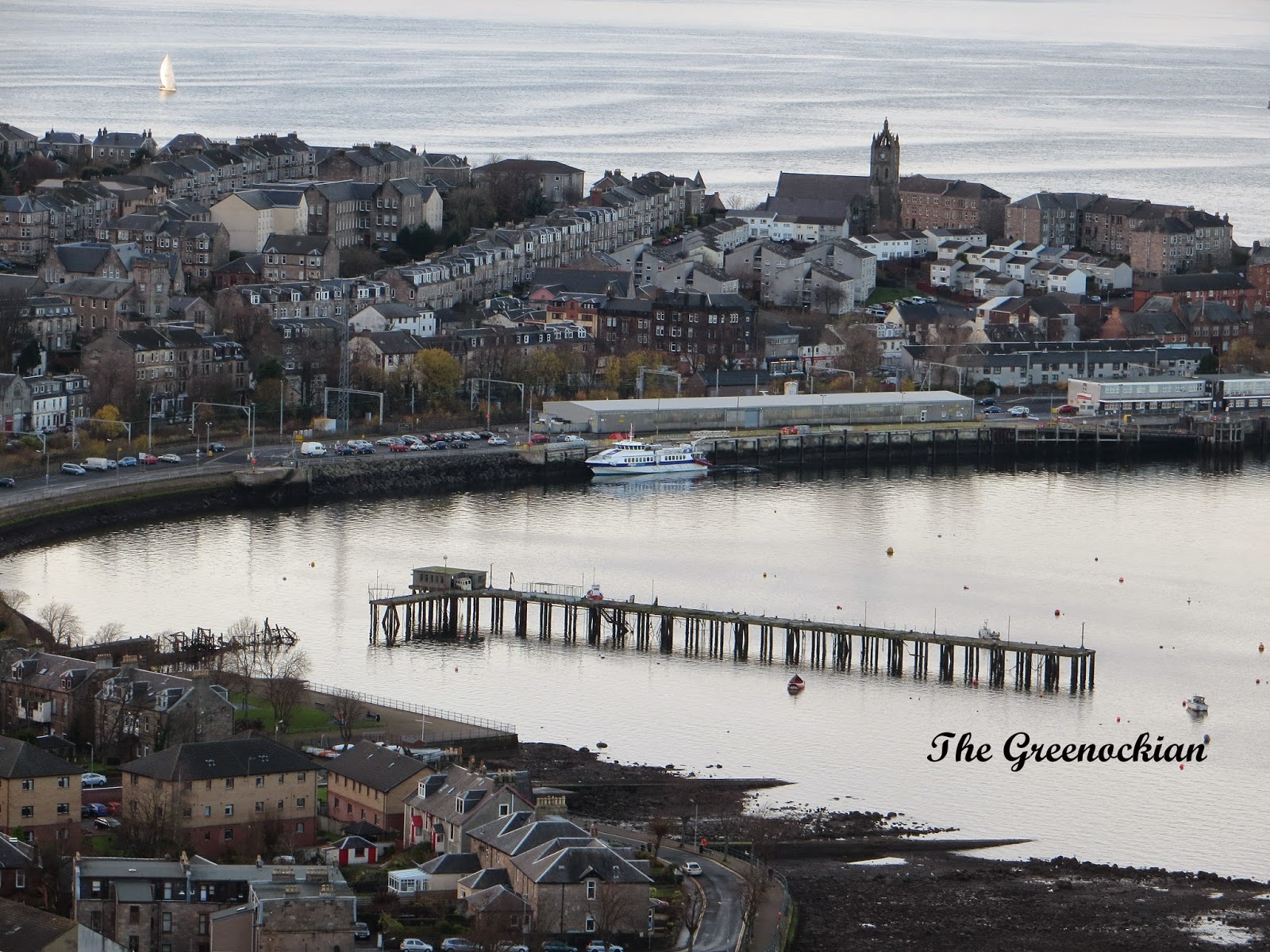
Still a bit stormy here in Inverclyde today.
Went down to Gourock - there was a high tide and the waves were amazing!
Labels:
Gourock
Friday, 21 November 2014
East India Harbour Reflections
The River Clyde was beautifully calm last Sunday when I took this photograph.
These boats can be found in Greenock's East India harbour. I liked the way the mast was reflected in the water.
Joining with Weekend Reflections.
These boats can be found in Greenock's East India harbour. I liked the way the mast was reflected in the water.
Joining with Weekend Reflections.
Labels:
Clyde
Monday, 17 November 2014
Rusty Relics
Out and about in Greenock yesterday.
Enjoyed taking photos of some old rusty relics of Greenock's industrial past.
The Greenockian
Enjoyed taking photos of some old rusty relics of Greenock's industrial past.
The Greenockian
Labels:
Greenock
Friday, 14 November 2014
Mearns Street School - No More!
I blogged about Mearns Street School in Greenock's in December last year and expressed the hope that it was not due for demolition.
Well ... guess what?!
Yup - it has gone!
All those lovely architectural details smashed. What a shame!
The Greenockian
Well ... guess what?!
Yup - it has gone!
All those lovely architectural details smashed. What a shame!
The Greenockian
Labels:
schools
Thursday, 23 October 2014
Old Greenock Gates
These old Greenock gates have seen better days!
They show Greenock's coat of arms - you can read what the symbols mean here.
God Speed Greenock - a proud motto from Greenock's past as a leading trading port and shipbuilding town.
One side of the gates has weathered better than the other. They are on a quiet street, not many people will have noticed them.
Hope one day these are taken away from the yard they open into, restored and given a much better home somewhere where they can be seen and appreciated by many more people.
Joining with Good Fences - come over and join us.
The Greenockian
Labels:
coat of arms
Sunday, 19 October 2014
Lyle Kirk, Greenock
This is Lyle Kirk, Union Street in Greenock. It was built in 1871 by architect John Starforth (1822-1898).
At that time it was called Trinity United Presbyterian Church, one of many which lined Greenock's Union Street in those days. It became Ardgowan Parish Church following an amalgamation with another church and is now part of Greenock's Lyle Kirk.
I love the incredibly detailed carving in the tympanum - wonderful!
A beautiful building.
Joining with InSPIRED Sunday - come on over and see many other beautiful churches from all over the world.
The Greenockian
Labels:
architecture,
church
Thursday, 16 October 2014
Wednesday, 24 September 2014
Former Buttercup Dairy, Kilmacolm
These beautiful tiles come from the entrance to a shop in
Kilmacolm. Now a small electrical shop,
the tiles show that it was once a branch of the Buttercup Dairy Company.
Founded by Andrew Ewing in 1904, at its height the company
had over 250 shops throughout Scotland. The picture is of a little girl feeding a
buttercup to a cow and is taken from a painting by Thomas Curr (1887-1958).
The tiles were part of the Company's distinct branding. Even the floor tiles at the entrance
are wonderfully decorative.
The tiles were manufactured by the Glasgow firm of James
Duncan Ltd. You can read about them, and
their association with the Buttercup Dairy Co here.
The
Greenockian
Friday, 29 August 2014
On the River Clyde Recently
Some small ships/boats on the Clyde recently.
Can anyone tell me - when does a boat become a ship?
The
Greenockian
Friday, 15 August 2014
Newark Castle, Port Glasgow
Couldn't resist taking these photographs of the Doo'cot (dovecot) at
Newark Castle in Port Glasgow.
It was such a beautiful day and the view of the hills of Argyll across
the River Clyde was just fabulous.
Read more about Newark Castle's doo'cot here.
The
Greenockian
Sunday, 22 June 2014
Tuesday, 17 June 2014
Sinking of the Pomona 1859
It was (and probably still
is) every emigrants dream - to succeed and create a new life in a distant
land. Greenock mill worker William
Caldwell formerly of Duncan Street, emigrated to America and found employment
in New York. By the beginning of 1859 he
had saved enough money to send home to Greenock so that his wife and four young
children, two sons and two daughters, could travel out to be with him. Arrangements were made and his brother
travelled with the young family to help on the journey to Liverpool where they
would board the emigrant ship Pomona. At 5am, as she waved goodbye to her brother
in law, I wonder how Mrs Caldwell felt as she stood at the ship's rail with her
little children and the prospect of a long voyage ahead.
The New York based clipper Pomona (1500 tons) owned by the D L
Line, sailed from Liverpool on 27 April 1859 with a crew of 36 under Captain
Merrihew. There were 380
passengers. The mood on board was happy
as this newspaper clipping shows - there was music and dancing on deck.
However, later that night the
weather changed, high winds got up and the ship was slightly off course. The winds drove the ship onto the Blackwater
Bank - a notorious sandbank in Co Wexford, Ireland.
Attempts to launch the lifeboats failed and several crew died in the attempt. All night the pumps were manned and eventually, the next day a small boat was launched. In it were the 3rd mate, Stephen Kelly, along with 18 crewmen and 3 male passengers. As the howling gale continued, the ship slipped off the sandbank and immediately filled with water and sank. Captain Merrihew, his 1st and 2nd mates and the rest of the crew, went down with the ship as did all the passengers.
The only survivors were those in the boat, who immediately on reaching shore raised the alarm (although it is said that they all, with the exception of Stephen Kelly removed themselves from the scene). But by the time the lifeboat reached the stricken ship, only the mizzen mast was visible. Almost 400 lives had been lost.
Men, women and children, many
of whom, like the Caldwell family from Greenock, would have been looking
forward to being reunited with loved ones and starting new lives in America. As the long day wore on, bodies began to wash
ashore at Ballyconigar beach and along the coast. Unfortunately some locals stripped the
clothes from the bodies. They were
eventually caught and severely punished.
A sad tale, but not uncommon
in those days when the winds and weather could dramatically alter the fate of
a voyage.
Interestingly, another victim of the sinking was Irishman Henry Lavery, a Belfast publican on his way to New York to find work. He left behind a wife who died of grief three months later and a young son who went on to become the acclaimed Glasgow trained artist Sir John Lavery.
The Greenockian
Subscribe to:
Posts (Atom)