Wednesday, 2 May 2018

Darroch Mausoleum, Gourock


Hidden away in Gourock Park is a memorial to the family who gifted the land to the local people - the Darrochs.
  

This is the Darroch Mausoleum or Vault.


It is the final resting place of many of the family members who once lived in this beautiful setting.  Duncan Darroch, who was said to have made his money in the West Indies, bought the land from the Stewarts of Castlemilk in 1784.  The original Gourock Castle, seat of the Finnart Stewarts was within these grounds, but was destroyed before Duncan Darroch bought the land.  A look at old maps shows where it was once thought to be, near the burn (stream) that runs through the park.


Duncan Darroch settled there with his family and eventually his descendants donated the land to the people of Gourock.  It used to be called Darroch Park, but for some reason the name was changed to Gourock Park.  Gourock House was bought by the town council, but was demolished in the 1940s.


The mausoleum has been allowed to remain.  In 'Memorials of Clutha; Pencillings of the Clyde' (1842), the author, Elvira Anna Phipps writes of a visit there -

"Above the glen, is a wild, romantic spot, thickly wooded, and in this recess is the family mausoleum.  It is pleasant, indeed, to visit the quiet resting place of the dead, when you can do so "in sure and certain hope" that the departed ones are waiting for a glorious resurrection … Hence I admire the simple tablets which this family have reared."


Let's hope that the Mausoleum lasts for some time to come as a reminder of the family who gave this lovely place to the people of Gourock.


Thursday, 22 February 2018

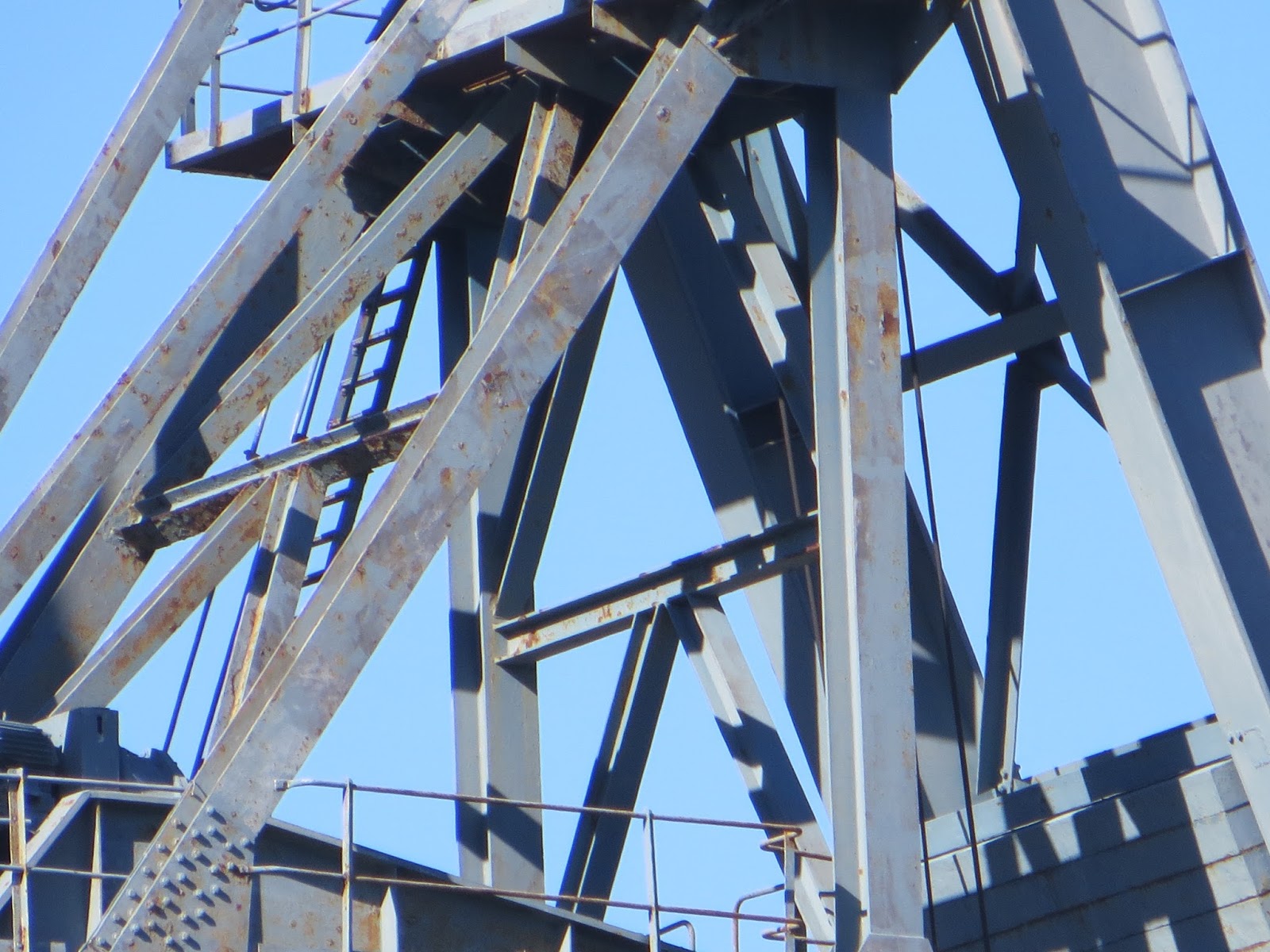
The Inchgreen Cranes

I called them the Three Graces.


Until July last year these three cranes graced the Clyde shore at the Inchgreen Dry Dock between Port Glasgow and Greenock.  Two were luffing cranes.


They were a wonderful part of the local skyline, and a constant reminder of the Clyde's great days as busy port and shipbuilding centre.  I miss seeing them.


There are some fabulous pictures and lots of technical information about the Inchgreen Graving Dock here.  It was built in the 1960s as a response to the increasing size of ships being built.


One crane still had its maker's plate - William Arrol & Co.


There are various films online showing their demolition - I haven't been able to watch them.

Friday, 16 February 2018

New Toll Boys Memorial in Port Glasgow

A new memorial to the Toll Boys has been erected at the west end of Robert Street in Port Glasgow.
 

The original plaque has been removed from a tenement wall and placed in a beautiful monument in the little garden nearby.  You can read the names on the plaque on my previous post here or click on the photo below to enlarge it.


It is a very fitting monument to those from the area who gave their lives in World War 1 and much easier to locate.


There is a wonderful searchable site called Inverclyde's Great War which has, as well as the names of all the locals who died in World War 1, many other resources connected with the war.  There is a page dedicated to the Toll Boys Memorial.

Sunday, 11 February 2018

Famous wardrobe malfunction


I don't suppose when the Countess of Salisbury's garter fell down while she was dancing with King Edward III sometime in the 1340s she ever thought that the occasion would still be talked about over 670 years later.  But it is! 

Coat of Arms above the north door of Greenock Custom House
A quick glance at the Scottish version of the royal arms shows the usual unicorn, Scotland's national animal, and the lion, that of England.  This recently refurbished version appears over the north door of Greenock's Custom House.  It really is bright and absolutely gorgeous!  Look at the thistles between the unicorn and the motto and the red roses on the other side.
But it is the motto in the middle which tells the story of the Countess of Salisbury's unfortunate wardrobe malfunction.  


The words "Honi soit qui mal y pense" are clearly visible and can be translated as "Shame be to him who thinks evil of it" - which are supposed to have been the words uttered by the then King - Edward III who was dancing when the Countess of Salsibury's garter slipped.  Being a gentleman, he picked it up and turning to the laughing crowd shamed them with his words.

Edward III as Head of Order of the Garter - source
The phrase then became the motto of the Order of the Garter - a special order or chivalry whose members are chosen by the monarch.  The current members still parade in Windsor on "Garter Day" in dark blue cloaks (just like the one in the picture above), fancy hats with white ostrich feathers and with the badge of the order, the insignia on their cloaks.  There are some great photographs of Queen Elizabeth II and her family in the procession here.

Greenock Custom House
There's another motto on a scroll at the bottom of the sculpture "Dieu et mon droit" (God and my right) which is the monarch's motto.


Thursday, 8 February 2018

5 things to see in Inverkip

The village of Inverkip in Inverclyde is a wonderful mixture of the old and the new and there are a couple of things that you shouldn't miss if you visit.


Impossible to miss is the Marina - Kip Marina has over 600 berths containing a wonderful variety of yachts of all sizes.  In summer it is nice to walk around the marina admiring the boats and watching the comings and goings in and out of the Marina, or sit and enjoy a some food and a glass of wine in the Chartroom restaurant.  Kip Marina is host to Scotland's Boat Show.  There's quite a lot of new housing in this area too.


Inverkip's main street is narrow and despite the parked cars and occasional bus, still gives you the idea of what the village would have been like in the past, with small houses and narrow lanes leading from them.  With lots of new housing up on the hill behind the village, it is mostly now a commuter village with regular transport links to Glasgow.  The main street also boasts the Inverkip Hotel, a former coaching inn, now a family run business with a great atmosphere and serving wonderful food.


Inverkip War Memorial - situated in a little car park on the edge of the village, on the banks of the River Clyde, this is a poignant reminder that despite being a small village, there were many local men who gave their lives in Britain's wars.  A lot of work has been done recently researching the names on the Memorial, which you can take a look here.


There has been a place of worship in Inverkip (sometimes written as Innerkip) since 1170.  The present Inverkip Parish Church (Church of Scotland) was built in  1806.  The building has a fascinating history and it is worth having a look at the Church website to read all about it.  Notice the fake window at the front - cute!  There is something quite plain, solid and almost comforting about this building - not sure why it makes me feel like that.


If, like me, you are fascinated by graveyards, then a visit to Inverkip graveyard (just up from the Church) will not disappoint.  The Shaw Stewarts of Ardgowan (local landowning family descended from an illegitimate son of King Robert III who granted the land in 1403) had their family mausoleum here.  It is a bit spooky and it is thought that the mausoleum was built from some of the stones from the original 12th century church (Auldchurch). 


All the Shaw Stewart memorial tablets are the same - which could perhaps mean that the originals were taken away and replaced.  The Shaw Stewarts built a private chapel (St Michael and All Angels, Episcopalian)  near Ardgowan House in the 1850s - so perhaps they were taken there.


Inverkip Graveyard also contains a wonderful memorial to James "Paraffin" Young and his wife, Mary, who once lived at Kelly House near Inverkip.


So, that's five things to do in Inverkip.  On a sunny day there are lovely views across the Clyde to sit and contemplate.  For the more active, there are plenty of walks and trails around the area or you could just sit back and relax in one of the great cafes and restaurants in the village.


Inverkip has a marvellous history - I'm sure I'll be writing some more posts about this village in the not too distant future!

Thursday, 1 February 2018

Important Greenock Memorial

I recently came across some extra information about the memorial stone to Greenock artist John Fleming (1792 - 1845).  It is situated in the west wall of the Duncan Street burying ground in Greenock.  The photographs show how badly eroded the stone now is.  It would be a shame if such an important Greenock artist had no permanent memorial in the town, but time and weather are taking their toll on this gravestone.


The memorial stone is so badly eroded that it is difficult to make out the inscriptions, but it is interesting to know what was originally depicted -
"It consists of a palette and brushes sculptured in white marble by Mr Mossman of Glasgow, and having a variegated marble tablet beneath …".


It would appear that the palette is inscribed with the words "Lakes of Scotland" referring to a work of that name which consisted of engravings by Joseph Swan of Glasgow of John Fleming's sketches.  Swan also illustrated "Strathclutha" from Fleming's landscape paintings.  Sixty gentlemen subscribed to the monument which also bears the words "In memory of John Fleming, artist, who died at Greenock, 16th February, 1845.  Erected by a few friends and admirers of his genius."


The sculptor, Mossman, was part of a family of famous Glasgow sculptors.  You can read more about them here.  It is such a shame that this memorial stone is slowly being allowed to decay, soon it will be almost unrecognisable.

Monday, 27 November 2017

Westburn Underpass Mural

This great mural brightens up the Westburn underpass in Greenock.


The underpass is between Westburn Street and the Oak Mall in Greenock.


Made of painted tiles, the mural shows some of the buildings that existed before the Oak Mall was built.


6274 Public Art were responsible for the mural, replacing a previous one which had been damaged.


Joining with Monday Murals.

Wednesday, 22 November 2017

Greenock Town Hall Saloon

The Saloon of Greenock Town Hall is used for a variety of purposes.  It is beautifully decorated.


There are beautiful glass inserts in the ceiling.  The colours and details are amazing.


There's a fantastic blue and white plaster frieze around the top of the walls.


Some of the windows are painted with wonderful allegorical figures - just look at the details.


The plasterwork ceiling is lovely.


There is so much to see in just that one room.

Tuesday, 21 November 2017

Son of Greenock - Henri Temianka

This wonderful sculpture was on show at the Beacon Arts Centre in Greenock at the weekend.  It depicts violinist Henri Temianka (1906 - 1992) by sculptor Miriam Baker.


It was unveiled in Greenock last year on the 110th anniversary of his birth here in Rue End Street, Greenock to Polish immigrants.  They were part of the small Jewish community in the town.  Shortly afterwards the family moved to Rotterdam.


Temianka eventually moved to America where he achieved fame with the Paganini Quartet and many other notable orchestras.  Viki McDonnel of Greenock has done much research into the Jewish community in this area and she is responsible for the wonderful little booklet which you can see in the photograph.  She had been in touch with Henri's son Daniel in California in respect of her research into Greenock's Jewish community


The plaque reads:
Henri Temianka (1906 - 1992)
Violinist, Conductor, Educator, Writer
Son of Greenock
Founded and led the Paganini Quartet (1946 - 1966)
and California Chamber Symphony (1960 - 1990)
"You have a very simple choice: to create or not to create."
Bust by Miriam Baker

A very interesting and unusual piece of Greenock's history and heritage.

Sunday, 17 September 2017

Uncle Sam - the Greenock connection

Uncle Sam - the personification and symbol of the United States and the descendant of a Greenockian!

Samuel Wilson, is generally considered to be the original Uncle Sam.  Samuel and his brother Ebenezer were employers of over 100 men in their slaughterhouse and meat-packing business in Troy, New York.  Samuel Wilson, according to the "History of the City of Troy" by A J Weise -
     "Being one of the first settlers, and besides having a kind and benevolent disposition, he won the         esteem and affection of everybody in the village, and was more generally designated as Uncle             Sam than by his proper name."

Wikipedia
During the 1812 - 1815 war they were contracted by Elbert Anderson to provide beef for soldiers stationed at Greenbush, New York.  All provisions had to be stamped, and the initials E.A.-U.S. appeared on the barrels of meat from the Wilsons.  Seemingly a soldier asked what those initials meant and the reply, from a local, was Elbert Anderson and Uncle Sam.  The name caught on and any other wagons or barrels carrying the initials U.S. was deemed to be from Uncle Sam.

According to Albert Matthews in his book "Uncle Sam", the term appeared in Bartlett Dictionary of Americanisms in 1848 and has been in use ever since.  This recruitment poster from World War I by the artist James Montgomery Flagg (1877 - 1960) is probably the image most of us have in mind when we think of Uncle Sam.


So what's the Greenock connection?

Most sources name Samuel's grandfather as Robert Wilson from Greenock who settled in Massachusetts.  His son, Edward Wilson was Samuel's father.  Samuel was born in West Cambridge (now Arlington) on 13 September 1766 and moved in his early twenties with his brother to Troy in New York, on the Hudson River.  He started out as a brick maker before owning slaughterhouses.  He married Betsey Mann of Mason, New Hampshire, and had four children.  He died on 31 July 1854 at Troy and was buried originally at Mt Ida Cemetery in Troy.  In 1858 he was re-interred in a family plot at Oakwood Cemetery, Troy.