Saturday, 29 April 2017

Trade in 1791 - essentials and home comforts

Greenock's shipbuilding and sugar refining industries relied heavily on imported goods.  Shipbuilding required timber, much of which was imported from Canada.  Sugar was imported from the West Indies and refined here.  However the Greenock ships which brought back these valuable cargoes did not make their outward journey empty.  They supplied invaluable commodities which the settlers and traders in these far away lands could not easily obtain.


This advertisement (I've reproduced part of it here) from Halifax, Nova Scotia, Canada in 1791 shows what goods were being exported from Britain by ships belonging to Greenock merchants.  Among the items being offered for sale were:-
Food - refined sugar, Cheshire cheese, salad oil
Clothing - shoes, stockings, hats
Fabric - Irish linen, printed cotton in fashionable patterns, corduroys, woollens, embroidered serge
Metal goods - nails, ships anchors, German steel,
Household essentials - earthenware, frying pans, kettles, window glass, candles
Toiletries - soap, hair power
Other items included - tobacco, paint and oil, fishing nets, sail cloth guns, powder and shot.


It is so interesting to see the sorts of things that were traded then.  Obviously it was not just the working essentials that were important to settlers, they also required some home comforts and luxury goods.  Many local merchants had branches of their business on both sides of the Atlantic in order to make the most of the trading opportunities available.  William Forsyth, who is named in the advertisement, was an important merchant in Nova Scotia with trading partners in Greenock.  There will be more about William Forsyth and his family in future posts.


Monday, 24 April 2017

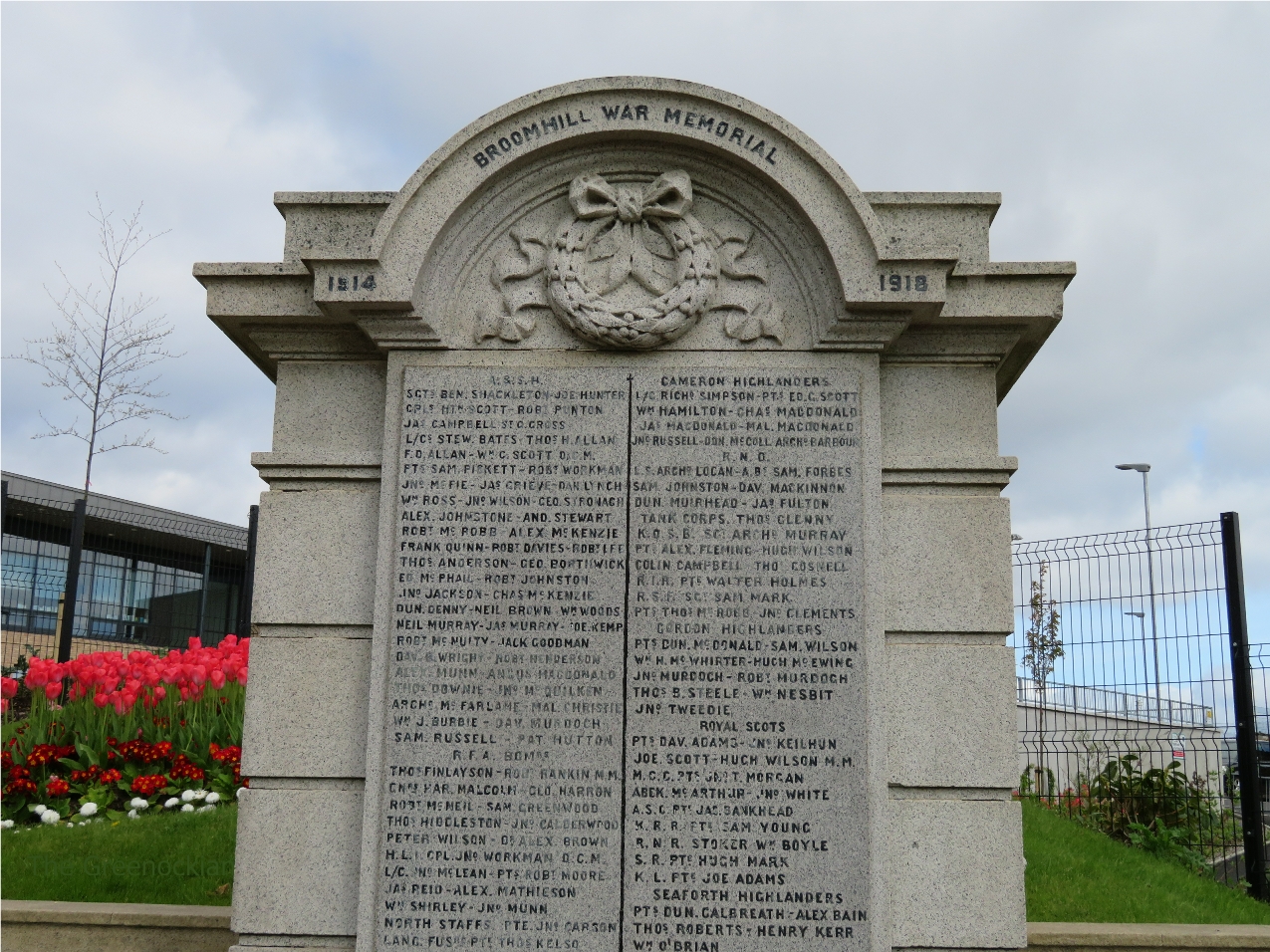
Broomhill War Memorial, Greenock

This is the Broomhill War Memorial commemorating those from the area who died in World War I.


It is situated at the corner of Drumfrochar Road, Cornhaddock Street and Broomhill Street.


It was unveiled by Greenock's Provost Thomas Mitchell on 16 April 1920.


There are many names on the Memorial from many different regiments.  A full list of names can be found at Inverclyde's Great War.  At that site you can click on the individual names and find out more about the person.


The site has information about all the War Memorials in the area and if you are researching family from Greenock and surrounding places, this site is well worth a visit.  It is run by the McLean Museum and Inverclyde Council and also provides an invaluable collection of resources about World War I and the local people who gave their lives.

Sunday, 23 April 2017

Great views across the Clyde

It was such a great day here in Greenock yesterday that I set out in search of some photographs of the River Clyde.  The Clydeport Cranes are always a good signpost for getting your bearings.


One of the best places for good views is up high on the Kilmacolm Road.  The views across the river from here are just amazing - you can see right up to the Gareloch.


Looking down just past the James Watt Dock Marina into what was the Great Harbour there were a few boats berthed.


I never tire of this view.


Wednesday, 19 April 2017

Greenock Jougs

Once upon a time, at the bottom of Broad Close in Shaw Street in Greenock there was a thatched house that served as the town gaol.  Daniel Weir in his "History of the Town of Greenock" (1829) describes it as "an ill-looking thatched house of one story, and consequently one apartment".  From the walls of the building hung the jougs (or jugs) - an iron collar attached to the wall by a stout iron chain.  This representation of the jougs can be seen on a wall off Cathcart Street (east end) in Greenock where the Broad Close once ran down to Shaw Street which (neither still exist).


In Scotland, the jougs were used both for detention of wrongdoers and also as a punishment.  Offenders would be secured in the collar and left to the mercies of the local population who hurled abuse, and heaven only knows what else, at the miscreants.  Jougs were often attached to churches and town tollbooths. They acted as deterrent as well as a punishment.  Another set of jougs could be found at the West Quay head in Greenock - handy for errant sailors!


In the Ayrshire town of Kilmaurs, the jougs can still be seen attached to the Tollbooth in the centre of the town.


Tuesday, 11 April 2017

Tall ship on the Clyde

On the River Clyde at Greenock yesterday, the beautiful tall ship Stavros S Niarchos.


Part of the Tall Ships Youth Trust.


What a beautiful sight!


Sunday, 9 April 2017

Riot at opening of new Greenock school

The opening of the new Highlanders' Academy in Greenock on 5 December 1887 was accompanied by a riot!  The Glasgow Herald reported -

"An unprecedented and, as the sequel proved, disgraceful exhibition was yesterday witnessed at the opening of a new Board school in Greenock, which resulted in the injury of several persons, the jeopardising of the lives of very many more, the destruction of much valuable property, besides having a bad moral affect among the young persons who were present, which will probably take years to get rid of."


The problem concerned the transfer of the former headmaster, Robert Wilson to a different school.  He had been headmaster at the original Highlanders' Academy (1837), located in Roxburgh Street.for 17 years.  As its name suggests, the school had been built to accommodate the large number of children whose parents had come to Greenock from the Highlands of Scotland looking for work.  Money was raised for the school partly by subscription and the land gifted by Sir Michael Shaw Stewart.  The original school had to be demolished when the railway was being extended.  Now that the new Highlanders' Academy building was completed, the parents and children wanted their own headmaster to be transferred to the new school with them.  However, the authorities had chosen a William Cook as the new headmaster.


At nine o'clock on the morning of 5 December 1887, the day of the opening, a procession, headed by local councillors and teachers as well as many children accompanied by their parents walked to the school.  Joined by many onlookers, the Herald reports that four or five thousand people were gathered -  
 "The majority of the crowd was composed of the working class, many of them being young men, although a few of the parents in the middle-class were also here and there observable."

A few protesters stated voicing their opinions about the choice of headmaster, and once most of the children were safely inside the school, Mr Wilson tried to enter.  He had been suspended for not accepting a position at another school and attempts were made to stop him entering the school.  This led to more agitation, and with the large crowd filling the surrounding streets panic set in, many people trying to get out of the area.  Inside the school, the Councillors and members of the School Board locked themselves in the headmaster's room.  The mob managed to get inside the school where they seem to have run amok.  The police were already inside the building and tried to beat back the crowd.


Mr Wilson was raised shoulder high and paraded through the school.  More and more people seem to have joined the fracas, and it was not until Mr Wilson left the building about 11 o'clock that the police managed to get control of the situation.  The children were led to safety and eventually the crowds dispersed.  The Councillors and School Board members escaped by a side door to a waiting cab.


The new headmaster, Cook, also tried to escape in a cab, but it was followed by a crowd.  Police officers were stationed at the homes of various Councillors and School Board members in case of more trouble.  Eventually things quietened down.  Mr Robert Wilson was some months later reinstated as headmaster of Highlanders' Academy, Greenock.


Highlanders' Academy was completed in 1887 to a design by David Barclay.  It is situated at the corner of Dempster Street and Mount Pleasant Street in Greenock.  The school was closed in 2012 and the building put up for sale by Inverclyde Council.


Let's hope it doesn't share the same fate as Mearns Street School.


Wednesday, 5 April 2017

The Failure of the Renfrewshire Bank

On 1 April 1842 the Renfrewshire Bank in Greenock stopped all payment causing widespread panic in the area.  It was reported that -
     "The whole town was in commotion, and men, women and children were seen
running in all directions, hurrying from shop to shop,
and place to place, seeking change of Renfrewshire Bank notes."
As word of the Renfrewshire Bank's failure spread people started arriving in Greenock from all over hoping to change their Renfrewshire Bank notes and withdraw money from their accounts.  There was a general run on all the local banks until it was ascertained that it was only the Renfrewshire Bank that had failed.  Many local people, shipowners, business owners, shopkeepers and small savers lost just about everything.

Former Renfrewshire Bank premises in Bank Street, Greenock
The Renfrewshire Bank had been set up in 1802 in the lower flat of a house in Hamilton Street, Greenock, opposite Tan-work Close.  It moved to its own premises in Bank Street, across from Shaw Place in 1811.  At one time it had branches in Inverary, Campbeltown, Rothesay, Port Glasgow and Glasgow.  The Bank published its own banknotes - you can see examples at the McLean Museum's Online Collection site here.
     
McLean Museum Online Collections 
There had originally been nine partners in the Renfrewshire Bank -
Archibald Speirs of Elderslie,
Boyd Alexander of Southbar, Renfrewshire,
John Cunningham, a merchant in Port Glasgow,
Alexander Dunlop, magistrate of Greenock
John Hamilton, merchant in Greenock
William Napier of Blackstone (near Paisley)
Charles Stirling of Kenmuir, a West Indies merchant
Peter Speirs of Culcreuch, Glasgow tobacco merchant
James Patten, of Greenock, formerly with the Greenock Bank

The death of Alexander Dunlop of Keppoch in 1840 seems to have been the tipping point in the Bank's downfall.  The only original partner remaining was William Napier.  Roger Aytoun had been admitted as a partner in 1820.  He was a former army captain (92nd regiment) and brother in law of William Napier, having married Anne Napier in 1810.  


The Renfrewshire Bank ceased on 1 April 1842 with liabilities of over £230,000.  John Ker, a Greenock merchant was made trustee.  Holders of notes issued by the Bank prior to 1840 were paid by the estate of Alexander Dunlop (Keppoch), one of the original partners.


William Napier, one of the remaining partners, was described as "unmarried and of quiet and reserved manners, and took no particularly active interest in public matters." Both he and Roger Aytoun were declared bankrupt.  Napier sold his family estate of Blackstone, Renfrewshire in order to pay his debts.  Even the Bank's fixtures and fittings were auctioned to raise money.


The failure of the Renfrewshire Bank had long lasting effects for the people of Greenock and the surrounding area..  Many ships and houses were under mortgage to the bank and banknotes issued  by the bank became almost worthless - just two shillings and three pence per pound.  It was just one of the many small local banks which failed at this time.  However the lovely building still remains in use as a rehabilitation centre in Greenock today.


Wednesday, 29 March 2017

The Wreck of the Amazon

On 1 September 1908 the four-masted barque Amazon of Greenock was wrecked on Margam Sands near Port Talbot.  Owned by Robert Hill of Greenock, the Amazon was carrying a cargo of 3,000 tons of coal bound for Iquique in northern Chile.  Commanded by Captain A Garrick and manned by a crew of 28 men, she left Port Talbot on 31 August.


Due to increasingly bad weather Amazon put back into Swansea Bay.  Next  morning high winds snapped on of the ship's cables and she started to drift.  The Captain decided to try to make it back to Port Talbot, but the wind was increasingly strong (later described as hurricane force).  The crew tried to ready the ship's lifeboats but the wind was so strong that they were blown off and some of the crew injured and some were washed overboard.

The Amazon eventually beached on Margam Sands, and began to break up.  Some of the crew could be seen attached to the main mast and rigging, but no one could get near enough to help because of the atrocious weather.  A newspaper reported -

     "It was felt that as long as the mast remained there would be a chance of rescuing the crew, but suddenly a wild shriek of agony was heard as the mast was seen to topple over and, as far as could be judged, some twenty-five men were thrown into the surging surf."

The shore authorities had alerted the Coastguard and a tug sent out to try and help.  Rockets were fired to try and get a rope across, but those attempts failed.  The lifeboat could not get near enough but could see that all was lost, however, they managed to save two crewmen.  Six of the crew managed to swim ashore.  Local people bravely did their best to help the stricken men and give aid to those who survived.  Twenty men, including the Captain were lost.


Of the twenty who died, four were Greenockians -
     Alexander Crawford, sailmaker of 28 Tobago Street, Greenock
     Edward Hendry, seaman, 1 Bogle Street, Greenock
     William Lamont, carpenter, 37 Roxburgh Street, Greenock
     John McLean, steward, 68 Wellington Street, Greenock

The names of the others who died were - Captain Arthur Garrick of Penarth (just west of Cardiff), J Logan, Second Mate, Joseph Marien, Ship's cook, Sydney G. Evans, Ordinary seaman,
Charles E. Kie, Arthur M. Pillans, John Flynn, G. Wright, James Hendry, G. Baker , G. Kent, James Deacon and Patrick Morgan.  The Amazon carried five apprentices, all lost - James Robertson (Leith), Robert L Hendry (Edinburgh), Reginald B. Mayes, Alan F. Orr and Neil C. McLeod.  Those saved were - Halley, Adams, Evans, Nolan, Christensen, Wickenberg, Sullivan and Lockwood.  At the end of October 1908 a Board of Trade enquiry was held at the Town Hall, Swansea into the loss of the Amazon.

Some of the wreckage can still be seen on Margam Sands as you can see in this photograph by Gareth James.

© Copyright Gareth James and licensed for reuse under this Creative Commons Licence

Alexander Crawford, the ship's carpenter who died that day was my Great Grandfather.  He left a wife and six young children in Greenock.  My Granny was just two years old when her father died.  His loss is just one story from one shipwreck.  That fateful day in 1908 many other families lost their loved ones, which in a time of no automatic state help, meant untold financial hardship as well as the aching loss of beloved father, son, husband, brother.  While we are fascinated by stories of ships and wrecks, the human cost should never be forgotten.

Tuesday, 28 March 2017

Cathcart Street in the 1930s

A while ago I wrote a post about Cathcart Street in Greenock - at one time the main commercial street in the town.  Apart from some remaining buildings and the cobbled road, it is difficult to conjure up exactly what a wonderful street this was.  There are of course many old photographs, but I was absolutely delighted to come across some old film of the busy street from the 1930s.  You can view it here at the National Library of Scotland Moving Image Archive site - it really is a remarkable piece of local history.

Cathcart Street 2016
The film was taken looking along Cathcart Street.  You can just see the dock cranes on the right of the picture.  The footage also shows along the west part of the street towards Cathcart Square.  Much of the east end of Cathcart Street was destroyed in the Blitz of 1941.

Cathcart Street 2017
Filmed by Thomas Stuart Black, it also shows the interior of Thomas Black's sail loft in the town.  The original Thomas Black started business as a ship chandler and sail maker in Greenock round about 1861.  He had business premises at Dock Breast and  Brymner Street, not far from Cathcart Street.  The firm Blacks of Greenock is still going strong today.

Black's rented out tents and marquees for various local and national events back in the early 1900s. They received many government and war office contracts for various pieces of army equipment and tents.

Take a look at the film - even if it is just to see what Greenock looked like back in the 1930s.

Monday, 27 March 2017

Scotts' Shipbuilders Memorial

This plain brick plinth is a simple reminder of Scotts' Shipbuilders in Greenock.


Just at the Cartsburn roundabout, next to the former dry dock is this small memorial plaque.  The roundel shows the Green Oak Tree of Scotts' flag and the wording around it reads -
Scotts' Shipbuilding and Engineering Company Limited


On top is an old map showing the extent of Scotts' shipbuilding yards in Greenock and the words -


Scotts' of Greenock
Established 1711
Site of Scotts' Shipbuilding & Engineering
Company Limited - Cartsburn Yard
HMS Challenger was the last ship
launched here - in 1984
Dry dock was built c1820


For those of us who remember the bustling, busy days of the Greenock shipyards, it is a poignant reminder of all that's gone.


Sunday, 26 March 2017

Church for sale

This is the former Methodist Church in Ardgowan Street, Greenock, just off Nelson Street.  It is no longer used for worship, the small remaining congregation now meet in St John's Episcopal Church in Union Street, Greenock.  The building was for sale and is now under offer.


It is a solid little church with some lovely architectural details.  The building could accommodate a congregation of 500, it also had a large hall and meeting rooms.  The foundation stone for this church was laid in 1882 and the building work completed in 1883.  There had been a previous church building at this location but,
"Some time ago it was found necessary to take down the old Church, dry rot having got into every part of it, rendering it incapable of repair."


In February 1884 an appeal was made in the Greenock Telegraph by the Wesleyan Methodists of Greenock -
"… to aid them in clearing off the DEBT of their NEW CHURCH in ARDGOWAN STREET."
 To that end, a grand bazaar was held to raise funds. 


The estimated cost of this building was £2,200 and most of the money was raised, however the final cost exceeded the estimate and a further £750 had to be found by the congregation which,

"… is chiefly composed of the working classes, and they have contributed to the utmost of their ability to the cost of the erection.  In the circumstances they appeal for aid in the extinction of the remaining debt, and relying on the kind co-operation of friends of all denominations, they confidently anticipate a most successful result."


When I see churches up for sale, I often think about the hard-working members of congregations who put their hearts and souls into making sure that their churches were kept clean and warm.  Those who raised funds for repair work and overseas missions, and those who gave up their spare time to clean the church, provide flowers, make endless cups of tea for special meetings and occasions, complete running repairs, keep the boiler in working order.  All that without even mentioning the special occasions that have taken place there like baptisms and weddings.  I know that "church" is not about bricks and mortar, but it must break a few hearts to see a For Sale sign on a much loved and cared for building.


Like church buildings - then have a look for more at InSPIREd Sunday.

Saturday, 25 March 2017

Greenock Poet's Plaque

As a Greenockian I am ashamed to admit that until today I had never heard of the Greenock born poet William Sydney Graham.  It wasn't until I had downloaded my photograph of this plaque that I did a bit of research to find out who he was.  The plaque is attached to the wall of 1 Hope Street in Greenock where Graham was born in November 1918.


According to most of the writings about him, he is was of the most underrated poets of the 20th century.  After studying engineering in Glasgow he had several jobs around the country.  In 1947 Graham travelled in the United States and later lived for a while in London.  However Madron, Cornwall was his home where he mixed with the St Ives artistic community.


He married Agnes Kilpatrick (Nessie) Dunsmuir (1909 - 1999) in 1954, the couple had known each other since 1938 when they met at Newbattle Abbey College, Nessie also wrote poetry.  His best known book "The Nightfishing" was published in 1955.  William Sydney Graham died in 1986.  More information about the poet can be found at the Scottish Poetry Library website.  You will also find some of his work there,  However, of the ones I've read, this really stood out for me, it moved me to tears.  It is called "To Alexander Graham" -

"Lying asleep walking
Last night I met my father
Who seemed pleased to see me.
He wanted to speak.  I saw
His mouth saying something
But the dream had no sound.

We were surrounded by
Laid-up paddle steamers
In The Old Quay in Greenock.
I smelt the tar and the ropes...."

You can read the remainder of the poem here.  Another of his poems "Loch Thom", in which he remembers outings from his childhood, is also worth a read.