If you are travelling to Greenock you must visit the Fire Brigade Museum, or to give it its full title -
The Scottish Fire and Rescue Service Museum and Heritage Centre.
It is open when cruise ships visit Greenock and has welcomed firefighters from all over the world. It is staffed by volunteers, former firefighters and is also open on the second and last Sunday of the month, but check the website for details of opening times.
It is situated on Dalrymple Street just off Wallace Place in Greenock - right where the old fire station used to be when the Municipal Buildings were opened.
There's so much to see - old fire engines and equipment, lots of old photographs and some short films, and fire marks (showing that a building had fire insurance) from all over Britain.
The staff are wonderful and if you have any questions they are happy to answer.
It really is one of the best places to visit in Greenock. You can find their website here.
Sunday, 24 June 2018
Monday, 18 June 2018
Gourock Coat of Arms
This is a
representation of Gourock's coat of arms on a lamp post outside the Gamble
Halls, Shore Street, Gourock. It combines the arms
of the Stewarts of Castlemilk and the Darrochs whom I've written about in a
previous post.
Gourock was created
a burgh in 1694 and this is shown by the castellated top of the
device. As you look at the picture, the
left side is an adaptation of the arms of the Stewarts of Castlemilk with a
hand grasping a dagger.
The Darroch side
(right as you look at the picture) shows a three-masted ship with three oak
trees. The name Darroch is supposed to
be a form of the Gaelic word for oak 'darach'. This also includes a figure holding a club - a reference to an old legend of the warrior Macgille riabhaich (son of the brindled man) who brandished an oak club and was a fearsome fighter. Duncan Darroch was extremely proud of his roots and his links to the Macdonalds of Jura. You can read the legend of Macgille riabhaich here. The "wild man" was a popular symbol in heraldry.
Gourock's motto a
combination of those of the two families - 'Avant' (Stewarts of Castlemilk) and
'Be Watchful" (Darroch).
This photograph is some of the detail of a beautiful fireplace what is practically all that remains of the main residence of the Stewarts of Castlemilk - it can be found at Castlemilk Stables in Glasgow. You can seem more photographs of this wonderful place and read some of the story of the Stewarts here on my other blog Shortbread & Ginger.
There was a time when decorated lamps showing town coat of arms like this were to be seen outside the residence of the local provost (mayor). Port Glasgow still has its town lamp which you can see in this previous post.
Sunday, 17 June 2018
Alexander Allason - slave ship captain
Another Allason brother was involved in the trans-Atlantic trade - Alexander (Sandy) Allason (1739-1769) was the master of the ship Dalrymple part owned by the Liverpool merchant and slave trader William Davenport. Alexander kept up correspondence with his brothers in Port Glasgow and Virginia. He made several voyages for Davenport, but died on the Dalrymple's fifth voyage in 1769 he was succeeded as captain by Patrick Fairweather.
The Dalrymple would sail from Liverpool with a cargo of beads, cloth,
iron, cowrie shells, guns and other goods which were traded for slaves, ivory (often
called elephant's teeth) and palm oil at Old Calabar in what is now
Nigeria. These slaves were then taken to
the West Indies to work on the sugar plantations. They were sold in exchanged for rum,
sugar and molasses which would be taken back to Liverpool and sold there.
| Detail from sign at Greenbank House, Clarkston |
William Davenport, Liverpool
William Davenport (1725-1797) was apprenticed to William
Whaley Liverpool merchant, becoming a freeman of Liverpool in 1749 trading as a
grocer and wine merchant. He later went
into partnership with members of the Earle family of Liverpool.
| View of Liverpool |
Davenport immersed himself in business becoming involved in the
slave trade. He traded in glass beads
from Europe, at that time Venice was an important centre in the production of
beads and these were highly prized in trading ventures with the west coast of
Africa. Cowrie shells from the Maldives
were another important trading commodity, they were used for decoration and as
a form of currency in certain parts of Africa.
Copper rods and fancy fabrics like silk and chintz were also in great
demand. Each trading port had its own
particular needs which were eagerly supplied by British merchants in return for
slaves.
Davenport was part owner of the slave-ship Dalrymple on which Alexander Allason was
master, he also part owned other ships such as the King of Prussia. Many
Liverpool merchants were involved in the slave trade either directly or through
partnerships with those who were. Old Calabar was an important African port for
trade in slaves who would then be packed into ships to be sold in the West
Indies for plantation work. There, cargoes of rum, sugar, coffee and indigo would be bought for the return journey
to Liverpool and other ports in Britain.
| slave ship |
Slaves were shackled and forced into overcrowded hold for
the journey to the West Indies. Disease
was rife and many tried to commit suicide by jumping overboard. Women and children were held separately from
the men, but in equally appalling conditions.
However sick slaves did not make for profit and many ships carried
surgeons on board to deal with outbreaks of disease.
Here's a description of a slave ship on the Mersey by Ramsay Muir -
"This was the slaver, with its rakish build designed
for swift sailing so as to minimize the loss by death among the human cargo
during the horrors of the middle passage from West Africa to the West Indies,
and with its low 'tween-decks fitted with close-set benches and chains, and its
loose chain across the deck, under which the ankle-chains of the slaves were
passed when they were brought up for exercise to the music of the whistling
lash."
William Davenport was just one of many British merchants involved in the slave trade. Slavery was finally abolished in Britain in 1833.
The Davenport Papers, held by Liverpool Maritime Museum were
brought to light in an episode of the BBC's Antiques Road Show in 2001.
Saturday, 16 June 2018
William Allason tobacco trader of Virginia
William Allason's correspondence with his brother Robert (based in Port Glasgow) discussed in the previous post, indicates that they were involved in various trading enterprises with many of the leading Scottish tobacco merchants of the day.
William had been a prudent
businessman but was continually trying to recover money owed to him by his various business associates. He grew corn on his
plantation and built mills on his estate which became extremely profitable
during the War of Independence (1775–1783) when overseas trade was
limited. He owned slaves who worked the
plantation and mills. It was most likely
slaves who transferred the goods to and from the ships to his store in
Falmouth.
One of these was Robert Bogle
(1735 - 1808), the eldest son of prosperous Glasgow 'Tobacco Lord' George Bogle
(1701 - 1782) of Daldowie, he was also a West Indies sugar trader. Robert Bogle had moved to London and started
the firm Bogle & Scott of Love Lane.
Another son, John served as a plantation factor in Falmouth, Virginia
for Colin Dunlop & Co. Robert
Bogle's company failed in 1772. He moved
to Mount Craven sugar plantation in Grenada later returning to Glasgow. (Much more information on the people mentioned can be found at the UCL (University College London), Legacies of British Slave-ownership database.
In a letter dated 25 February
1763 William writes about the end of the Seven Years War (known in America as the French and Indian War) 1754 - 1763, hoping that there
will be an increase in trade. He also
refers to 21 hogsheads of tobacco he is sending to Bogle on the ship Carlyle, hoping it will be of good
quality. Writing to Bogle & Scott on
29 July 1764 he remarks that it is dangerous travelling inland and asking them
to send him -
"…
a pair Pistols about 30/- Price. let them be small, for the conveniency of
carrying in a side
Pocket, and as neat as the Price will admit of …"
This is a wonderful example
of how just about anything could be bought and sold by Scottish trans-Atlantic
merchants.
Books seem to have been in
great demand in Virginia. William
Allason sent an order to Glasgow bookseller James Knox on 3 November 1769 for 'sundry'
books and stationery. However because of
a tax on imported paper, he tells Knox -
"…
it will be necessary that the Package be said to contain only printed books,
which you can inform the
Person who ships it off …"
On 22 July 1771 Allason sent
a more detailed list of books he wishes Knox to ship to him. Bibles, dictionaries, hymn books, books of
sermons and spelling books are top of the list, but some specific titles are
also mentioned - Pilgrims Progress, Robinson's History of Scotland along with
other Scottish histories, Chattham's Political Conduct, various books of
memoirs and magazines. He also asks for
various stationery items to be sent to him.
In 1772 William Allason married
Ann, the daughter of Captain John Hooe.
After the death of her father, Ann inherited property called 'North
Wales' in Fauquier County which William called their 'summer retreat'. William oversaw the construction of a new
mansion, work on which began in 1773, the house itself was not completed until
after the Revolution. The couple had one
daughter (Polly) Mary Seymore Hall (1773 - 1853) who married Captain Robert
Rose and inherited the property on her father's death in 1800.
| North Wales House - Photo courtesy of the Fauquier Historical Society |
As well as trade, William
also occasionally acted as factor for Lord Fairfax (Thomas Fairfax, 6th Lord
Fairfax of Cameron, 1693 - 1782) of Greenway Court in Virginia, buying and
selling slaves and importing household and luxury items from Europe. Fairfax
was a friend of George Washington and had extensive land holdings in Virginia.
William Allason also acted on behalf of Lord Dunmore (Lord John Murray, 4th Earl of Dunmore) 1730 - 1809, Scottish peer and the last colonial Governor of Virginia who returned to Britain in 1776 after defeat in the Revolutionary War. Dunmore owed William money and was in no rush to pay up. In 1883 William writes to Dunmore requesting payment of his account and also payment to Ninian Wyse stone mason, "... an honest poor man and has a large family altogether depending on his labour ...". By 1888 he had still not recovered the debts!
William Allason corresponded with many important merchants and politicians in Virginia and elsewhere in colonial America. His letters and accounts are an invaluable
witness to events at such an exciting time in America's history and in the
history of the west of Scotland. They also reveal just how well informed merchants in Port Glasgow and Greenock were with what went on across the Atlantic.
My thanks to The Fauquier Historical Society for permission to use the photograph of North Wales.
Visit their website at the Fauquier Historical Society.
My thanks to The Fauquier Historical Society for permission to use the photograph of North Wales.
Visit their website at the Fauquier Historical Society.
Labels:
Port Glasgow,
slavery,
tobacco
Wednesday, 13 June 2018
Port Glasgow's tobacco trade
This simple memorial stone in
the wall of a Port Glasgow church bears the name Robert Allison. Born in 1721 in Glasgow, he was a baker in
Port Glasgow, the son of Zacharias Allason, a master baker in the Gorbals area
of Glasgow, and his first wife Janet Grahame who were married in Glasgow in
1718.
On 16 April 1747, the Glasgow
Burgh Records show that Robert Allason, listed as a baker in Port Glasgow,
petitioned for a feu right to build on a piece of ground in the town lying -
He was awarded the land. The church in question, the churchyard of
which contains his memorial stone, was at that time the parish church in Port
Glasgow, formerly St Andrew's Church, and now known as Port Glasgow New Parish Church - the present building dates from 1823. Beggar Raw (or Row) was situated behind
Princes Street. In 1752 Robert purchased
an old house for 20 guineas on behalf of the Glasgow authorities in order that
the one of the streets in the east end of the town could be extended. In 1757 he applied to feu some land facing
the West Quay in the town. This purchase
is probably in connection with his business partnership with his half brothers, the sons of Zacharias and his second wife Isabel Hall (married in 1827 in Glasgow). His brothers were William and David Allason who were merchants in Virginia.
William Allason had gone to Virginia
as a supercargo (the person responsible for selling a ship's cargo at the
destination) on a ship belonging to Baird & Walker (a small firm of tobacco
importers). After selling the cargo and
travelling extensively in Virginia, William, as an agent of Baird & Walker,
opened a store (in around 1759) in the town of Falmouth on the north bank of Rappahannock
River in Virginia. Of course, he
indulged in a little trading of his own with the help of his brother in Port
Glasgow.
William Allason, like many of the tobacco merchants, worked a
"store system". Tobacco was
bought from planters in exchange for goods such as tools, household goods, clothing,
luxury goods, foodstuffs etc. Credit
(again in the form of goods) was often given to planters in advance of the
tobacco harvest, which of course could often lead to debt if the harvest was
not as good as expected. The goods sent
to William Allason's store in Falmouth would be sourced by Robert in Glasgow, using
his contacts locally, and other parts of Britain.
The ship would be loaded and sent out, the goods deposited with William
who would then load the ship with tobacco and other produce from his contacts
in Virginia. Once the tobacco ship
arrived back in Port Glasgow, some of the cargo would be re-exported to Europe, or stored at Port Glasgow until a buyer, or better price could be
achieved. Many of the Glasgow 'Tobacco Lords' had storage facilities (cellars and warehouses) in Port Glasgow at this time.
![]() |
| source McLean Museum & Art Gallery, Greenock |
William's letters to Robert
in Port Glasgow and later, Glasgow contain not just trade news, but details of events going on in
Virginia at this time. In a letter to
Robert dated 5 October 1758 he writes -
"There never was so poor times in Virginia as is at present, there wonnt be above 5000 hhds Tobacco made this present Crop, … Inclosed is an accot. of a Battle between part of our Army and the French, in which the last got a Victory, it possibly may be the first accot. of it at your place …"
The quantities of tobacco
refers to hogsheads - large wooden barrels which when filled with tobacco
weighed 1000 pounds. The 'Battle' probably refers to the failed British
expedition against the French at Fort Duquesne.
However, tobacco was not the
only Allason export. In 1762 William
travelled to Antigua and St Christopher (St Kitts) in the West Indies sourcing
a supply of rum. In 1763 he wrote to
Robert concerning a supply of pig-iron from the Tubal Works in Virginia. He reports that he could not buy it for the
terms Robert was offering and that it had fallen into the hands of "Hucksters"
who could afford to offer a higher price.
In 1765 the Stamp Act was the
subject of many of William's letters. The Act, passed
by the British Parliament in March 1765, required all American colonists to
purchase (in British currency) and use special revenue embossed "stamped"
paper for newspapers, wills, official documents and even playing cards. As you can imagine this was not a popular
move. It was repealed in 1766, but there
was continued dissatisfaction with British authority over colonial America which,
just ten years later led to revolution.
William writes to Robert -
"Tis but a few
days since that a neighboring Town took the example from a northern Government and burn the effigy of the Person
appointed for the distribution of the stamps here, tho' he is not yet arrived from England, and a native of
Virginia …"
Stamped paper was scarce and William
was concerned about ship's papers and port clearances -
" … Ships are
in danger in Crossing the Sea, notwithstanding all the Clearance that the Governour & Custom house officers
can give them they are subject to be seized by the first Kings Ship they meet with, and also in the first Port they put
into at home, for want of their Clearances being on stamped Paper, which is not now to be had …"
![]() |
| Greenbank House, Mearns |
The trans Atlantic links of the Allason family highlight a very important part of Port Glasgow's early trading history. Tobacco and sugar from Virginia and the West Indies grown on plantations worked by slave labour provided profitable cargoes for merchants trading out of Glasgow's port. The Allasons had links with many of the big names, like Robert Bogle, of the tobacco trade on both sides of the Atlantic.
Labels:
Port Glasgow,
slavery,
tobacco
Sunday, 27 May 2018
Newark's neighbours - Ferguson Marine
If you visit Newark Castle in Port Glasgow as suggested in a previous post then it will be impossible to miss its very near neighbour, the Clyde shipbuilders Ferguson Marine.
There's been a lot going on in the few years since Ferguson Marine took over, investing in building hybrid ferries.
The whole area has been given a new look with these wonderful gates and railings. It's great to see work going on in the yard.
Ferguson Marine's website has a great selection of old photographs telling its history - including some fabulous photographs of King George V's visit in 1917.
There's been a lot going on in the few years since Ferguson Marine took over, investing in building hybrid ferries.
The whole area has been given a new look with these wonderful gates and railings. It's great to see work going on in the yard.
| The Glen Sannox, recently launched here. |
Labels:
Port Glasgow,
ships
Monday, 7 May 2018
Cardwell Bay Fountain
Cardwell Bay in Gourock is a lovely little area to spend time in. At the west end of the Battery Park, it has some nice little shops, cafes and a pub.
I love this little fountain which sits at the junction of Cardwell Road and Cove Road.
It has a lovely red granite basin and a fabulous lion sculpture decorating it.
There's a nice walk along the shore to Gourock town centre too, if the weather is good.
I love this little fountain which sits at the junction of Cardwell Road and Cove Road.
It has a lovely red granite basin and a fabulous lion sculpture decorating it.
There's a nice walk along the shore to Gourock town centre too, if the weather is good.
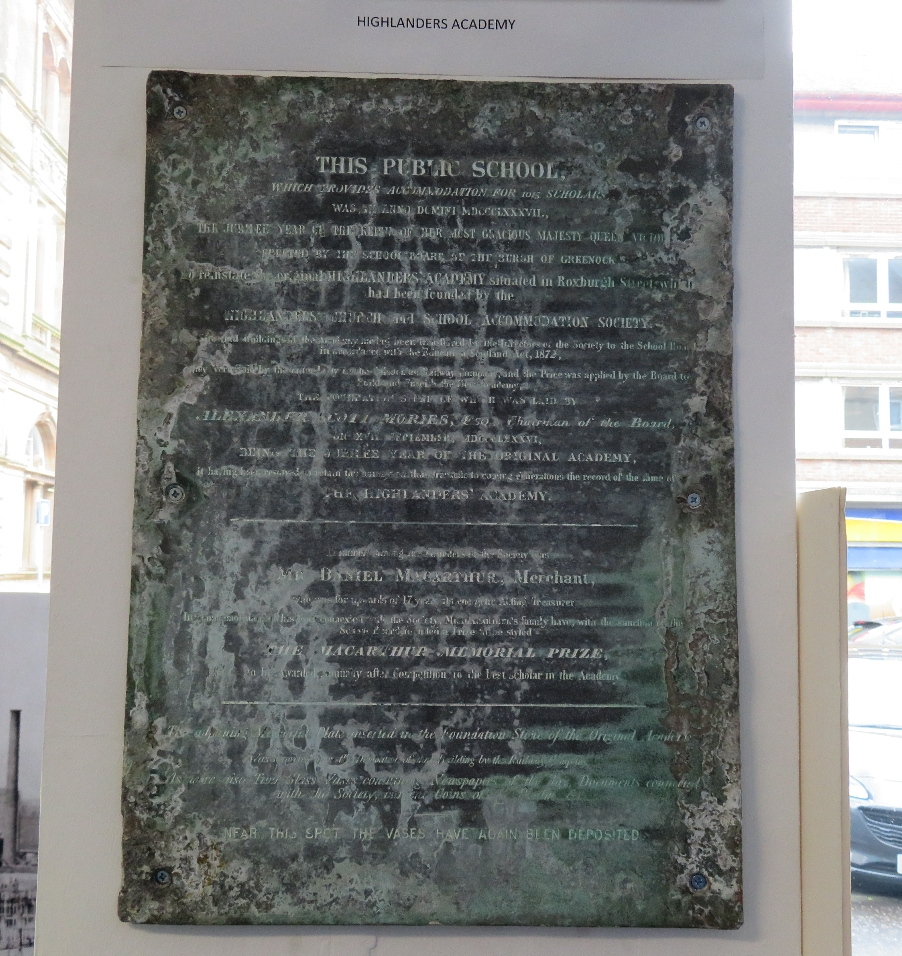
Highlanders Plaque
There's a plaque on display in Inverclyde Heritage Hub which has come from the now demolished Highlanders Academy in Greenock. On the wall of the Hub is a photograph of the original Highlanders' Academy in Roxburgh Street, Greenock.
| Source - Inverclyde Heritage Hub |
The plaque is quite worn in places and is very wordy, but I've tried my best to transcribe what it says ... here goes!
This Public School which provides accommodation for 1015
scholars was … anno domini MDCCCLXXXVII, the jubilee year of the reign of her most
gracious majesty, Queen Victoria.
Opened by the School Board of the Burgh of Greenock to reinstate
the original Highlanders Academy situated in Roxburgh Street which had been
founded by the Highlanders' Church and School Accommodation Society, the
building of the Academy having been transferred by the Directors of the Society
to the School Board in accordance with the Education Scotland Act 1872.
They were sold by the … to the Caledonian Railway Company
and the price was applied by the Board to build and furnish the new Academy. The foundation stone of which was laid by
Alexander Scott Mories Esq, Chairman of the Board on XVII September
MDCCCLXXXVI being the Jubilee year of the original Academy, it having been
decided to retain the name and thus transmit to coming generations the record
of the fame of The Highlanders Academy.
Prominent among the members of the Society was Mr Daniel Macarthur, Merchant, who was for upwards of 17 years its energetic Acting
Treasurer.
In remembrance of his long connection with the Society, Mr Macarthur's
family have, with the sanction of the School Board, founded a prize to be
styled The Macarthur Memorial Prize, to be awarded annually after competition, to the best
scholar in the Academy.
The adjoining memorial plate inserted in the foundation
stone of the original Academy was recovered on the demolition of the building
by the Railway Company, as were also two glass vases containing newspapers of
the day, documents connected with the Society, current coins of the realm, etc. Near this spot the vases have again been deposited.
This is an old picture of the Highlanders Academy in Mount Pleasant Street, Greenock recently demolished.
The Heritage Hub, in Cathcart Street in Greenock (just across from the James Watt Bar) is a fascinating place to visit. As well as lots of fantastic pictures, films and artefacts from the area's past, there are copies of Lloyds Registers of Shipping, Trade Directories for the area and lots of books on every aspect of local history. Anyone interested in researching local family history will find a great variety of resources to help. (Note - unfortunately now closed.)
Labels:
schools
Sunday, 6 May 2018
Old School Bell, Gourock
This is the old school bell of the former Gourock Eastern School.
The Eastern School was built here in 1876 and demolished in 1962. A block of high-rise flats, Eastern View, now occupies the site just across from Gourock Park and the old Gourock burying ground.
In my schooldays, the bell was rung in the morning, at interval time, lunch time and, best of all, at the end of the school day! It was usually the school janitor's job to ring the bell. It is a nostalgic reminder of the school and there's a plaque which reads -
The bell has the makers name on it - John C Wilson & Co, Founders, Glasgow AD 1894. They were part of the Gorbals Brass & Bell Foundry of Glasgow and there's a fabulous website of the Whiting Society of Ringers where you can read all about the Foundry's history.
The Eastern School was built here in 1876 and demolished in 1962. A block of high-rise flats, Eastern View, now occupies the site just across from Gourock Park and the old Gourock burying ground.
In my schooldays, the bell was rung in the morning, at interval time, lunch time and, best of all, at the end of the school day! It was usually the school janitor's job to ring the bell. It is a nostalgic reminder of the school and there's a plaque which reads -
This is the bell from the
Eastern School which stood
on this site from 1876 - 1962
"Welcome Home"
The bell has the makers name on it - John C Wilson & Co, Founders, Glasgow AD 1894. They were part of the Gorbals Brass & Bell Foundry of Glasgow and there's a fabulous website of the Whiting Society of Ringers where you can read all about the Foundry's history.
Labels:
Gourock
Friday, 4 May 2018
Newark Castle, Port Glasgow
If you are going to be visiting Inverclyde over the summer months, then the one place not to miss is Newark Castle in Port Glasgow.
Parts of Newark Castle date back to the 15th century, but it was adapted and added to over the years.
I love looking at the old timbers in the castle. The roof of the upstairs gallery is spectacular. When conservators dated the roof timbers they found that they were much older that the actual building and had been taken from somewhere else and reused here - recycling even then! You can see numeral carved into this one - others have them too. It is thought this was to help the carpenters assemble the roof when it was being built.
This old door certainly shows its age, but is absolutely wonderful.
Please don't leave Newark Castle off your Inverclyde itinerary. The Castle is looked after by Historic Environment Scotland. Check their site for opening times and entry prices.
Parts of Newark Castle date back to the 15th century, but it was adapted and added to over the years.
I love looking at the old timbers in the castle. The roof of the upstairs gallery is spectacular. When conservators dated the roof timbers they found that they were much older that the actual building and had been taken from somewhere else and reused here - recycling even then! You can see numeral carved into this one - others have them too. It is thought this was to help the carpenters assemble the roof when it was being built.
This old door certainly shows its age, but is absolutely wonderful.
Please don't leave Newark Castle off your Inverclyde itinerary. The Castle is looked after by Historic Environment Scotland. Check their site for opening times and entry prices.
Thursday, 3 May 2018
Admiralty Anchor, Greenock
This is the Admiralty Anchor which is set in its own little garden near the Custom House in Greenock.
There's a plaque which reads -
It is a beautiful piece of sculpture and very apt for this area.
There's a plaque which reads -
This anchor was presented
to the town
by the Admiralty in 1972
to mark the long association
between the Royal Navy
and the port of Greenock
It is a beautiful piece of sculpture and very apt for this area.
Labels:
anchor,
Royal Navy
Subscribe to:
Posts (Atom)


